Building SaaS with Claude Code? Avoid This #1 Mistake First

Write a clear "source of truth" spec before letting AI write code, constraining a probabilistic model with determinism.
The article describes a non-technical creator who hit a pitfall building SaaS with Claude Code: letting AI write code before it fully understood the requirements, causing the same prompt to produce different outputs each time — a disaster for building software. The solution is to establish a "source of truth" before writing a single line of code, clarifying what the product should and shouldn't do, and having AI proactively ask questions to clarify technical details; Claude offered four approaches, and the creator chose one as the roadmap. The author stresses updating the spec file before changing code to avoid patching over an old spec and drifting from intent. An analogy to outsourcing firms refusing jobs without specs underscores the point, followed by three practical principles for non-technical founders.
Why AI Must Know What You Want Before It Writes Code
A creator with no coding background, building a SaaS product from scratch with Claude Code, hit a classic pitfall: letting the AI write code before it fully understood the requirements. The result was that the same prompt produced a different answer every time.
This kind of variability is harmless when generating subtitles, but it's a disaster when used to build software. As the creator put it in the video: "When I'm building software, this is a disaster." The root problem isn't model capability — it's the lack of an explicit "source of truth." A probabilistic AI can only produce stable, usable code when it's constrained within a deterministic framework.

Probabilistic AI vs. deterministic output
When generating code, a large language model (LLM) is essentially performing probabilistic sampling of the next token given the context (commonly controlled by parameters like temperature and top-p), so getting different results from the same prompt across multiple runs is normal behavior, not a bug. "Deterministic" here usually means getting reproducible, reviewable results under the same inputs and constraints. In engineering practice, the common approach isn't to make the model truly deterministic, but to narrow the solution space by specifying requirements clearly, fixing the context, and constraining output formats (e.g., interface signatures, data structures, acceptance criteria), so that outputs reliably fall within the expected range. This also explains why a "source of truth" file significantly reduces drift: it makes implicit assumptions explicit, reducing the room for the model to improvise.
The Core Solution: Write the "Source of Truth" First, Then the Code
The creator's approach was straightforward: before writing a single line of code, hand the full context to the AI. Specifically, that means two things — what the app should do, and what the app should not do. For technical details he wasn't sure about, he had Claude ask him questions proactively.
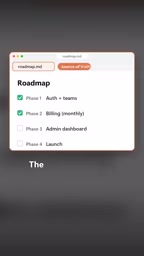
During this process, Claude offered four implementation approaches. The creator picked one, and that choice directly became his roadmap.
The key value here is that it turns the AI from "improvising randomly each time" into "executing against a fixed specification." In the creator's words: "It makes a probabilistic AI behave like a deterministic one."

What "source of truth" means in software engineering
A "source of truth" is the single authoritative definition of a fact, from which all other artifacts (documents, code, configuration, tests) should be derived or kept consistent. In a product development context, it can be a requirements spec, a domain model, an interface contract, or a data dictionary. Its value lies in eliminating conflicting descriptions: when requirements change, you only update the source of truth and then sync it to code and tests, avoiding the "one set of docs, another set of code" problem. In AI-assisted development, the source of truth also serves as a "context anchor" — it converts the founder's implicit intent into explicit constraints the model can repeatedly reference, giving every generation a common baseline and reducing back-and-forth rework.
What If the Plan Changes? Update the Spec First, Then the Code
Requirement changes are the norm in SaaS development. The creator established an iron rule: when the plan changes, update the source-of-truth file first, then change the code.
What happens if you reverse the order? The AI will patch on top of the old spec, the codebase will gradually drift from the true intent, and eventually even you won't be able to say what the product is supposed to be. Updating the spec file first avoids this problem — the code remains a faithful mapping of the spec rather than a product of arbitrary drift.

Spec-driven development
Spec-driven development emphasizes writing down "what to do, what not to do, and how to verify it" before moving into implementation. It complements test-driven development (TDD): the spec defines behavioral boundaries, and tests solidify those boundaries into executable checks. This process matters especially for AI-generated code, because models tend to make local patches on top of existing code; if the spec isn't updated, patches stack up around outdated assumptions and form technical debt that's hard to trace. In practice, you can break the spec into requirement items and acceptance criteria — when something changes, update the items first, then the code, and finally run the tests, ensuring the code is always a mapping of the spec rather than an accidental byproduct.
A Simple Analogy: No Spec, No Agency Will Take the Job
The creator offered an analogy: no outsourcing firm would take on your $20,000 project without a specification. AI is the same.
This analogy highlights a blind spot many non-technical founders have — they assume AI "can do anything," so they skip requirements analysis and just let the AI start building. But AI isn't magic; it needs boundaries, constraints, and a baseline document it can repeatedly cross-reference. Without these, all you get is a pile of code that needs to be rewritten over and over.
Takeaways for Non-Technical Founders
The core of this lesson can be summed up in one sentence: manage AI like a highly capable engineer who needs explicit instructions. Concretely, there are three practices:
- Define boundaries first: Clarify what the product should and shouldn't do, and turn it into a written spec;
- Let the AI ask questions back: For technical decisions you don't understand, have the AI list options and explain the trade-offs, and you make the final call;
- Spec-driven development: Any change goes into the spec file first, then into the code.
For entrepreneurs without a programming background who want to build products with AI, this process may be more valuable than any prompt trick. It doesn't rely on the model's occasional brilliance — it uses engineering discipline to constrain a probabilistic tool into predictable productivity.
Prompting strategy for getting AI to ask questions back
"Letting AI ask questions back" essentially uses the model to fill in the founder's knowledge gaps: before implementation begins, require the model to list key decision points, possible options, their trade-offs and risks, and let a human make the final choice. You can use structured prompts, for example asking for output in the form of "question list — options — pros and cons — rationale for recommendation — decisions I need to confirm," and explicitly instruct it to ask questions first rather than write code when key information is missing. The benefit is turning vague requirements into a reviewable decision record, while letting the founder steer as the product owner rather than being led along by the model's first implementation.
Related articles

DeepSeek Harness in Detail: DIY Your Own Software Like Building with LEGO
What is DeepSeek Harness? Using the metaphor of a car assembly platform, this article explains this equipment system of freely combinable functional modules, analyzes its spatiotemporal composability technical foundation, and shows how ordinary users can DIY exclusive software that does not exist on the market at extremely low cost.

DeepSeek Harness Step-by-Step Tutorial: Master DSH and Its Plugin Ecosystem in 50 Minutes
DeepSeek Harness step-by-step install tutorial: from Node.js environment setup to client installation, covering three plugin install methods — chat, marketplace, and command line — plus practical uses of local file access and plugin extensions.

DeepSeek Open-Sources Super-agent Architecture: A Turning Point for Proactive AI
DeepSeek's open-source Super-agent architecture proposes a new proactive AI paradigm: a central Agent dispatches tasks, sub-Agents execute autonomously, and humans only decide and accept. This article analyzes the watershed between passive and proactive AI, and the implementation logic of proactive Agents in scenarios like short-video lead generation.