Building the Linux Desktop Email Client Parcel with Zig

Parcel is a Linux native email client written in Zig, debuting early on HN with ecosystem reference value.
Parcel is a Linux desktop email client written entirely in Zig that recently debuted on Hacker News with only 4 points and no comments. The article analyzes the significance of this choice: Zig emphasizes simplicity, performance, and memory control, with no garbage collection and explicit memory allocation, which may bring lower resource usage and faster startup for an interaction-heavy, data-heavy application like an email client while avoiding Electron's memory overhead and the complexity of GTK/Qt bindings. Since Zig's desktop GUI ecosystem is still growing, the project is likely in an early stage, and its features and documentation remain to be verified. The article argues its value goes beyond being just a client: it provides a practical sample for the Zig desktop ecosystem and a touchstone for the language's engineering capabilities.
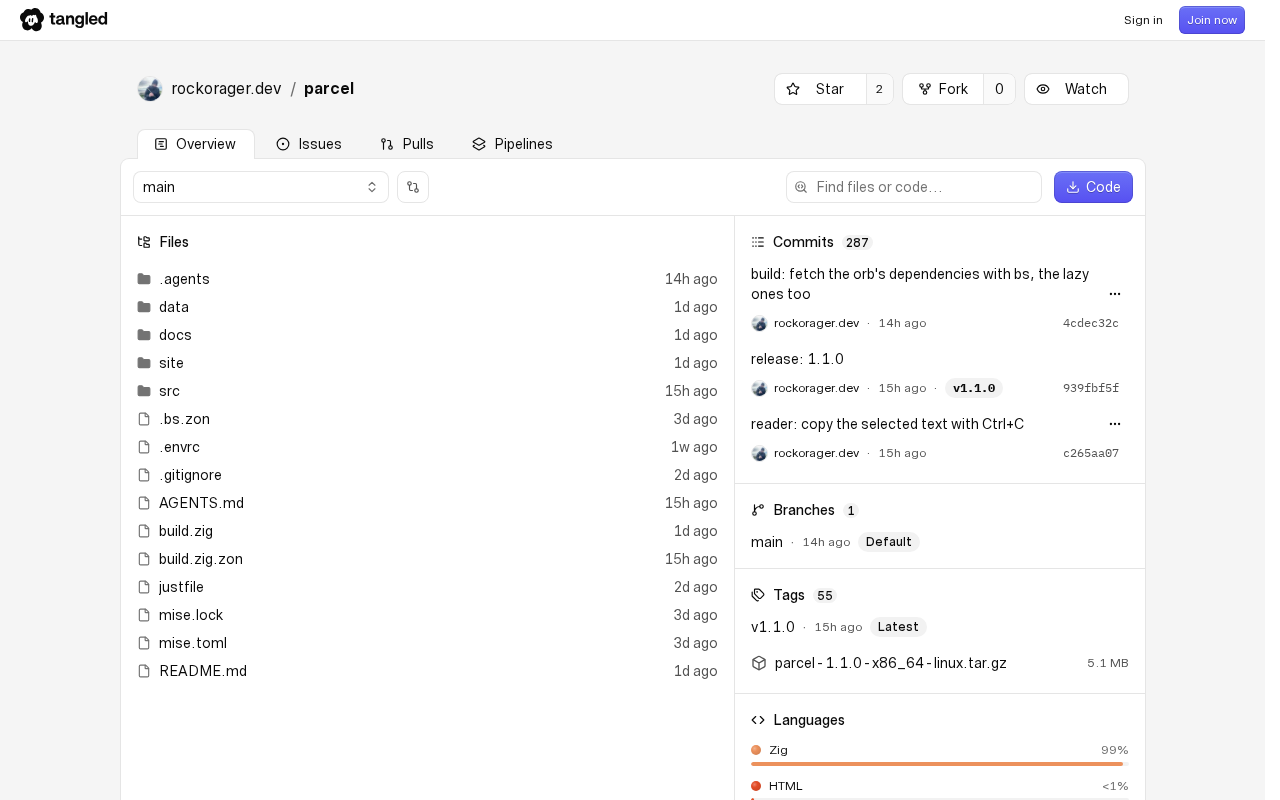
In the Linux desktop application ecosystem, there is no shortage of email client options, but one built from scratch in the systems programming language Zig is extremely rare. The recently appeared Parcel project on Hacker News is exactly such a bold attempt: a desktop email client for Linux, written entirely in Zig.
Why a Zig email client is worth paying attention to
Zig is an emerging systems programming language that emphasizes simplicity, performance, and memory control. It has no hidden memory allocations, does not rely on garbage collection, and has powerful compile-time computation capabilities. It is often used to replace C for writing low-level software. Applying these characteristics to a desktop email client means Parcel may have inherent advantages in resource usage, startup speed, and memory management.
An email client is a typical "interaction-heavy + data-heavy" application: it needs to handle the IMAP/SMTP protocols, parse MIME email structures, manage local caches, render HTML content, and ensure a smooth and responsive interface. Implementing these features in Zig can avoid the memory overhead of Electron-style solutions and also bypass the complexity brought by GTK/Qt bindings, appealing to users who demand performance and controllability.
IMAP (Internet Message Access Protocol) is the core protocol for synchronizing mail between an email client and a server. It allows the client to browse the mailbox structure on the server without downloading all messages, fetch message bodies and attachments on demand, and manage read/unread status through flags. Unlike the earlier POP3, which was only responsible for "download and delete," IMAP natively supports multi-device synchronization, so almost all modern email clients are implemented based on IMAP. SMTP (Simple Message Transfer Protocol) is specifically responsible for sending and relaying mail. Together they form the complete chain of sending and receiving mail. The client needs to handle a large amount of state management issues such as connection persistence, authentication, folder synchronization, and reconnection after disconnection, which is also an important source of the implementation complexity of email clients.
MIME (Multipurpose Internet Mail Extensions) defines how the email body carries multipart content: an email can simultaneously contain plain text, HTML body, inline images, and arbitrary attachments, with each part organized into a tree structure through boundary delimiters and Content-Type headers. When parsing MIME, the client needs to perform header decoding, character set conversion, recursive expansion of nested multipart structures, attachment extraction, and other operations, and must also handle a large number of non-compliant emails in the real world. The rendering of HTML email further introduces security and compatibility issues, usually requiring restrictions on script execution and filtering of external resources. The robustness of MIME parsing often directly determines the usability of an email client.
Parcel's positioning and possible technical direction
Based on the information currently available, Parcel is clearly positioned as a Linux desktop email client, with Zig as its core implementation language. These two points together point to a relatively clear audience: Linux users who like a native experience and care about resource efficiency, as well as developers interested in the Zig ecosystem.
As a detail, Zig's desktop GUI ecosystem is still growing, and the common approach is to directly bind system native libraries or draw the interface from scratch. Parcel's choice of Zig very likely means that it also tends toward a lightweight, system-close implementation at the UI layer, rather than applying a cross-platform framework. Such a choice makes the application more "Linux native," but it also means that many platform details must be handled on its own.
GTK and Qt are the two main graphical interface toolkits on the Linux desktop, written in C and C++ respectively, providing windows, widgets, event loops, and rendering capabilities. For other languages to use them, language bindings usually need to be written or relied upon, mapping C/C++ interfaces to the target language. The binding layer brings additional maintenance costs, version compatibility issues, and cross-language call overhead, and it is difficult to fully cover the upstream APIs. Therefore, some projects choose to bypass bindings, directly call system libraries through the C ABI, or even draw the interface from scratch. Zig has strong interoperability with C and can directly import C header files to call system libraries, which provides a realistic path for avoiding heavy frameworks and staying close to native implementations.
Community signals and project stage
Parcel's launch on Hacker News received 4 points and no comments yet. This signal indicates that the project has just entered public view, discussion is still very low, and a community feedback loop has not yet formed. For early open-source projects, this is a common state: the author first puts out the concept and waits for the first batch of testers and contributors.
Judging from the project's visibility, Parcel is most likely still in an early development stage, and its feature completeness, documentation, and packaging and distribution methods all still need time to be verified. For potential users, at this stage it is more suitable for observation than for directly migrating their daily workflow.
Significance for the Zig desktop ecosystem
The value of Parcel is not just as an email client. Desktop applications have long been occupied by C++, Rust, and various scripting language frameworks, and practical cases of Zig in this field are still scarce. Every genuinely usable desktop project will push Zig's GUI libraries, protocol implementations, and packaging toolchains toward maturity.
An email client involves multiple layers such as network protocols, data persistence, and interface rendering, making it a good touchstone for testing a language's engineering capabilities. If Parcel can continue to iterate, it may become a reference sample project for the Zig community and also provide reusable experience for other developers who want to write desktop software in Zig.
Conclusion
Parcel currently has limited information, but it represents a clear direction: using Zig to build native, lightweight desktop applications for Linux. For readers interested in the real-world adoption of systems programming languages and the diversity of Linux desktop software, this project is worth adding to the watch list. As community discussion increases and features are completed, whether Parcel can become a daily usable email client still needs time to give the answer.
Background supplement
Electron-style solutions package the Chromium rendering engine and the Node.js runtime together into the application, enabling developers to build cross-platform desktop software with web technologies, at the cost of each application carrying a huge runtime, with significantly higher memory usage and installation size. In contrast, native solutions directly use the interface libraries and rendering capabilities provided by the system, starting faster and using fewer resources, but they need to be adapted separately for different platforms. When the article discusses the advantages of Zig, it is precisely against this contrast as the background: avoiding Electron's memory overhead and bypassing the complexity of GTK/Qt bindings points to a lighter implementation route that is closer to the operating system.
One-line Summary
Parcel is a Linux native email client written in Zig, debuting early on HN with ecosystem reference value.
Paragraph Summary
Parcel is a Linux desktop email client written entirely in Zig. It was recently first made public on Hacker News, receiving only 4 points and no comments yet. The article analyzes the significance of this choice: Zig emphasizes simplicity, performance, and memory control, has no garbage collection, and makes memory allocation explicitly visible. Applied to an application like an email client that is interaction-heavy and data-heavy, it may bring lower resource usage and faster startup speed while avoiding Electron's memory overhead and the complexity of GTK/Qt bindings. Because Zig's desktop GUI ecosystem is still growing, the project is most likely in an early stage, and its features and documentation still need to be verified. The article argues that its value lies not only in being an email client, but also in providing a practical sample for the Zig desktop ecosystem and serving as a touchstone for testing the language's engineering capabilities.
Related articles

RePlan-VLA: Progress-Aware Replanning Breakthrough for Long-Horizon Robotic Manipulation
The RePlan-VLA framework converts VLA models' short-horizon capabilities into reliable long-horizon execution through progress-aware adaptive replanning, improving success rates by 21.9% and 10.4% on RoboCasa365 and CALVIN, and validating real-world deployment on a Franka Research 3 robot.

Geometric Bridge Flow Matching: A New Breakthrough in Blind Rigid Motion Correction
Geometric bridge flow matching enables blind rigid motion correction in head CBCT, achieving 37.1 dB PSNR and 0.27 mm RPE on simulated data in ~9.1 minutes, outperforming existing methods.

Google Releases Gemini 4 Hydrogen: 2.5x Faster Without Sacrificing Intelligence
Google releases the lightweight Gemini 4 Hydrogen: 2.5x faster task completion, AA Intelligence Index of 54 beating its flagship sibling, 7.3s single-step on Agent Arena faster than Claude and GPT rivals, four thinking levels with pay-as-you-need pricing, now available across AI Studio and more.