BuildingAI Open Source Project Deep Dive: Building AI Apps Like Stacking Blocks

BuildingAI is an open source, block-based framework that makes building AI apps as easy as snapping together Lego bricks.
BuildingAI is a TypeScript-based open source project with 1,613 Stars, positioning itself as "the WordPress of the AI era." Through modular, visual block-based assembly, it lets users build complete AI applications without mastering prompt engineering or context management. Compared to platforms like Dify and Coze, it offers system-level full-stack building from frontend to backend, supporting use cases like enterprise agents, AI comic creation, academic assistance, and intelligent customer service — though it still faces stiff competition and ecosystem-building challenges.
The WordPress of the AI Era? An Overview of BuildingAI
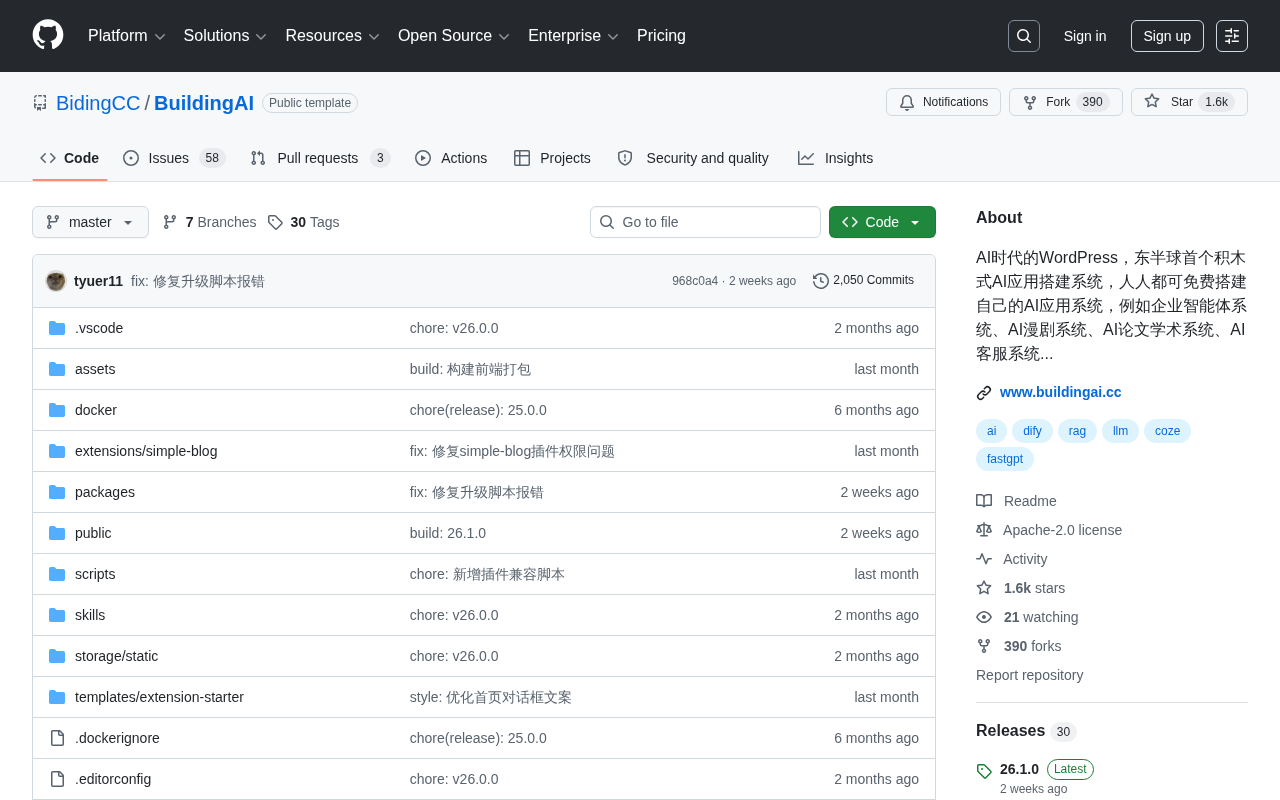
The barrier to AI application development remains high — and an open source project called BuildingAI is drawing attention on GitHub. The project positions itself as "the WordPress of the AI era," with the goal of letting anyone build their own AI application system from scratch, at zero cost, simply by snapping modules together like building blocks.
Since launch, the project has earned 1,613 Stars and 390 Forks, built with TypeScript — a clear signal of the developer community's strong appetite for low-barrier AI app building tools.
What Is Block-Based AI App Building?
Modularity and Visualization: The Core Design Philosophy
BuildingAI's design philosophy draws from the same playbook that made WordPress revolutionary for website creation — wrapping complex technical implementations into draggable, composable modules. Users don't need to understand the inner workings of large language models or write elaborate prompt engineering code. By snapping modules together, they can assemble a fully functional AI application.
To appreciate the weight of this analogy, it helps to revisit WordPress's historical impact. WordPress launched in 2003 as a simple blogging system, but through its plugin architecture and theme system, it evolved into the world's largest content management system (CMS). As of 2025, WordPress powers roughly 43% of all websites on the internet — from personal blogs to major outlets like The New York Times. Its success came from encapsulating the most complex parts of web development — database management, user authentication, SEO optimization, responsive layouts — into out-of-the-box features, and building a massive ecosystem of over 60,000 plugins. This allowed users with zero coding knowledge to launch a fully functional website in a matter of hours. BuildingAI is attempting to replicate this path in the AI application space. The challenge is that AI applications are far more complex than traditional websites, and the interaction logic between modules is far more dynamic and non-linear.
This approach directly addresses several core pain points in AI application development today:
- High technical barrier: Traditional AI app development requires mastering model invocation, prompt design, context management, and more
- Reinventing the wheel: Every AI app requires building foundational infrastructure from scratch, which is inefficient
- High iteration costs: Changing business logic often triggers cascading rewrites across large portions of the codebase
Two technical concepts worth unpacking here are prompt engineering and context management. Prompt engineering refers to the practice of carefully crafting the text instructions fed to a large language model in order to guide it toward a desired output. What seems like simply "asking a question" actually involves instruction structure design, few-shot example arrangement, role-setting, and output format constraints. Context management is even more complex — large language models have fixed context window limits (e.g., GPT-4 Turbo supports 128K tokens), and developers must decide, across multi-turn conversations, which historical information to retain, which to compress or discard, and how to handle chunking and vector storage for long documents. The introduction of RAG (Retrieval-Augmented Generation) architectures adds further complexity, requiring developers to coordinate vector database queries, relevance ranking, and prompt assembly. These are precisely the technical details BuildingAI aims to abstract away through modular encapsulation.
How Does BuildingAI Differ from Dify, Coze, and Similar Platforms?
Platforms like Dify, Coze, and FastGPT already exist in this space. BuildingAI's differentiation lies in its "block-based" system-level building capability — not just workflow orchestration, but a complete application-building experience covering everything from frontend UI to backend logic, making it closer to a full-stack AI application development framework.
Looking at the competitive landscape more closely: Dify is one of the most popular open source LLM application development platforms, with over 60K GitHub Stars, offering visual workflow orchestration, RAG pipelines, and Agent building capabilities with support for private deployment — widely adopted by enterprises. Coze is ByteDance's AI bot development platform, built around the Doubao model ecosystem, focused on zero-code AI chatbot creation, with a large domestic user base. FastGPT specializes in knowledge base Q&A, with strong RAG capabilities. What these three share is a "workflow orchestration" paradigm — users define AI processing flows by connecting nodes. BuildingAI's claimed "system-level" building capability implies it covers not just backend AI logic orchestration, but also frontend UI generation and full application deployment — a more ambitious technical vision, but one that also entails significantly greater engineering complexity.
What Application Scenarios Does BuildingAI Support?
Enterprise-Grade Agent Systems
Enterprises can use BuildingAI to rapidly build internal agent systems that deeply integrate knowledge bases, business processes, and AI capabilities. Functional modules for intelligent Q&A, document analysis, and decision support can be combined on demand. Projects that might traditionally take weeks or months to develop can see their timelines dramatically compressed through block-based assembly.
It's worth explaining the technical substance of the "agent" concept here. An Agent is one of the core paradigms in modern AI applications. Unlike simple chatbots, agents have autonomous planning, tool-calling, and memory management capabilities. A typical enterprise-grade agent system contains multiple collaborative layers: a perception layer for understanding user intent (via NLU), a planning layer for decomposing complex tasks into executable sub-steps (e.g., ReAct or Plan-and-Execute patterns), an execution layer for calling external tools and APIs, and a memory layer for managing short-term conversational context and long-term knowledge accumulation. In enterprise settings, agents also need deep integration with existing IT systems — connecting to ERP, CRM, and OA system APIs, accessing private enterprise knowledge bases, and adhering to strict access control and data security policies. Traditional development cycles for such systems typically run 2–6 months. If BuildingAI's modular approach can pre-package the core components, it could genuinely compress that timeline significantly.
AI Comic Creation Systems
This is a particularly imaginative use case. By combining text generation and image generation modules, users can build systems that automatically generate comic storylines and visuals — with broad application potential in content creation, education, and training.
AI Academic Research Assistance Systems
For academic use cases, BuildingAI supports building tools for paper retrieval, literature review generation, and academic writing assistance. For universities and research institutions, these tools can meaningfully improve research productivity.
AI Intelligent Customer Service Systems
Intelligent customer service is one of the most mature AI deployment scenarios. BuildingAI's modular approach lets enterprises quickly build customer service systems with multi-turn dialogue, knowledge base retrieval, and intent recognition capabilities — and adjust them flexibly as business needs evolve.
Technical Architecture: A Deeper Look
Why TypeScript?
The project uses TypeScript as its primary development language, and the reasoning is clear:
- Type safety: In a complex modular system, TypeScript's type system effectively reduces runtime errors
- Full-stack unification: Using the same language on both frontend and backend lowers development and maintenance costs
- Rich ecosystem: The Node.js/TypeScript ecosystem offers a wealth of reusable AI-related libraries and toolchains
This technology choice deserves further analysis. TypeScript is a Microsoft-developed superset of JavaScript that catches potential errors at compile time through static typing. In AI application development, while Python dominates at the model training and research level thanks to frameworks like PyTorch and TensorFlow, the TypeScript/JavaScript ecosystem is rapidly rising in the "last mile" of AI applications — packaging model capabilities into user-facing products. Toolchains like LangChain.js, Vercel AI SDK, and the OpenAI Node SDK are maturing quickly, enabling developers to handle everything from frontend interactions to backend AI logic orchestration in TypeScript. There's also an important community consideration: the global JavaScript/TypeScript developer population exceeds 17 million, far surpassing the Python developer community — meaning a larger pool of potential contributors and a lower barrier to community participation. For an open source project whose core mission is lowering barriers, this choice carries real strategic significance.
The Community Effect of Going Open Source
Choosing to go open source means BuildingAI can leverage community momentum to accelerate iteration. The 390 Forks indicate that a meaningful number of developers are already building on top of it or deploying customized versions — an important signal of healthy growth for a project positioning itself as infrastructure-level tooling.
Market Outlook and Challenges Ahead
The Market Opportunity in Low-Code AI Building
Low-code AI application building is in a period of rapid growth. Multiple research firms predict that by the end of 2025, over 70% of enterprises will attempt to build AI applications using low-code approaches. BuildingAI is entering precisely this high-growth track.
A deeper analysis of this market's growth logic reveals three driving forces. First, the commoditization of large model APIs — OpenAI, Anthropic, Google, and others now offer standardized API interfaces, making model invocation itself no longer a technical barrier; real value has shifted to rapid application-layer assembly and business adaptation. Second, the "last mile" problem in enterprise AI deployment — McKinsey research shows that over 60% of enterprise AI projects stall at the proof-of-concept (PoC) stage and never reach production, with one core reason being the prohibitively high engineering cost of moving from prototype to product. Third, the long-tail demand for AI applications — every industry, every company, and even every department has unique AI application needs that can't be fully served by generic products, yet don't justify the investment of a dedicated team building from scratch; low-code platforms fill exactly this gap. Gartner predicts that by 2026, low-code development will account for more than 75% of all application development activity, and AI applications — as the fastest-growing software category — naturally become the central battleground for low-code platforms.
Real Challenges That Can't Be Ignored
Of course, the project also faces real-world challenges:
- Intense competitive landscape: Mature platforms like Dify (60K+ GitHub Stars) and Coze already hold first-mover advantages
- Ecosystem building is a long road: WordPress's success relied heavily on a rich plugin ecosystem — BuildingAI similarly needs to attract more developers to contribute modules
- Enterprise trust takes time: As a relatively young project, it still needs more production-environment validation to earn the confidence of enterprise users
Conclusion: Is BuildingAI Worth Watching?
BuildingAI represents an important exploration in the democratization of AI application development. The vision of being "the WordPress of the AI era" is ambitious, but its core idea — making AI app building as simple as stacking blocks — precisely targets a genuine market need. For individual developers and small-to-medium businesses looking to quickly validate AI application ideas, the practical value of tools like this is self-evident.
Whether it can truly become the WordPress of the AI application world ultimately depends on the speed of ecosystem development, the vitality of its community, and its real-world performance in actual business scenarios. This is a project worth keeping an eye on.
Related articles
 Product Reviews
The Programmer's Desk Setup Guide: Building a Workspace That Feels Like Home
Discover how programmers build productive, comfortable workspaces. From multi-monitor setups to ergonomic design, explore the desk philosophy that drives focus and flow.
 Product Reviews
Qoder vs Cursor Real-World Comparison: Which $20/Month AI IDE Is Better?
Hands-on comparison of Qoder vs Cursor AI IDEs: Agent autonomy, human interaction count, and architecture decisions. Qoder needed only 2 interactions vs Cursor's 8.
 Product Reviews
Cursor Cloud Agent Demo: Eliminating Bottlenecks Across the Entire Software Development Lifecycle
Deep analysis of Cursor's Cloud Agent demo showing how cloud VMs, automated test artifacts, and a full-chain control plane systematically eliminate human bottlenecks across the software development lifecycle.