Bunny CDN Security Incident Exposed: Another Infrastructure Provider Breached

Bunny.net proactively discloses a CDN security incident, highlighting the systemic risks of CDNs as trust nexuses and key emergency steps for operators.
Bunny.net proactively disclosed a security incident through its official status page, and the related post received 220 points and 44 comments on Hacker News, drawing attention from the technical community. The article points out that CDNs sit at the trust nexus between users and origin servers, managing critical assets such as DNS, TLS certificates, caching, and WAF; a single point of compromise may amplify impact across a large number of connected sites. The vendor's choice to publish the security notice through the high-priority status page channel indicates that the incident was treated as an emergency on par with a large-scale outage. The article compiles a practical checklist for site operators, including rotating API keys, reviewing configuration changes, confirming origin exposure, following official updates, and reviewing multi-CDN disaster recovery dependencies, while emphasizing that there are no bystanders in infrastructure security.
CDN provider Bunny.net has published a security incident notice, which quickly drew attention on Hacker News. For an edge network provider known for being "cheap, fast, and simple," this kind of announcement often does more damage than one might imagine — a CDN sits at the trust nexus between users and origin servers, so when something goes wrong, thousands of connected sites are affected.
This article is based on public information from Bunny's official status page announcement and the Hacker News discussion thread. It outlines the basic contours of the incident, the systemic risks of CDN security, and the signals that ordinary site operators should take away from it.
Incident Overview: What the Notice Says and What It Doesn't
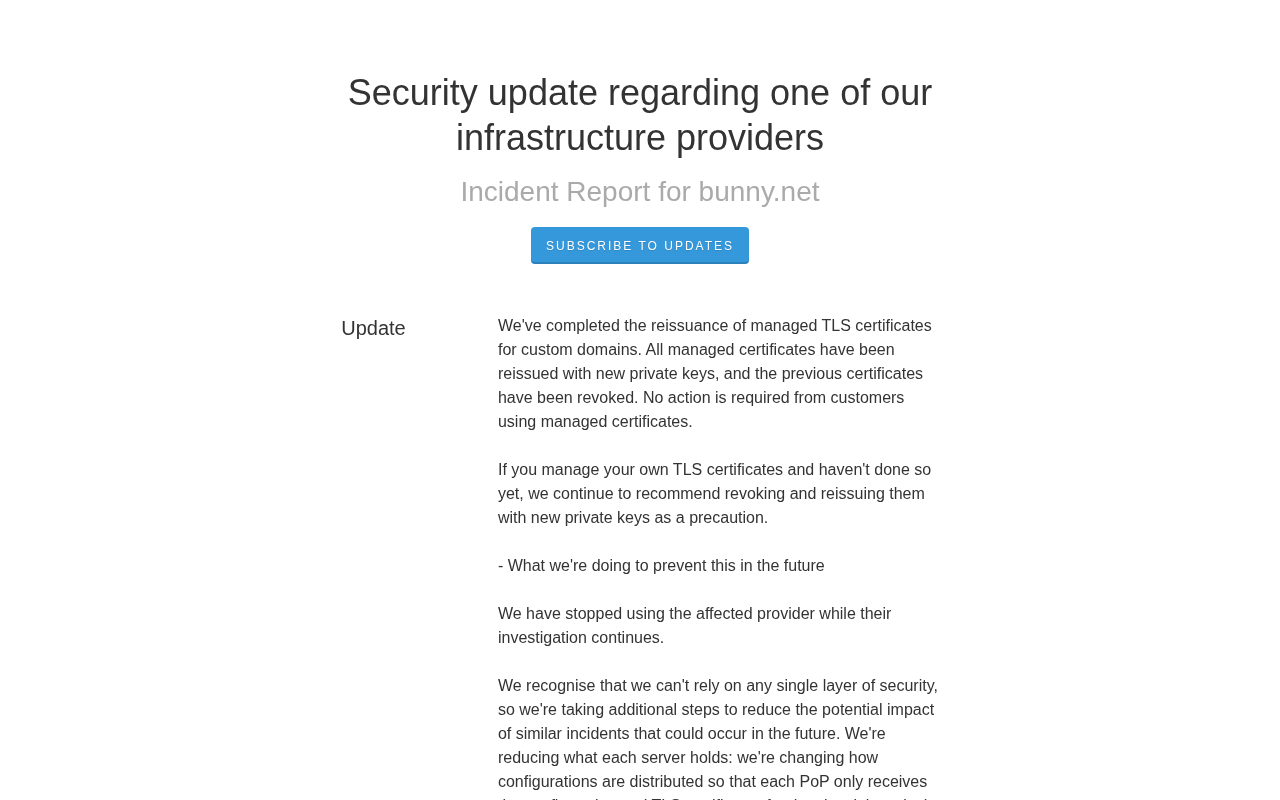
According to an incident notice posted on Bunny.net's official status page (status.bunny.net), the company confirmed that a security incident occurred and notified users through the status page channel. The notice was subsequently submitted to Hacker News, where it quickly gained 220 points and 44 comments.
Based on public information, this is a security incident disclosure made proactively by the vendor, rather than a passive response after third-party exposure. This is not common in the infrastructure industry — most CDN security incidents are either kept private for a long time or disclosed only under regulatory pressure. Bunny's choice to publish a security notice on the status page, a channel normally used to report node failures and network jitter, itself sends a signal: they treated this as a high-priority matter requiring immediate reach to all users.
It should be noted that the specific technical details, scope of impact, and remediation status of the incident should be based on the official original text. This article does not speculate on undisclosed technical details.
Why CDN Security Incidents Should Alarm the Entire Industry
Single-Point Amplification Effect in the Trust Chain
The CDN business model is essentially about bearing the first line of defense for traffic and security on behalf of users. Once a site entrusts DNS resolution, TLS certificates, the cache layer, and WAF rules to a CDN vendor, the vendor's security boundary becomes directly equivalent to the security boundary of those sites.
This means that in the eyes of attackers, a CDN is not "a vendor" but "a unified entry point for a batch of high-value domains." Compromising a single link in a CDN's chain may simultaneously affect a large number of unrelated sites — this leverage effect is something ordinary SaaS vendors do not possess.
The CDN's position as a trust nexus is specifically reflected in several types of critical assets it manages on behalf of sites. DNS resolution determines where traffic goes; if tampered with, users may be redirected to malicious servers. TLS certificates are held by CDN edge nodes, which store the private keys and complete the handshake; a private key leak means attackers can conduct man-in-the-middle attacks against the site. The cache layer stores static resources and even some dynamic responses; misconfiguration or unauthorized access may lead to content leakage. WAF rules are the first layer of filtering that protects a site against common web attacks. Together, these four types of assets constitute the site's external security boundary, and control over them is concentrated on the CDN vendor's side. Therefore, the risk of a CDN security incident lies not in a single node going down, but in the possibility that these high-value control planes are exposed simultaneously — which is why the industry often calls the CDN a "shadow security boundary."
The Special Meaning of a Status Page Notice
Bunny's use of the status page to publish a security notice is a pragmatic but somewhat heavy choice in the industry. Status page subscribers usually sign up to receive service outage notifications; putting a security incident in the same channel amounts to acknowledging that this incident has reached the same level of urgency as a large-scale outage. For sites relying on Bunny for origin protection and DDoS scrubbing, this notice should be treated as top priority.
The status page itself is an availability notification system that runs independently of the main site, usually hosted on a third-party platform or a separate domain, so that it can still communicate externally when the main site fails. Because of this, the subscriber profile of a status page is highly concentrated among operations personnel and technical leads — information reaches precisely the right people, but the audience is limited. Publishing a security incident on the status page rather than issuing a formal security advisory blog post or email notification suggests, on the one hand, that the vendor wants to quickly reach the people who most need to know, and on the other hand, that the formality and depth of detail of the disclosure may be lower than a dedicated security advisory. For site operators, this means they need to proactively subscribe to status page updates and follow subsequent clarifications, rather than relying on a one-time announcement to judge the full picture.
Industry Sentiment Revealed in the Hacker News Discussion
The post on Hacker News received 220 points and 44 comments, a moderately high level of discussion heat among similar infrastructure incidents. From the technical community's focus, discussions around CDN security incidents usually center on a few directions: whether the incident involves user credentials or configuration data, whether it is related to supply chain links, and the vendor's response speed and transparency.
It is worth noting that the community often gives relatively positive evaluations of "proactive disclosure" itself, but demands a high level of granularity in the disclosure — merely saying "a security incident occurred" without explaining the scope of impact is usually followed up with questions in the technical community. The value of such discussions lies not in guessing details, but in forming public scrutiny of the vendor's security governance level.
Practical Checklist for Site Operators
For site operators using Bunny CDN or similar edge services, what they should do immediately upon seeing such a notice is not panic, but check against a checklist:
- Check accounts and API keys: Confirm whether the CDN console login credentials and API tokens need to be rotated, especially keys with configuration modification permissions.
- Review recent configuration changes: Check whether cache rules, origin addresses, and DNS records show signs of changes not made by authorized personnel.
- Confirm origin exposure: A common collateral risk of CDN security incidents is indirect exposure of origin IPs; check whether firewall rules still only allow CDN back-to-origin ranges.
- Follow official updates: Base judgments on subsequent updates to the status page notice, and assess whether temporary switching or multi-CDN disaster recovery is needed.
- Review dependency depth: Think about the real duration of business impact from a single CDN vendor failure or security incident — this is often the key input for deciding whether to adopt a multi-vendor architecture.
API key rotation is the most cost-effective action in incident response. API tokens for a CDN console usually have permissions to modify DNS records, cache rules, origin configuration, and even deploy edge code; once leaked, attackers can tamper with site behavior without touching the origin server. Rotation should follow the principle of least privilege: assign separate tokens for different purposes (such as CI/CD deployment, monitoring reads, and manual operations), and set reasonable expiration times. In addition, it is recommended to enable operation audit logs and retain a sufficiently long retrospective window so that anomalous calls can be investigated after an incident. For sites using Bunny Edge Scripting or similar programmable edge features, it is also necessary to additionally review whether edge code has been modified without authorization — such code runs on the CDN side, and conventional origin monitoring often cannot cover it.
No Bystanders in Infrastructure Security
The Bunny CDN incident is another reminder: modern web architecture outsources more and more trust to a small number of infrastructure vendors, and the probability distribution of security incidents does not decrease because a vendor is small. For small and medium-sized sites, the reason for choosing Bunny is usually cost-effectiveness and ease of onboarding, but incident response capability, disclosure transparency, and user-side emergency preparedness should also be included in vendor evaluation dimensions.
The specific investigation conclusions of the incident are still subject to the official announcement. For the industry, the more valuable question to ask is: as CDNs become the de facto security boundary, have the division of responsibility between vendors and users and the emergency notification mechanisms kept pace with this architectural change?
Related articles

Anthropic's IPO Crisis: Why $16.8B in Revenue Can't Buy a High Valuation
Anthropic posted $16.8B in Q3 revenue with 85% gross margin yet faces a cut to its IPO valuation. A deep dive into halved growth, the token price war, circular financing, and the clash between safety ideals and capital reality.

Anthropic Races Toward the Largest IPO in History: Can a $100 Billion Raise Ignite the AI Investment Boom?
Anthropic may file its prospectus as early as October 23, aiming to raise up to $100 billion at a valuation of up to $2 trillion, potentially the largest IPO ever. Q3 revenue hit $16.8 billion, up nearly 50% quarter over quarter, with adjusted profitability, but slowing growth has led some investors to cut valuation to $1.5 trillion. The IPO is a key test of whether the AI investment boom can continue.

Bessemer Partner on Anthropic IPO: The Public's First Direct Investment in AI Software
Bessemer partner Byron Theta on the Anthropic IPO: why it's called the moment everyone's been waiting for, the $650M four-round investment, the LP liquidity bind, and expectations of a 2027 IPO wave—plus open-source model pricing pressure, existential risk disclosures, and what the founders' 50.1% voting structure means for ordinary investors.