Burning Through Tokens Every Month: How AI Subscriptions Are Transforming Power Users' Productivity

A Reddit post about burning through a $200 AI subscription reveals the mindset of today's AI power users.
A Reddit user posted about finally getting their $200 AI subscription's worth, marveling at the productivity boost while feeling ambivalent about their heavy dependence. The post reflects a broader reality among premium AI subscribers — productivity-driven users who have deeply embedded AI into their workflows, where token consumption has become a key measure of collaboration depth. As usage habits shift from occasional queries to continuous collaboration, per-user resource demands are rising, posing new challenges for providers. The article also cautions that high usage doesn't automatically equal high value, and rational dependency management matters just as much.
A Reddit Post That Sparked a Conversation
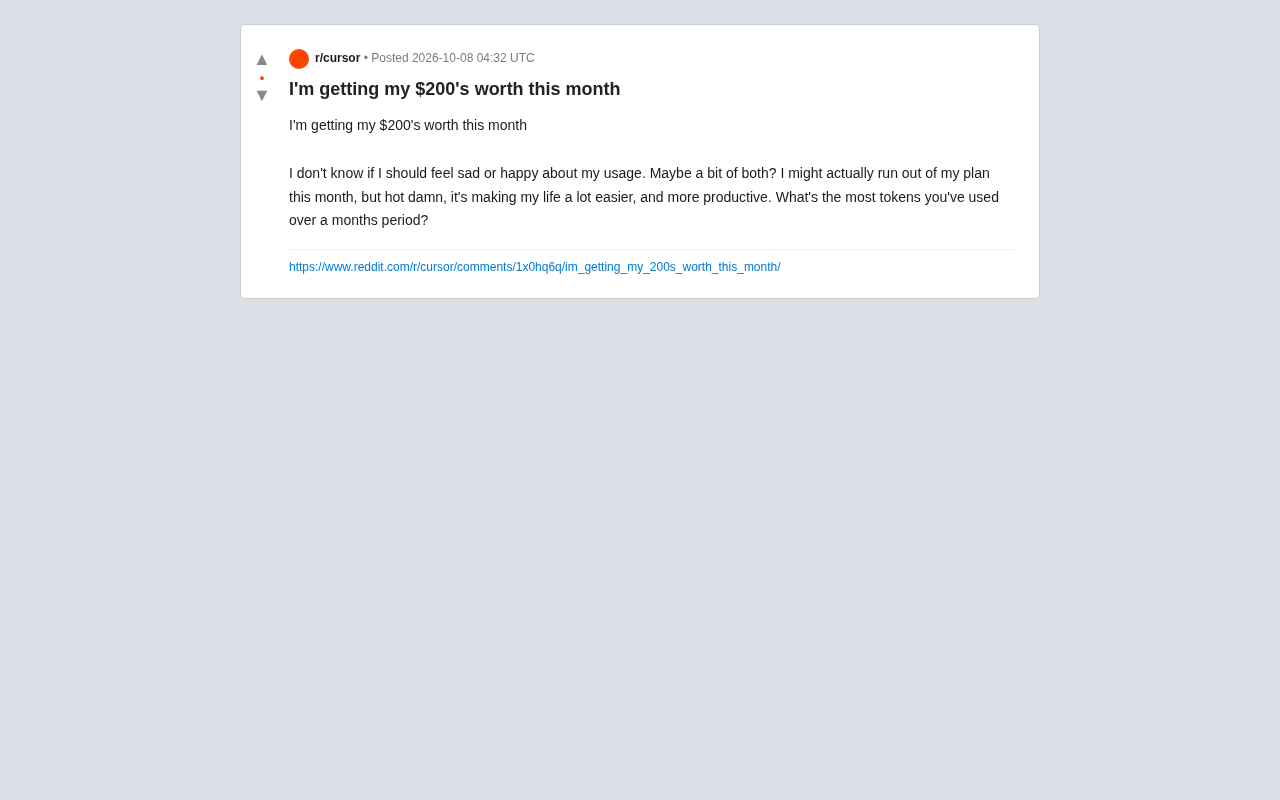
A Reddit user posted about finally "getting their $200's worth" out of their AI subscription this month. Half-jokingly, they admitted not knowing whether to feel bad or good about their usage — "maybe a little of both." They might burn through their plan's quota before the month is even over, but followed that up with: "Damn, this thing has made my life so much easier and I'm so much more productive."
The post ended with a question: what's the most tokens you've ever used in a single month?
This seemingly casual share actually reflects a mindset common among today's heavy AI subscription users: genuinely benefiting from the productivity gains AI delivers, while harboring a complicated mix of feelings about their own "heavy dependence."
The Power User Behind a $200 Subscription
Today's major AI providers — OpenAI, Anthropic, and others — all offer premium subscription tiers aimed at professional users, typically priced around $200 per month. These plans generally offer higher call limits, larger context windows, and priority access to the latest and most capable models.
The people willing to pay for this aren't casual experimenters. They're "productivity-first users" who have deeply integrated AI into their daily workflows. For them, "getting their money's worth" isn't a simple consumer calculation — it's a direct measure of how much value AI is contributing to their work. When a month's usage approaches or exceeds the plan's limits, it's a clear sign that AI has become an indispensable part of how they operate.
The "Mixed Feelings" Reaction Is Worth Unpacking
The poster's comment about not knowing whether to feel bad or good is surprisingly relatable. The upside is obvious: real productivity gains, a subscription that's clearly paying off. The unease likely comes from two places: a nagging worry about over-reliance on AI, and a very practical anxiety about hitting usage limits on an expensive plan.
This tension is a genuine psychological portrait of the moment when an AI tool stops being a nice-to-have and starts becoming a necessity.
Looking at today's leading products, OpenAI's ChatGPT Pro and Anthropic's Claude Max plans both sit in the $100–$200/month range, targeting professional developers, researchers, and enterprise users. The key differentiators typically include unrestricted or high-priority access to flagship models (like GPT-4o and Claude 3.5 Sonnet), longer context windows that can handle tens or even hundreds of thousands of words in a single conversation, and higher concurrent request limits. By contrast, free and basic tiers often get throttled or denied during peak hours — a non-starter for professionals who depend on AI for time-sensitive work. It's this "reliability premium" that convinces some users to pay up for the higher tier.
Token Consumption: A New Metric for AI Engagement Depth
In the billing and quota systems of AI services, the token is the fundamental unit of measurement — covering both the user's input and the model's response. How many tokens someone burns through in a month is, in some ways, a direct reflection of how deeply and frequently they're collaborating with AI.
For heavy users working in areas like coding, writing, or data analysis, long conversations, large blocks of code, and repeated iterations all rack up token usage fast. The poster's comment about potentially running out of quota before the month ends suggests their usage intensity is approaching — or even testing — the upper limits of a premium plan.
This also points to a broader industry observation: as AI capabilities improve, user behavior is shifting from "asking occasional questions" to "ongoing collaboration," and per-user resource consumption is rising significantly. This creates new challenges for providers around cost structure and pricing strategy.
The concept of tokens comes from natural language processing. Simply put, large language models don't process "characters" or "words" directly — they break text into finer-grained linguistic fragments called tokens. In English, one token corresponds to roughly 3/4 of a word; in Chinese, due to differences in character encoding, a single Chinese character typically maps to 1–2 tokens. In a conversation, both the user's prompt and the model's completion consume tokens, and the combined total is the usage count for that interaction.
Token pricing varies significantly across models. For OpenAI's GPT-4 series, for example, the cost per million tokens for the flagship model is far higher than for lighter-weight models. Subscription plans (like ChatGPT Pro at $200/month) typically define limits by "usage caps" rather than strict token quotas, but the underlying resource logic is the same. Understanding how token counting works helps users more clearly evaluate their actual usage costs and whether their subscription tier is really the right fit.
The Productivity Gains Are Real — But Worth Examining Rationally
Setting aside the emotion, the core point the poster kept coming back to is this: AI has made their life easier and their work more productive. That's the shared experience of most heavy users, and it's the fundamental reason they keep paying.
That said, the "getting my money's worth" conversation is worth approaching with a few cool-headed observations:
- Usage volume ≠ value created. Burning through a lot of tokens doesn't necessarily mean you've produced equivalent value. What matters is whether AI actually solved real problems and saved meaningful time.
- Managing dependency. When AI becomes a core part of your workflow, understanding your plan's usage limits and overage billing rules in advance can help you avoid unwanted interruptions.
- Diversity in tool selection. Different tasks may be better suited to different models or tiers. Thoughtfully allocating use cases across tools can help every dollar of your subscription work harder.
Closing Thoughts
This Reddit post may only be a few sentences long, but it vividly captures the real state of today's premium AI subscribers — highly productive, deeply reliant, and carrying a thread of self-aware reflection. As AI tools become ever more embedded in the workflows of professionals, comments like "I finally got my money's worth this month" are only going to become more common.
As for that question — what's the most tokens you've ever used in a month? Every heavy user probably has a number in mind that leaves them equal parts stunned and satisfied.
Related articles

MCP Protocol in 60 Seconds: A Real Session, Message by Message
Dissecting a real MCP session message by message: how an Agent dynamically discovers tools, forwards call requests, and has an MCP server execute them — all in just 9 JSON messages, with the model and reasoning loop untouched.

n8n 40-Minute Masterclass: Build Your First AI Automation Workflow from Scratch
Distilled from a 40-minute n8n masterclass: the core differences between automation, AI, and AI Agents, a comparison of n8n's four deployment methods, and a complete guide from dashboard to your first workflow.

Why Does a 35GB Quantized Model Blow Up an 80GB GPU? The Truth About KV Cache VRAM
Why does a 35GB 4-bit quantized LLM still blow up an 80GB GPU? This article breaks down the four components of inference VRAM, provides precise KV Cache formulas, compares GQA vs DeepSeek MLA memory, and offers production-grade OOM prevention like FP8 KV Cache.