Busabase: A Universal System of Record Built for AI Agents

Busabase gives AI agents like Claude Code and Codex a shared, persistent memory layer.
Busabase targets a core pain point of AI coding agents — the lack of persistent memory and a shared data layer across tasks. Positioning itself as the "general system of record for AI agents," it lets agents like Claude Code and Codex read from and write to the same base, enabling task handoffs and knowledge reuse. It covers both structured data and unstructured documents, offers access control, change review, and audit trails, and is open source with cloud, desktop, and self-hosted deployment options.
When AI Agents Need a Shared Memory Foundation
As coding agents like Claude Code and Codex become part of everyday development workflows, a recurring pain point has emerged: these agents tend to be "forgetful." Every task effectively starts from scratch — the business context, documentation, and accumulated knowledge from the previous run rarely carry over, let alone serve as a foundation for the next task. Busabase was built to address exactly this structural gap.
On its Product Hunt launch day, the product earned 121 upvotes and 29 comments, landing at #3 on the daily leaderboard across three categories: Productivity, Developer Tools, and Databases. Its positioning is straightforward — "the general system of record for AI agents."
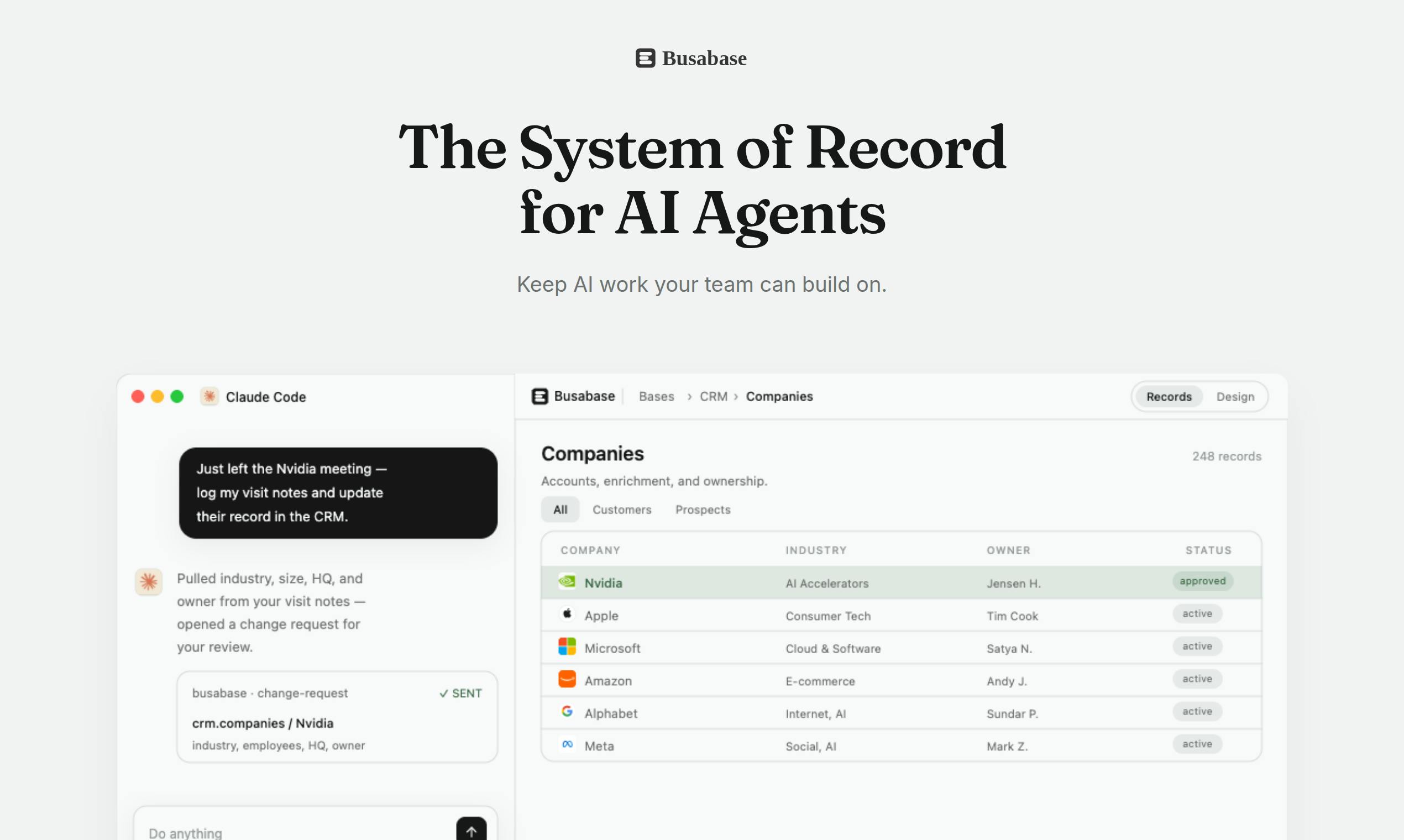
One Shared Base, Multiple Agents
Busabase's core value proposition can be summed up in a single line: Different agents. One shared base. At its heart, it's a general-purpose database and workspace designed to serve both humans and AI agents.
In traditional workflows, business records, documents, skills, and applications are scattered across different systems — making it impossible for agents to maintain continuity across tasks. Busabase aims to consolidate these elements in one place, so that "the next task can build on the results of the previous one." This design philosophy is less about providing a temporary context cache and more about building a persistent layer of organizational memory for AI agents.
In terms of product categorization, Busabase is simultaneously a database and a workspace — a hybrid positioning that signals its ambition to handle both structured data and unstructured documents, serving the dual needs of human-AI collaboration.
"System of Record" is a classic concept in enterprise software, referring to the authoritative source of truth for a given type of data — for example, a CRM is the system of record for customer data, and an ERP serves that role for financial data. All other systems that need this data should defer to it. By positioning itself as "the general system of record for AI agents," Busabase is borrowing this concept deliberately: when an organization runs multiple agents simultaneously, it needs a single authoritative source where data remains consistent and trustworthy — rather than letting each agent maintain its own copy, leading to fragmented data and out-of-sync states.
Connecting with Leading Coding Agents
Busabase explicitly supports integration with Claude Code, Codex, and similar tools, with more agents on the roadmap. This directly addresses the current reality of the developer ecosystem — more and more teams are using multiple AI coding assistants simultaneously, and these tools lack a shared data layer.
When multiple agents can read from and write to the same base, task handoffs become theoretically possible: the results and accumulated skills from one agent can be directly reused by another. For teams trying to embed AI agents into real business workflows, this kind of "shared record layer" may ultimately matter more than improving the capabilities of any individual agent.
Claude Code is Anthropic's command-line coding agent, capable of reading and writing files directly in a terminal environment, executing commands, understanding codebase structure, and completing multi-step programming tasks. Codex is OpenAI's cloud-based coding agent, similarly capable of autonomously executing programming tasks and running tests and debugging workflows in a sandboxed environment. Both tools represent the mainstream form of today's "autonomous coding agents" — they're not just code completion tools, but task executors that can accept high-level goals and act independently. This also means that when teams use multiple such tools simultaneously, the lack of shared context between them becomes a significant problem: each agent's understanding of project history, existing conventions, and technical decisions remains isolated.
Access Control, Auditing, and Oversight
Giving AI agents read/write access to business data naturally raises concerns around security and control. Busabase addresses this with several foundational capabilities:
- Set access: Configure permissions for different entities, controlling who can view and who can modify data.
- Review changes when needed: Enable human review of modifications rather than allowing agents to write freely and autonomously.
- See what changed: Maintain a clear record of what data changed, creating a traceable audit trail.
The significance of this feature set lies in its underlying assumption: humans should retain ultimate control over critical data. Given the real-world risk of agent errors and hallucinations, mechanisms for review and rollback are what allow organizations to confidently connect real business data to AI workflows.
Open Source with Multiple Deployment Options
Busabase is open source and offers three deployment options:
- Cloud: Ready to use out of the box, ideal for users who want to get started quickly.
- Personal Desktop: A local solution for individual users.
- Self-hosting: For teams with strict requirements around data sovereignty and compliance, enabling full deployment within their own infrastructure.
The combination of open source and self-hosting is a deliberate play for the developer community and privacy-conscious enterprises. For organizations unwilling to store business records in a third-party cloud, self-hosting means data never leaves their control — a consideration that often determines whether a new infrastructure tool gets adopted in the first place.
Data Sovereignty is increasingly a core factor in enterprise software procurement, especially when sensitive assets like codebases, business logic, and internal documentation are involved. Self-hosting allows organizations to deploy an entire system on their own servers or private cloud, with data never passing through any third-party nodes — satisfying compliance audits, industry regulations, or internal security policies. For sectors like finance, healthcare, and government, where strict restrictions on data transfer often apply, self-hosting is frequently a prerequisite for adoption rather than a nice-to-have. Open-source licensing also allows organizations to audit the code itself for security vulnerabilities, further lowering the trust barrier for adopting new infrastructure tooling.
A Few Observations
Busabase is entering a space that's rapidly taking shape — the persistent data and collaboration layer for AI agents. As agents evolve from "single-session conversations" to "long-running task execution," the absence of shared memory and a unified record system will only become more pronounced. Integrating a database, workspace, access control, auditing, and multi-agent connectivity — backed by open source and flexible deployment — makes for a reasonably coherent vision.
That said, products positioning themselves as a "universal foundation" typically face a common set of challenges: striking the right balance between generality and ease of use in specific scenarios, actually enabling meaningful collaboration across different agents, and whether the open-source ecosystem can reach sufficient adoption scale. These questions will take time and real-world deployment to answer. Based on the launch-day leaderboard performance and community response, at minimum, this direction has caught the attention of the developer community.
Related articles

Chain of Thought Isn't Just for AI: How Humans Can Use CoT to Improve Thinking Quality
Chain of Thought isn't just a prompt trick for large models. Starting from a Hacker News discussion, this article analyzes why CoT works for human thinking too, breaks down actionable ways to transfer it, and highlights the key differences between human CoT and machine CoT.
Cloudflare Teams Up with OpenAI: Closi…
Cloudflare Teams Up with OpenAI: Closing the Loop from Vulnerability Discovery to Defense with AI
Cloudflare uses OpenAI Daybreak to investigate security vulnerabilities and generate reviewable remediation plans, while developers use Codex to boost coding efficiency and quality.

Orca Multi-Agent Orchestration in Practice: A Guide to Parallel Collaboration with Claude and Codex
Orca is Stable AI's free open-source agent workbench supporting 34 agents like Claude Code and Codex in parallel. Learn its Git worktree isolation, multi-model orchestration, and mobile management.