BusemannFormer: Horospherical Self-Attention for Hyperbolic Graph Transformers
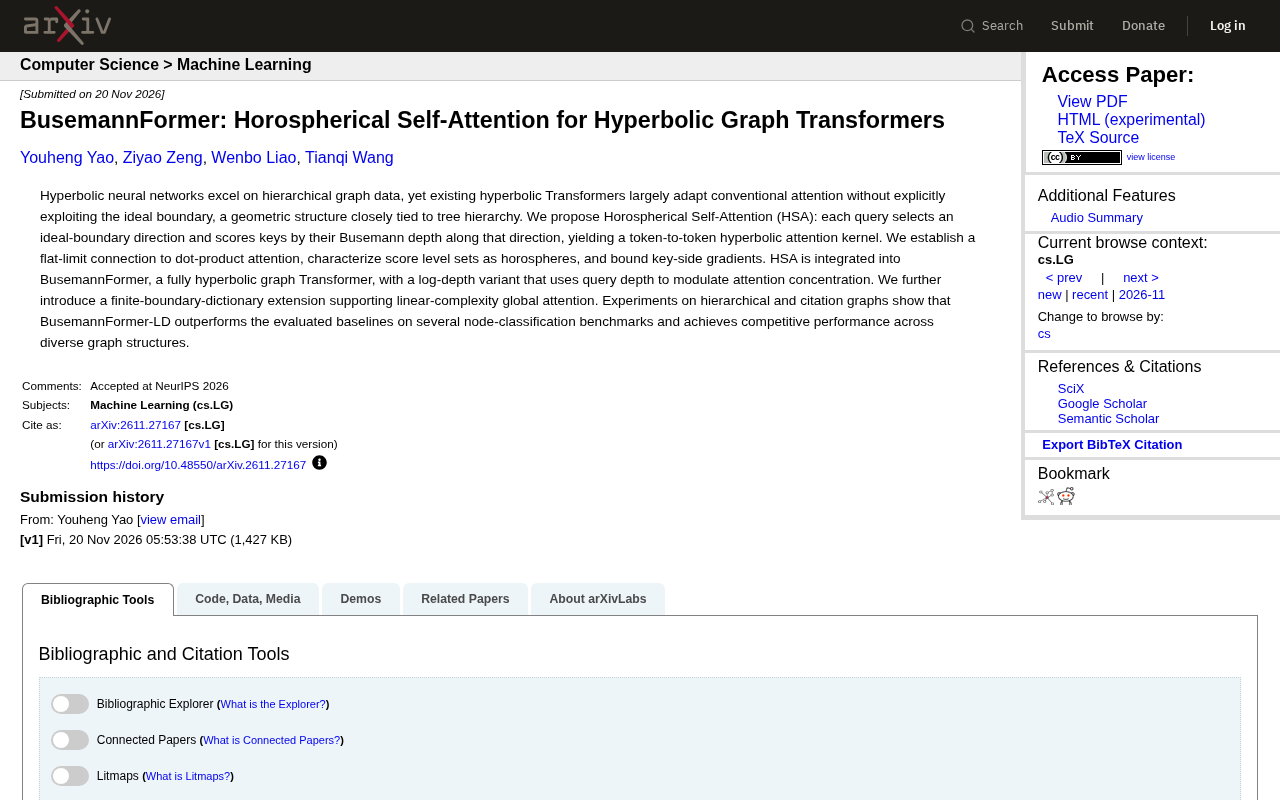
BusemannFormer uses Horospherical Self-Attention to explicitly exploit hyperbolic ideal boundary geometry for better hierarchical graph modeling.
The article introduces BusemannFormer, a fully hyperbolic graph Transformer from an arXiv paper. Its core Horospherical Self-Attention (HSA) lets queries pick directions on the hyperbolic ideal boundary and scores keys by Busemann depth, encoding tree hierarchy in attention. Theory shows HSA reduces to dot-product attention at zero curvature; a finite boundary dictionary enables linear-complexity global attention, and a log-depth variant boosts results on hierarchical node classification.
A New Geometric Perspective on Hyperbolic Graph Transformers
Graph neural networks excel at handling graph-structured data, but when graphs have pronounced hierarchical structure, traditional Euclidean space often falls short. Hyperbolic space, with its exponential growth property, is naturally suited to embedding tree-like hierarchical structures, so hyperbolic neural networks perform well on hierarchical graph data. However, most existing hyperbolic Transformers directly reuse traditional attention mechanisms without explicitly exploiting the geometric structure in hyperbolic space that is closely tied to tree hierarchies—the ideal boundary.
A recent paper from arXiv proposes BusemannFormer, which fills this gap by introducing Horospherical Self-Attention (HSA). The work treats ideal boundary directions as queries, uses Busemann depth to score keys, forms a token-to-token hyperbolic attention kernel, and achieves performance superior to baselines on multiple node classification benchmarks.
Hyperbolic space is a class of non-Euclidean geometric spaces with constant negative curvature, whose volume grows exponentially with radius—highly consistent with the property of tree structures where the number of nodes grows exponentially with depth. In hyperbolic space, the Poincaré disk is a commonly used model: the closer to the origin, the weaker the curvature effect; the farther away, the more "crowded" the space. This property allows hyperbolic embeddings to losslessly represent hierarchical tree structures in extremely low dimensions (Sarkar construction), so hyperbolic neural networks have inherent advantages over Euclidean models on hierarchical graphs, knowledge graphs, and similar data.
The ideal boundary, also called the boundary at infinity, is the set of limit points of hyperbolic space "at infinity." In the Poincaré disk model, the ideal boundary is simply the unit circle. Each boundary point corresponds to a family of asymptotic geodesic directions in hyperbolic space, which can be understood as a "direction" extending from the root toward infinitely deep leaves in a tree structure. There is a deep correspondence between the boundary of a tree and the boundary of hyperbolic space (hyperbolization of trees), which makes the ideal boundary a natural carrier for encoding hierarchical directional information.
Horospherical Self-Attention: Principles and Design
Redefining Attention with Busemann Depth
The core idea of HSA is very intuitive: each query selects a direction on the ideal boundary, and then keys are scored according to their Busemann depth along that direction. Busemann depth measures a certain notion of "distance" from a point to the boundary along a specific direction in hyperbolic space, which exactly corresponds to the hierarchical position of nodes in a tree. In this way, attention scores are no longer simple inner products but embody geometric hierarchical information.
The paper theoretically establishes the flat-limit connection between HSA and dot-product attention: as the curvature of hyperbolic space tends to zero, HSA degenerates into standard dot-product attention. This property guarantees that HSA is the natural generalization of dot-product attention under hyperbolic geometry. In addition, the authors characterize the level sets of attention scores as horospheres and provide bounds on key-side gradients, offering theoretical support for training stability.
The Busemann function is a classic tool in hyperbolic geometry: given a point in space and an ideal boundary direction, the Busemann function measures the "signed distance offset" of that point along this direction, which can be viewed as the relative height of the point with respect to the geodesic having that direction as its limit point. Its level sets are horospheres—analogous to parallel planes in Euclidean space, a horosphere is a family of mutually parallel hypersurfaces that are tangent at infinity. The discrete analogue of the Busemann function on tree structures is exactly the depth of a node (hierarchical distance to the root). Therefore, using Busemann depth as attention scoring essentially makes attention weights reflect the relative depth differences of nodes along a certain hierarchical direction—this is precisely the geometric root of HSA's ability to capture tree hierarchical structure.
BusemannFormer Architecture and the log-depth Variant
Based on HSA, the authors build BusemannFormer—a fully hyperbolic graph Transformer. "Fully hyperbolic" means that from input embedding to attention computation to output representation, the entire network operates in hyperbolic space, avoiding information loss caused by repeated projections between Euclidean and hyperbolic spaces.
To adapt to graph structures at different levels, the paper also proposes a log-depth variant (BusemannFormer-LD), which uses query depth to modulate the concentration of attention. Intuitively, deep nodes (near leaves) can have more concentrated attention, while shallow nodes (near the root) can have more diffuse attention, thereby better capturing hierarchical relationships at different scales. This variant performs particularly well in experiments.
Finite Boundary Dictionary: Global Attention with Linear Complexity
Standard HSA requires selecting a direction on the continuous ideal boundary for each query, which is computationally difficult to scale directly to large graphs. To this end, the authors introduce a finite boundary dictionary extension: a finite number of directions are pre-sampled on the ideal boundary to form a dictionary, and queries only need to select directions from the dictionary, thereby reducing the complexity of global attention to linear. This enables BusemannFormer to handle larger graphs while maintaining the geometric inductive bias.
It is necessary to distinguish two types of complexity: the computational complexity of the attention kernel and the interaction complexity between token pairs. Standard global self-attention requires computing $O(n^2)$ token pairs for $n$ tokens, whereas if HSA freely selects directions on the continuous boundary for each query, direction optimization itself is also an expensive operation. The finite boundary dictionary discretizes the continuous direction space into a fixed set of $m$ candidate directions, and each query only needs to select or weight over the dictionary, reducing direction-related computation from continuous optimization to $O(m)$. When $m$ is of the same order as $n$ or fixed, the overall complexity can be reduced to linear. This idea shares similar motivation with feature maps in linear attention and Performer's random feature approximation, but the dictionary directions carry clear geometric semantics (hierarchical directions) rather than pure function approximation.
Experimental Performance and Significance
The paper evaluates on node classification benchmarks including hierarchical graphs and citation graphs. Results show that BusemannFormer-LD outperforms the evaluated baseline models on multiple benchmarks and achieves competitive performance on diverse graph structures. Although the abstract does not disclose specific datasets and improvement margins, this result preliminarily validates the effectiveness of explicitly exploiting ideal boundary geometric structure.
From a broader perspective, the value of this work lies in more tightly integrating the attention mechanism of hyperbolic graph Transformers with the core structures of hyperbolic geometry (ideal boundary, Busemann depth, horospheres), rather than simply transplanting Euclidean attention into hyperbolic space. This "geometry-aware" attention design approach may provide new directions for the future development of hyperbolic neural networks.
Conclusion
Through Horospherical Self-Attention, BusemannFormer enables hyperbolic graph Transformers to truly "make use of" the hierarchical inductive bias of hyperbolic geometry. Its theoretical flat-limit connection, gradient bounds, and linear-complexity boundary dictionary extension constitute a relatively complete scheme. Although the experimental scale is still limited, this approach deserves further exploration by researchers interested in hyperbolic representation learning and graph Transformers.
One-line Summary
BusemannFormer explicitly exploits hyperbolic ideal boundary geometry via Horospherical Self-Attention to improve hierarchical graph modeling.
Paragraph Summary
The article introduces BusemannFormer, a graph Transformer proposed in an arXiv paper that operates entirely in hyperbolic space. Its core is Horospherical Self-Attention (HSA): queries select directions on the ideal boundary of hyperbolic space, and keys are scored by Busemann depth along that direction, so that attention scores carry tree hierarchical structure information. Theoretical analysis shows that HSA degenerates into standard dot-product attention as curvature tends to zero, that attention level sets are horospheres, and it provides key-side gradient bounds. To improve scalability, the authors introduce a finite boundary dictionary that reduces global attention complexity to linear; they also propose a log-depth variant that uses query depth to modulate attention concentration. On hierarchical graph and citation graph node classification benchmarks, BusemannFormer-LD outperforms the evaluated baselines, preliminarily validating the effectiveness of geometry-aware attention design.
Related articles
Running Local AI Agents on Mac: A Full Breakdown of the MLX Four-Layer Stack
A breakdown of Apple engineer Joanna's local Mac AI agent solution: the MLX four-layer stack, a three-step setup, and how the neural network accelerator, continuous batching, and distributed inference solve local agent performance bottlenecks.
52KB Engine Runs 2B LLM in a Browser Tab
52KB Engine Runs 2B LLM in a Browser Tab
A 52KB WebAssembly engine on Hacker News claims to run Qwen3.5-2B in a browser tab. We analyze the engine-model separation, browser inference pros and cons, and the on-device AI runtime race.
MIT PhD Takes You from Scratch to Build DeepSeek: A 25-Hour Hardcore Course
MIT PhD Raj Dandekar launches a 25+ hour Bilibili course building DeepSeek from scratch—MoE, MLA, GRPO, hand-written code plus math derivations, aiming to reproduce mini R1.