ButterShare: Peer-to-Peer File Transfer with No Size Limits

ButterShare enables encrypted, account-free, unlimited-size P2P file transfers via a 6-digit room code.
ButterShare is a lightweight peer-to-peer file transfer tool designed to bypass cloud storage headaches — no account, no size cap, no uploads to third-party servers. Senders generate a 6-character room code; recipients enter it to join and receive files directly. The product emphasizes end-to-end encryption and privacy, though implementation details remain undisclosed. Currently in early stages on Product Hunt (ranked 20th, 4 votes), it competes with tools like Snapdrop and Wormhole, with its clearest differentiator being the explicit removal of file size limits.
When transferring large files across devices, dealing with cloud storage uploads, account logins, and capacity limits can be a real headache. ButterShare aims to solve this with a lighter approach: no cloud storage, no registration — just a 6-character room code to transfer files of any size directly between devices.
What Is ButterShare
ButterShare is a tool built around "instant peer-to-peer file transfer." After launching on Product Hunt, it was listed under three categories: Productivity, Marketing, and Privacy. Its core value proposition is straightforward — share anything with anyone, with no file size limit.
Unlike traditional cloud storage sharing, ButterShare emphasizes direct transfer: files don't need to be uploaded to a third-party server first. Instead, a connection is established between two devices and the transfer happens directly. For users who regularly send video footage, design source files, or large archives, bypassing cloud storage capacity walls and upload wait times is a genuinely meaningful solution.
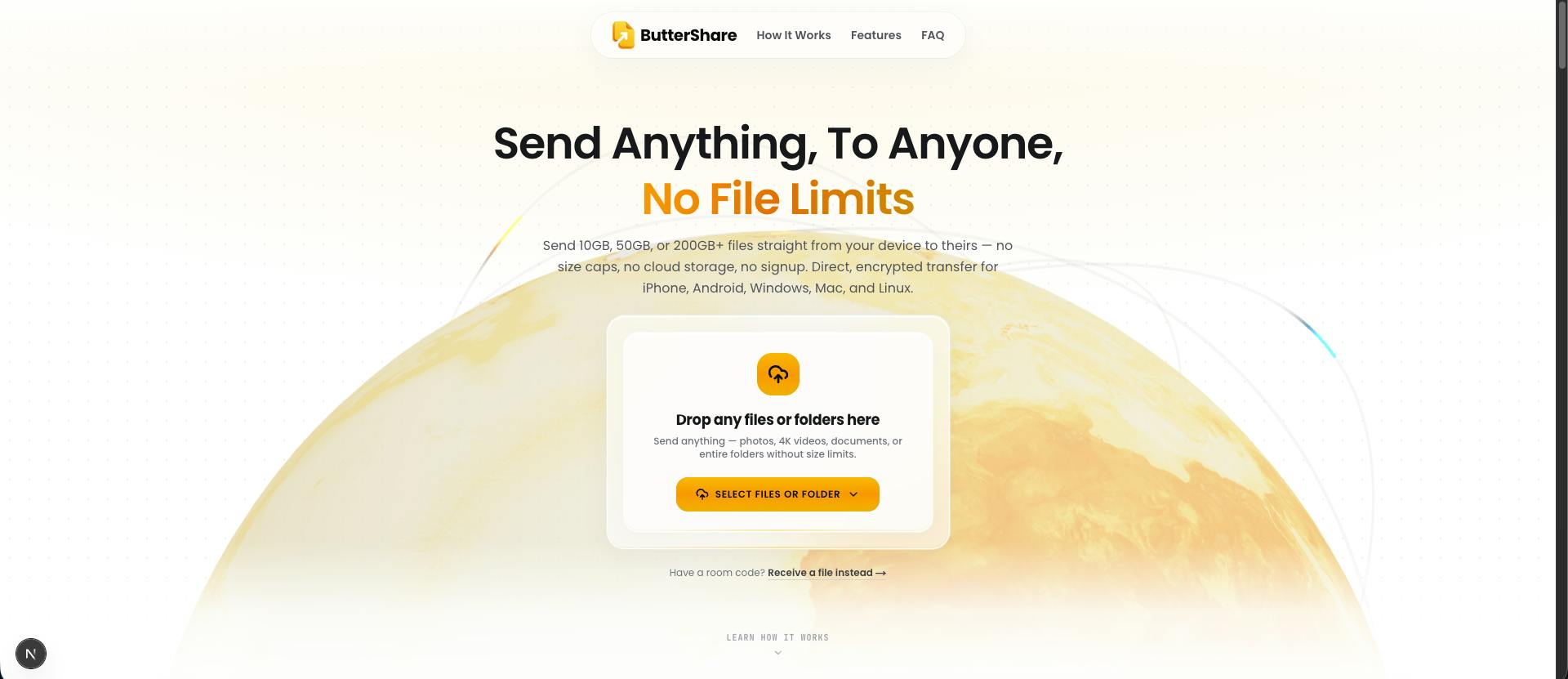
How It Works: Three Steps to Transfer
ButterShare compresses the entire workflow into three minimal steps: generate or enter a 6-character room code, drop in your file, and the recipient retrieves it using the same code. No account creation, no complex configuration required.
This "room code" mechanism feels like a temporary session — the sender generates a short code, the recipient enters it to join the same "room," and a transfer channel is established between them. The 6-character design strikes a balance between memorability and security: easy enough to share verbally or via instant message, while retaining enough random combinations to make accidental guessing unlikely.
The no-registration requirement lowers the barrier to entry significantly, making it especially well-suited for one-off or temporary transfer scenarios — like quickly sending a large file to a colleague, or moving data between two of your own devices.
Privacy and Security: End-to-End Encryption
ButterShare positions privacy as a key selling point, claiming to offer end-to-end encryption (E2EE). In an ideal implementation, this means file contents can only be decrypted by the sender and recipient — no intermediate party can read the raw data.
Combined with the no-cloud-storage design, files don't linger on servers long-term, which offers meaningful advantages in terms of data sovereignty and privacy protection. For users handling sensitive materials who don't want their content cached by third parties, this peer-to-peer encrypted transfer approach is worth paying attention to.
That said, the publicly available information about ButterShare is still fairly sparse. The specific implementation of end-to-end encryption, whether it's open source, and how key management works have not been disclosed. Users with high security requirements should seek out a technical whitepaper or implementation documentation before relying on it for sensitive transfers.
A note on E2EE: The core principle of end-to-end encryption is that data is encrypted on the sender's device and can only be decrypted by a recipient holding the corresponding private key — even if intermediate nodes (including the service provider's servers) intercept the data packets, they cannot reconstruct the plaintext. Typical implementations use a hybrid approach: asymmetric key exchange (e.g., ECDH) combined with symmetric encryption (e.g., AES-256). It's important to distinguish this from "transport layer encryption" (TLS/HTTPS), which only secures data over the network link while the server itself can still access plaintext. True E2EE places decryption power entirely in the hands of the end user. Key verification points for any product claiming E2EE support include: whether keys are generated locally, whether the code is open source and auditable, and whether the key negotiation process has undergone independent security auditing. Until ButterShare discloses its implementation details, its E2EE claims remain to be independently verified.
Market Position and Competitive Landscape
This space is far from empty. From the early days of Snapdrop to Wormhole and various WebRTC-based direct transfer tools, the concept of "peer-to-peer file transfer without uploading" already has many practitioners. ButterShare's differentiation lies primarily in two things: explicitly setting no file size limit and the room code interaction model.
On the day of its Product Hunt launch, ButterShare ranked 20th, with 4 upvotes and 2 comments — firmly in early-stage territory. The modest numbers suggest it's still in the market validation phase, with a long way to go before building a sizable user base.
A note on WebRTC: WebRTC (Web Real-Time Communication) is the core underlying technology powering this category of peer-to-peer transfer tools. Standardized by W3C and IETF, it allows browsers to establish audio, video, or data channels directly without a server intermediary. NAT traversal is the primary challenge WebRTC faces in real-world network environments — most devices sit behind routers or firewalls without public IP addresses, requiring STUN (Session Traversal Utilities for NAT) servers to discover external addresses, or TURN (Traversal Using Relays around NAT) relay servers when direct connections fail. The latter means that in complex network environments, data may actually pass through a relay node — which creates a gap between "pure peer-to-peer" marketing claims and reality. Whether ButterShare uses WebRTC and how it handles NAT traversal failure fallback are critical questions for evaluating cross-network transfer reliability.
Open Questions Worth Watching
As an early-stage product, ButterShare has a clear concept — but several aspects still warrant observation: whether the transfer requires both devices to be online simultaneously, connection success rates across different networks (e.g., different LANs, through NAT), actual speed and stability for large file transfers, and mobile device compatibility. All of these directly affect real-world usability.
For users looking for a lightweight, account-free file transfer solution, ButterShare offers an option worth trying. Reducing a complex transfer workflow down to "one room code" is the right direction — whether it can ultimately stand out will depend on how consistently it delivers on transfer reliability and security transparency.
Related articles

Chain of Thought Isn't Just for AI: How Humans Can Use CoT to Improve Thinking Quality
Chain of Thought isn't just a prompt trick for large models. Starting from a Hacker News discussion, this article analyzes why CoT works for human thinking too, breaks down actionable ways to transfer it, and highlights the key differences between human CoT and machine CoT.
Cloudflare Teams Up with OpenAI: Closi…
Cloudflare Teams Up with OpenAI: Closing the Loop from Vulnerability Discovery to Defense with AI
Cloudflare uses OpenAI Daybreak to investigate security vulnerabilities and generate reviewable remediation plans, while developers use Codex to boost coding efficiency and quality.

Orca Multi-Agent Orchestration in Practice: A Guide to Parallel Collaboration with Claude and Codex
Orca is Stable AI's free open-source agent workbench supporting 34 agents like Claude Code and Codex in parallel. Learn its Git worktree isolation, multi-model orchestration, and mobile management.