Buyer's Guide to Cheap Cursor Tools: How to Spot Ban Risks and Privacy Traps

How to identify and avoid ban risks and privacy pitfalls in cheap third-party Cursor tools.
Cheap Cursor tools typically fall into two dangerous categories: those that tamper with the Electron client code to bypass quotas, and those that route requests through third-party API relays. Both approaches risk account bans, data exposure, and service instability. This guide explains the technical mechanics behind these risks and offers practical criteria for evaluating whether a low-cost Cursor alternative is worth trusting.
Introduction: The Appeal and Hidden Risks of Cheap Cursor Tools
Cursor is an AI code editor deeply customized on top of the VS Code open-source framework, developed by Anysphere. Its core capabilities rely on API calls to mainstream large language models (LLMs) such as GPT-4 and Claude. Cursor's business model is SaaS-based subscription: it purchases API call rights from model providers like OpenAI and Anthropic, then resells them to developers as subscription packages — every code completion or chat response consumes a certain number of tokens (the model's compute units).
Cursor has become an essential daily tool for many developers thanks to its powerful code completion, project refactoring, and bug-localization features. However, the official subscription cost isn't friendly to developers who don't code at high frequency — large amounts of idle time translate directly into wasted money.
This supply-demand tension has given rise to a flood of so-called "cheap Cursor tools" on the market, priced anywhere from a few cents to a few dollars. They look attractive, but they hide serious risks of account bans and privacy breaches. This article draws on an in-depth technical breakdown to help developers understand the underlying mechanics of these tools and avoid common pitfalls.
Important Notice: This article aims to document industry patterns and technical risks to help readers make informed decisions. Any third-party account sharing or resale service may violate the official Terms of Service and carries compliance and privacy risks. Please proceed with caution.
Why Cheap Tools So Often "Blow Up"
According to the analysis in the source video, most cheap Cursor tools on the market suffer from two fatal technical flaws — and these are the root causes behind the frequent account deactivations, bans, and project disruptions that users experience.
Flaw #1: Tampering with the Client-Side Frontend Code
Many tools of this kind modify Cursor's client-side frontend code or tamper with local application data to enable so-called "discounted usage quotas." Understanding this requires knowing Cursor's underlying architecture: the Cursor client is built on the Electron framework, which essentially packages a web frontend (HTML/CSS/JavaScript) into a desktop application. This architecture makes the frontend code relatively easy to reverse-engineer and modify. Some cheap tools unpack the Electron app's asar archive files and directly modify authentication logic, API endpoints, or quota validation functions in the JavaScript source code, bypassing official usage restrictions.
This practice fundamentally violates the platform's enforcement rules. Cursor fights back through server-side validation, behavioral analysis (such as abnormally high request rates or simultaneous multi-device logins), and client integrity checks (detecting whether program file hashes have been tampered with). Once the detection system identifies anomalous behavior, the account is immediately banned — with virtually no chance of recovery.
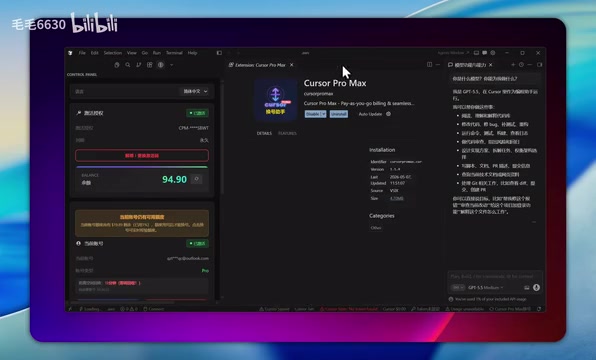
For an active development project, a sudden ban means an immediate workflow interruption — an extremely costly outcome.
Flaw #2: Risks of Third-Party API Relay
Another category of tools uses a third-party API "relay" approach and cannot connect directly to Cursor's native models. From a network architecture perspective, this means inserting an intermediate node between the user and Cursor's official servers: user requests first reach the relay server, which then forwards them to the official Cursor API, with response data traveling back along the same path. All data must pass through this intermediary, creating three distinct problems:
- Performance degradation: Network latency increases by at least one additional RTT (round-trip time), and the longer request chain causes lag. The integrity of the context window depends on the relay service's correct implementation — any flaw causes conversation memory truncation, significantly degrading AI output quality.
- Service instability: If the relay service provider shuts down or goes dark, the tool stops working immediately.
- Privacy leak risk: Code content — including business logic, database schemas, API keys, and other sensitive information — is fully exposed to the relay service operator, with a real risk of interception or disclosure. This is especially unacceptable for enterprise development teams.
This is the fundamental reason why many developers cycle through tool after tool and can never find a version that works reliably over the long term.
The Technical Key to Stability: Native Scheduling
The video author argues that the core of genuinely avoiding Cursor ban risks lies in not tampering with the client and not using API relays. A more reliable architecture should meet the following criteria:
Keeping the Client Natively Clean
The entire runtime process uses native scheduling: the client retains the official build at all times, with no parameter tampering, no additional script injection, and no interference with the official built-in logic. The key to understanding this lies in how Cursor's risk control works: Cursor's ban system is essentially a Risk Control framework that checks dimensions including device fingerprints (unique identifiers generated from hardware IDs and system information), IP address anomalies, behavioral sequence analysis, and client integrity checks. The less you modify the official program, the lower the probability of triggering risk controls — addressing the root cause of ban risks.

Full Model Compatibility and Synchronized Updates
Because the underlying architecture is left untouched, the solution theoretically supports all of Cursor's official models. When the official client pushes updates, it can seamlessly sync the upgrade, avoiding common issues like "broken after update," "won't open," or "API call errors."
From a technical standpoint, the less you modify the official program, the higher the compatibility and stability. However, it's worth noting that even with a "clean" architecture, account sharing itself may still trigger Cursor's multi-device or anomalous login detection. Cursor continuously updates its detection strategies, creating an ongoing "arms race" with cheap tool providers — and this is the fundamental reason why the usable lifespan of such services keeps getting shorter.
Billing Model: Pay-as-You-Go and Non-Expiring Balances
Another point worth noting from the video is the billing logic. The author advocates a pure pay-as-you-go model, in sharp contrast to the many platforms on the market that force monthly, quarterly, or annual subscriptions.
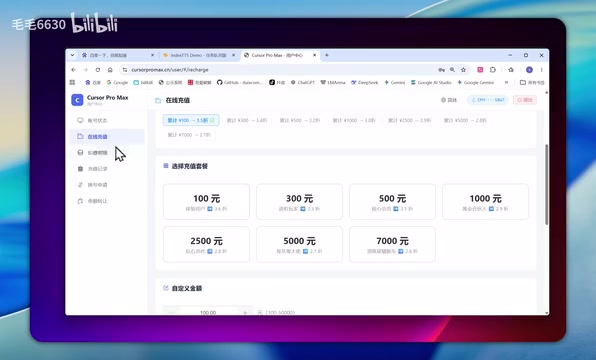
The core mechanism is intelligent scheduling through an account pool. An account pool is a resource-reuse technique widely used in cloud computing for database connection pools, IP pools, and similar scenarios. Operators register or purchase official accounts in bulk and use a scheduling system to perform load balancing across accounts based on their current remaining quota, online status, and last-active time, dynamically assigning them to active users. The system monitors account quotas and idle status around the clock. Precise token consumption measurement relies on real-time parsing of the usage field in Cursor's official API responses. Users are not charged when no tokens are consumed, and idle quota automatically flows to users who are actively working — achieving "balances that don't expire, you only pay for what you use."
From a user-experience perspective, this model genuinely addresses the pain point of wasted money from idle monthly subscriptions. However, from a compliance standpoint, bulk purchasing of official accounts for pooled shared scheduling explicitly violates Cursor's Terms of Service prohibiting account sharing and resale. Both the operator and the user are in breach of contract — a critical issue each user must independently assess.
How to Tell Whether a Cheap Cursor Tool Is Trustworthy
Drawing on the video's perspective and general evaluation criteria, here are some key reference points worth paying close attention to:
Billing Transparency
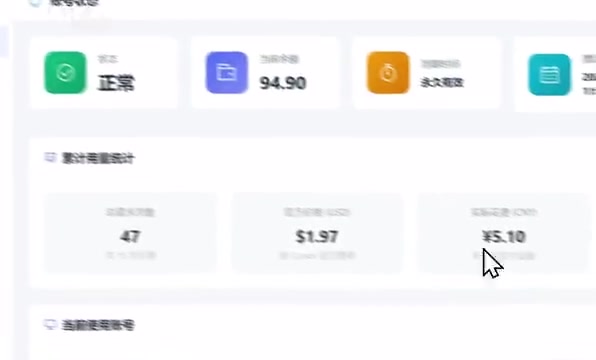
A trustworthy tool should provide records of every API call, token consumption, and deduction details — and allow users to verify them independently. The author emphasizes that their billing data maps 1-to-1 against Cursor's official underlying billing, accurate to three decimal places. Whether the billing is auditable is an important indicator of whether "black-box operations" are taking place.
Start with a Small Top-Up
The author personally recommends: don't load a large amount upfront. Start with a small amount to test stability, model response speed, and billing clarity in practice. This is the most practical way to avoid "rug pull" risk — any service claiming long-term stability should be able to withstand a small-scale test.
Be Wary of Account Origins
The author candidly acknowledges that cheap trial accounts selling for a few dollars online have largely already been flagged by Cursor's official detection channels. If a tool's price seems unreasonably low, the legitimacy and sustainability of its account sources deserve serious scrutiny. Given Cursor's continuously evolving risk control system, the usable lifespan of cheap accounts will keep shrinking as official detection capabilities improve.
Conclusion: Stay Rational, Own the Risk
The technically-minded author's critique of the chaotic low-price tool market is fair — a large number of poor-quality cheap tools have caused endless headaches for newer developers. The design principles they advocate — native scheduling, pay-as-you-go billing, transparent billing records — do point in a more technically sound direction.
But it's important to be clear-eyed: any non-official Cursor subscription service inherently operates in a gray area relative to the Terms of Service. Bulk account purchasing for shared pool scheduling, no matter how "clean" the technical architecture, cannot fully eliminate the risk of bans from policy changes — especially since Cursor's risk control system is itself continuously evolving. Working today is no guarantee of working tomorrow.
For teams that genuinely prioritize project continuity and code data security, an official subscription remains the safest choice. Budget-conscious individual developers who opt for third-party solutions should insist on starting with a small trial, pay close attention to billing transparency, and go in with a clear-eyed understanding of the potential compliance and privacy risks.
The prerequisite for choosing any tool is always — knowing exactly what risks you're taking on.
Key Takeaways
Related articles

How Big Can Stars Really Get? The Physical Limits of the Largest Stars
Red supergiants are the largest stars by volume, with radii up to 2,000 times the Sun, engulfing the inner solar system. But there is no precise upper limit on stellar size—models predict up to 15,000 solar radii. The most massive blue stars are far smaller than red supergiants—biggest and heaviest are two different things.

Apple HomeView Smart Display Full Feature Breakdown: Wall-Mount or Desktop, $299
Apple launches HomeView, a $299 smart display with wall-mount and desktop options, 12MP camera for facial recognition, smart home control, music playback, and recipe step-by-step cooking. Full breakdown of watch faces, apps, privacy, and cooking integration.

Where Did the Promised New Studio Go? Craft Computing Answers After Five Years
Craft Computing's host responds to viewer questions: the new studio promised five years ago was shelved as construction costs soared from $30,000 to $75,000, and was replaced by a 168-square-foot garage conversion.