ByteAsk Cloud Agents: Letting AI Fix Bugs in Large Codebases Directly from Slack

ByteAsk Cloud Agents uses repository indexing plus a cloud agent to take AI bug-fixing from Slack straight to draft PRs.
ByteAsk Cloud Agents is an AI developer tool ranked #10 on Product Hunt, focused on fixing and shipping bugs directly from Slack. It provides Claude Code and Codex with an index of the entire codebase so AI can quickly locate relevant files, while a Cloud Agent receives bug reports from Slack, Jira, or the browser, builds and tests in a sandbox, and automatically opens draft PRs. The four-step workflow suits large codebases and Slack-based teams; new users get $50 in credit with no credit card required, though pricing details and sandbox test coverage still need practical verification.
Title
ByteAsk Cloud Agents: Letting AI Fix Bugs in Large Codebases Directly from Slack
Meta Description
ByteAsk Cloud Agents provides codebase indexing for Claude Code and Codex, receives bugs from Slack or Jira, tests in a sandbox, and automatically creates PRs. New users get $50 in credit, no credit card required.
Article Content
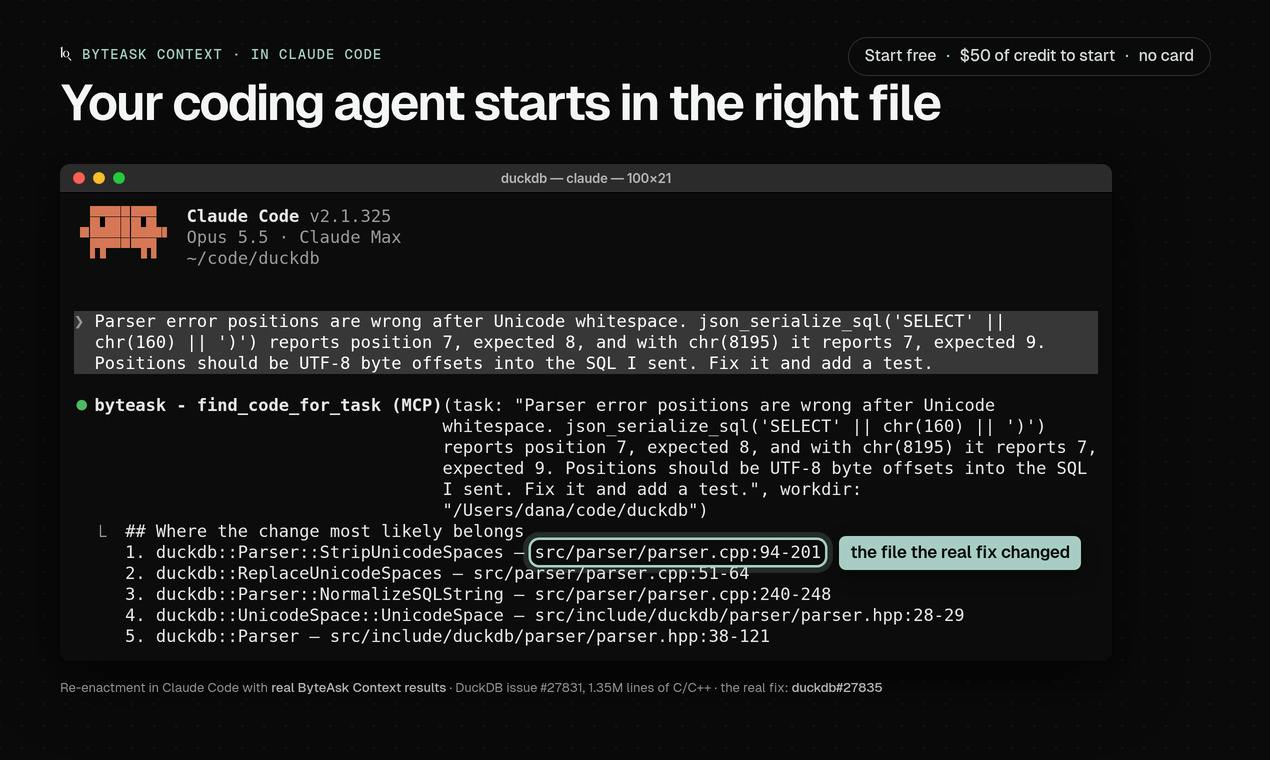
Locating bugs in large codebases is often like finding a needle in a haystack, and ByteAsk Cloud Agents aims to change that with AI. This developer tool, ranked #10 on Product Hunt, focuses on "fixing and shipping directly from Slack," providing Claude Code and Codex with an index of the entire repository so AI can start working from the right files.
Core Features: Indexing + Cloud Agent, a Complete Fix Pipeline
ByteAsk's core capabilities fall into two layers. The first is repository indexing: it provides Claude Code and Codex with an index of the entire codebase, enabling AI models to quickly locate relevant files instead of searching blindly through a massive project. The second is the Cloud Agent: it can receive bug reports from Slack, Jira, or the browser, build and test in a sandbox environment, and automatically open draft PRs.
This design connects bug discovery, fixing, verification, and submission, reducing the cost of developers switching between tools. According to the official description, users simply describe the problem in Slack, and the Cloud Agent takes over the rest of the process, ultimately generating a reviewable PR.
Repository Indexing: Traditional AI coding assistants typically rely on developers to manually provide context, or can only retrieve the currently open file, making them prone to getting "lost" in large codebases. Repository indexing works by pre-parsing the entire codebase to build a semantic index of files, symbols, and dependencies, so that when the AI executes a task, it can first retrieve the most relevant files and code snippets before handing them to the model. This is similar to the idea of retrieval-augmented generation (RAG)—essentially, given the model's limited context window, an external index expands its "visible range." The quality of the index directly determines the accuracy of the AI's code localization, which also explains why the article mentions that index construction has certain requirements for codebase structure.
Cloud Agent: Unlike AI assistants that run in a local IDE, a Cloud Agent is an agent that runs independently in the cloud with its own execution environment. It can autonomously plan task steps, call tools (such as file read/write, build commands, test runs), and loop until the task is complete. The Cloud Agent in this article also introduces a sandbox environment—an isolated, disposable runtime environment used to safely build and test code, avoiding contamination of the main branch or production systems. The sandbox mechanism is a key safety barrier for automated fixing tools, but the coverage of tests within the sandbox determines whether the fix is truly reliable.
How It Works: Automation from Slack to PR
ByteAsk's workflow can be summarized in four steps:
- Capture the issue: The Cloud Agent receives bug information from Slack, Jira, or a browser extension.
- Locate the code: With the help of repository indexing, the AI quickly finds the files related to the problem.
- Sandbox verification: Build and test in an isolated sandbox environment to ensure the fix doesn't introduce new problems.
- Submit a PR: Automatically create a draft PR for developer review.
This process is particularly well suited to maintenance teams working on large codebases, especially those that frequently communicate issues through Slack.
Draft Pull Request: A draft PR on platforms like GitHub is a pull request status marked as "not yet ready," which allows code to be submitted and discussed but does not trigger the formal merge process or notify all reviewers. ByteAsk's choice to automatically create draft PRs rather than submit directly is a pragmatic design: AI-generated fixes require human review and confirmation, and the draft status both preserves automated output and returns the final decision to the developer, reducing the risk of AI mistakenly modifying code.
Pricing and Getting Started: $50 in Credit, No Credit Card Required
ByteAsk offers a friendly starting plan: new users receive $50 in credit with no credit card required. This lowers the barrier to entry, especially for teams looking to explore AI-assisted fixing workflows.
However, the official pricing tiers and credit consumption rules have not been disclosed, so users will need to evaluate costs based on actual usage after trying it out.
Use Cases and Limitations
Typical scenarios for ByteAsk Cloud Agents include:
- Quickly locating and fixing bugs in large monorepos.
- Having AI take over issues directly when teams collaborate through Slack.
- Agile teams that need to quickly generate PRs for code review.
However, it's worth noting that the tool relies on Claude Code and Codex as the underlying AI, and index construction may have certain requirements for codebase structure. In addition, whether the test coverage in the sandbox environment is sufficiently comprehensive still needs to be verified in practice.
Conclusion
ByteAsk Cloud Agents extends AI code fixing from the IDE into collaboration tools through indexing and cloud agents, offering a new approach to maintaining large codebases. Its integration with Slack and Jira, along with automatic PR functionality, has the potential to improve teams' issue response speed. For teams already using Claude Code or Codex, it's worth trying with the $50 credit.
One-line Summary
ByteAsk Cloud Agents uses repository indexing plus a cloud agent to take the AI bug-fixing process from Slack straight to draft PRs.
Paragraph Summary
ByteAsk Cloud Agents is an AI developer tool ranked #10 on Product Hunt, focused on fixing and shipping bugs directly from Slack. It achieves this through two layers of capability: first, providing Claude Code and Codex with an index of the entire codebase so AI can quickly locate relevant files; second, a Cloud Agent that receives bug reports from Slack, Jira, or the browser, builds and tests in a sandbox environment, and automatically opens draft PRs. The workflow consists of four steps—capturing the issue, locating the code, sandbox verification, and submitting a PR—making it suitable for large codebases and teams collaborating through Slack. New users receive $50 in credit with no credit card required, but specific pricing rules, indexing requirements, and sandbox test coverage are not fully disclosed and still need practical verification.
Related articles

Abnormal Error Rate Spike in Claude Mythos 5.2 and Fable 5.2
Claude Mythos 5.2 and Claude Fable 5.2 show an abnormal spike in request error rates, marked as investigating on the official status page. This article covers the incident overview, practical impact on developers, and recommended responses.

ReAct Runtime Context Trimming: Why Claude Code Acts at 70%
A deep dive into ReAct runtime context trimming: why Claude Code compresses at ~70% usage, why tool calls dominate, why messages must be dropped in pairs, and why codebases don't need RAG.

AI Agent vs LLM: How Cursor and Claude Code Actually Work
An in-depth analysis of the essential difference between AI Agents and LLMs: LLMs generate code suggestions, while Agents modify files and run tests via tool calls. Using a Spring Boot bug fix as an example, it breaks down the workflows, permission control, and verification mechanisms of Cursor and Claude Code.