ByteVoice: Talk to Coding Agents with Your Voice and Free Your Hands

ByteVoice lets developers talk to coding agents by voice and listen to summaries, exploring interaction beyond the keyboard.
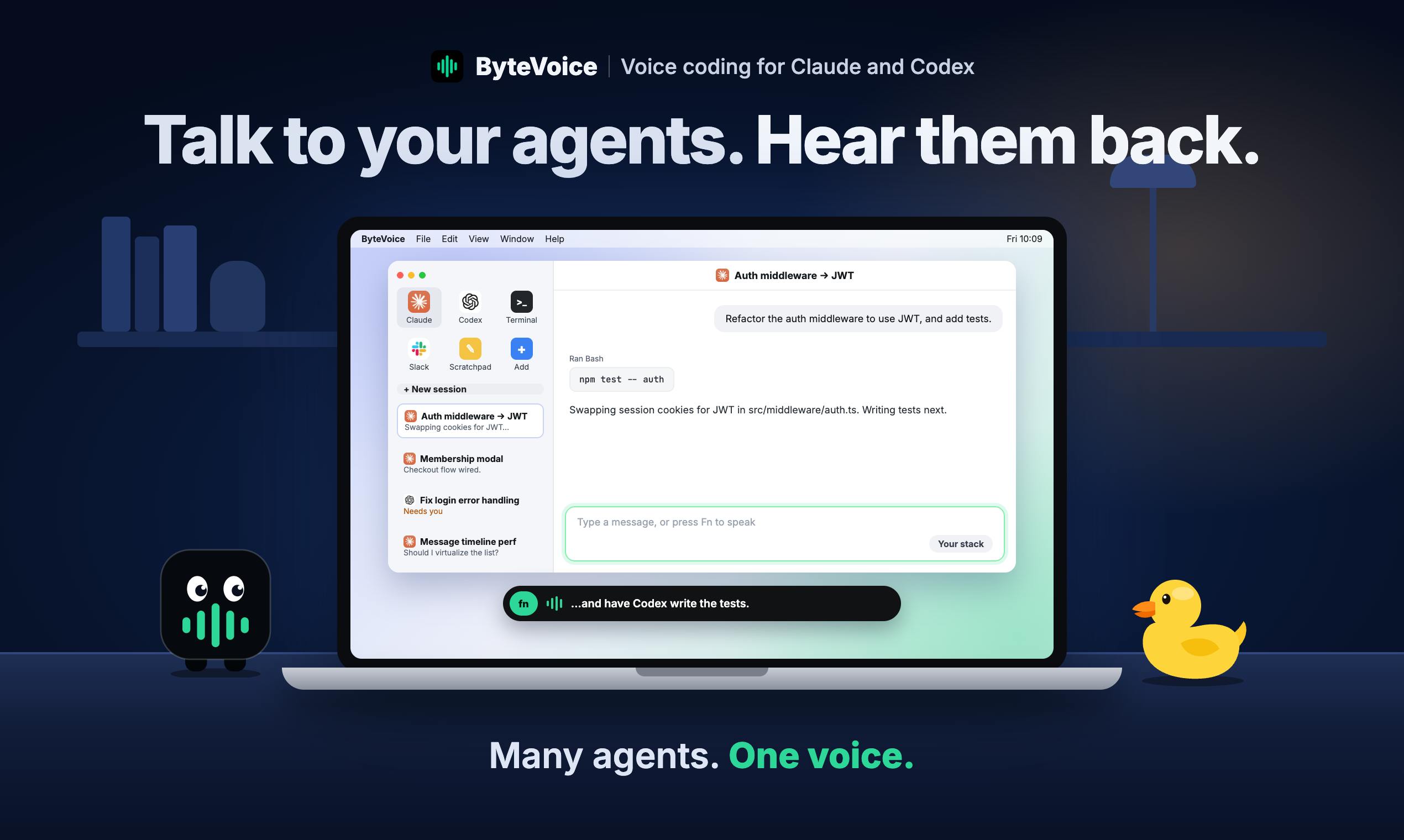
ByteVoice is a newly launched Product Hunt voice tool that lets developers talk to coding agents like Claude Code, Codex, and Cursor and hear voice summaries, forming a closed-loop voice interaction. It targets heavy users of AI coding assistants and suits rapid prototype discussions, code review, multitasking, and accessible programming. Emphasizing support for "any agent," it has 71 upvotes and ranks 14th—an early-stage product. The article notes voice programming still faces challenges in code recognition accuracy and summary conciseness, but diversified interaction is inevitable.
Why Do We Need Voice Interaction with Coding Agents?
With AI coding tools exploding in popularity, developers' interactions with agents rely almost entirely on keyboard input. Tools like Claude Code, Codex, and Cursor are powerful, but prolonged typing is both an obvious efficiency bottleneck and a burden on your hands. ByteVoice, newly launched on Product Hunt, aims to change this—it lets you talk to coding agents with your voice and hear their summaries directly.
AI coding agents refer to AI systems that can understand natural language instructions, plan autonomously, and execute coding tasks. Typical examples include Claude Code, OpenAI Codex, and Cursor. Unlike traditional code completion tools, agents can read project files, run commands, modify code, and explain results, with interaction primarily driven by conversation. This model shifts developers from writing line by line to describing tasks and reviewing results, but it also brings a heavy burden of text input and output. Voice interaction is precisely a complementary solution to this bottleneck, especially suited for scenarios where your hands are occupied or you need a quick summary.
Core Features of ByteVoice
ByteVoice's positioning is clear: to be the voice bridge between developers and AI coding agents. According to its Product Hunt page, it supports voice interaction with Claude Code, Codex, Cursor, and any agent. Specifically, you can:
- Replace typing with voice: Dictate requirements, instructions, or questions directly to the coding agent;
- Listen to agent summaries: The agent's replies are converted into speech so you can quickly grasp the results;
- Reply directly by voice: Continue the conversation with the agent without switching back to the keyboard.
This closed-loop voice interaction model lets developers keep collaborating with coding agents while their hands are busy (e.g., reading documentation or debugging hardware) or when multitasking.
Target Users and Use Cases
ByteVoice targets developers who rely heavily on AI coding assistants. Typical scenarios include:
- Rapid prototype discussions: During the ideation phase, describing requirements by voice is more natural and fluid than typing;
- Code review and summaries: Have the agent read out code change summaries so you can think while listening;
- Multitasking: Issue new instructions to the agent by voice while reviewing runtime results;
- Accessible programming: Provide a friendlier interaction method for developers with limited mobility.
You may not have noticed that ByteVoice emphasizes support for "any agent," meaning it isn't tied to a specific ecosystem and offers a degree of universality.
Accessible programming refers to alternative input methods such as voice, eye tracking, and switch control that help developers with physical motor impairments complete programming work. Traditional IDEs and command-line tools rely heavily on keyboard and mouse, creating barriers for people with limited mobility. Voice programming tools can convert dictated instructions into code edits or agent calls, reducing the operational burden. However, symbols, indentation, and precise variable names in programming remain challenges for speech recognition, so accessibility scenarios usually require voice correction and context-understanding technologies to reach a usable level.
Product Status and Community Feedback
On Product Hunt, ByteVoice has received 71 upvotes and ranks 14th, categorized under Productivity, Developer Tools, and Artificial Intelligence. Currently there are only 2 comments, and community discussion is not yet active. The maker is Eason He, and the product's official website link points to its Product Hunt page.
Based on the data, ByteVoice is an early-stage product, but it precisely addresses a real pain point in AI coding workflows: the limited ways of interacting. As coding agents become more widespread, voice interaction is expected to become an important complement to the keyboard.
Challenges and Outlook for Voice-Interactive Programming
Despite the promising prospects, voice-interactive programming still faces challenges. Programming languages and code structures demand extremely high accuracy from speech recognition, and dictating complex logic or variable names is error-prone; agent voice summaries also need to be concise enough, otherwise they reduce efficiency. Whether ByteVoice can refine these details will determine whether it evolves from a "novelty tool" into a "daily essential."
Still, the direction is worth affirming. As coding agents gradually become developers' "copilots," diversified interaction methods are an inevitable trend. ByteVoice has taken an interesting step.
Domain adaptation in speech recognition refers to optimizing general-purpose speech recognition models for a specific domain (such as programming) to improve the recognition accuracy of technical terms and symbols. Programming languages contain many non-natural-language words, such as camelCase names, underscores, brackets, and operators, which general ASR models easily confuse. Common approaches include building domain dictionaries, using custom language models, or applying post-processing correction combined with code context. For voice programming tools, domain adaptation capability directly determines the usability of dictated code and is one of the current technical difficulties.
One-line Summary
ByteVoice lets developers talk to coding agents by voice and listen to summaries, exploring interaction beyond the keyboard.
Paragraph Summary
ByteVoice is a voice interaction tool newly launched on Product Hunt, designed to let developers talk to coding agents like Claude Code, Codex, and Cursor by voice and listen to voice summary replies from the agents, forming a closed-loop voice interaction. It targets developers who rely heavily on AI coding assistants and is suited for scenarios such as rapid prototype discussions, code review, multitasking, and accessible programming. The product emphasizes universal support for "any agent" and currently has 71 upvotes and ranks 14th, making it an early-stage product. The article notes that voice programming still faces challenges in code recognition accuracy and summary conciseness, but diversified interaction is an inevitable trend.
Related articles

Prompt Engineering for Beginners: From Writing Prompts to Engineering Thinking
Starting from the essence and four functions of prompts, this article systematically explains the six-step process, four success criteria, learning value, and practical limitations of prompt engineering to help you build a complete understanding.

Anthropic Launches Nasdaq IPO: AI Giant's Listing and Risk Disclosures
Anthropic officially launches its Nasdaq IPO under ticker ANT, with market valuation expected to potentially exceed SpaceX's record. The prospectus devotes nearly 100 pages to AI risks, while first-half revenue grew over 14x but net losses widened sharply, reigniting the AI bubble debate.

Rust cURL Clone Uses 4,832 unsafe Blocks—Is the Memory Safety Myth Broken?
A Rust cURL clone uses 4,832 unsafe keywords, challenging Rust's memory safety narrative. We analyze what unsafe really means, compare Fil-C, and examine rewrite motives.