C++26 Rejected: The Standard Evolution Process Under Scrutiny

C++26 standard draft rejected in a vote, sparking intense community discussion about the WG21 consensus mechanism and the language's future.
The C++26 standard draft failed to pass the voting stage, and the discussion on Hacker News quickly heated up to 286 points and 171 comments. This rejection is not aimed at a single technical detail but exposes the structural contradiction of the WG21 consensus-driven decision-making model: caution and efficiency are hard to achieve simultaneously. The uncertainty of the standard will transmit to compiler vendors and frontline developers, increasing migration and portability costs. Community evaluations are polarized: some praise the committee's commitment to a quality baseline, while others worry that procedural deadlocks will weaken C++'s competitiveness. Citing Andreas Fertig's question, the article proposes three survival clues: improving process transparency, refining already-landed features, and responding to competition from languages like Rust.
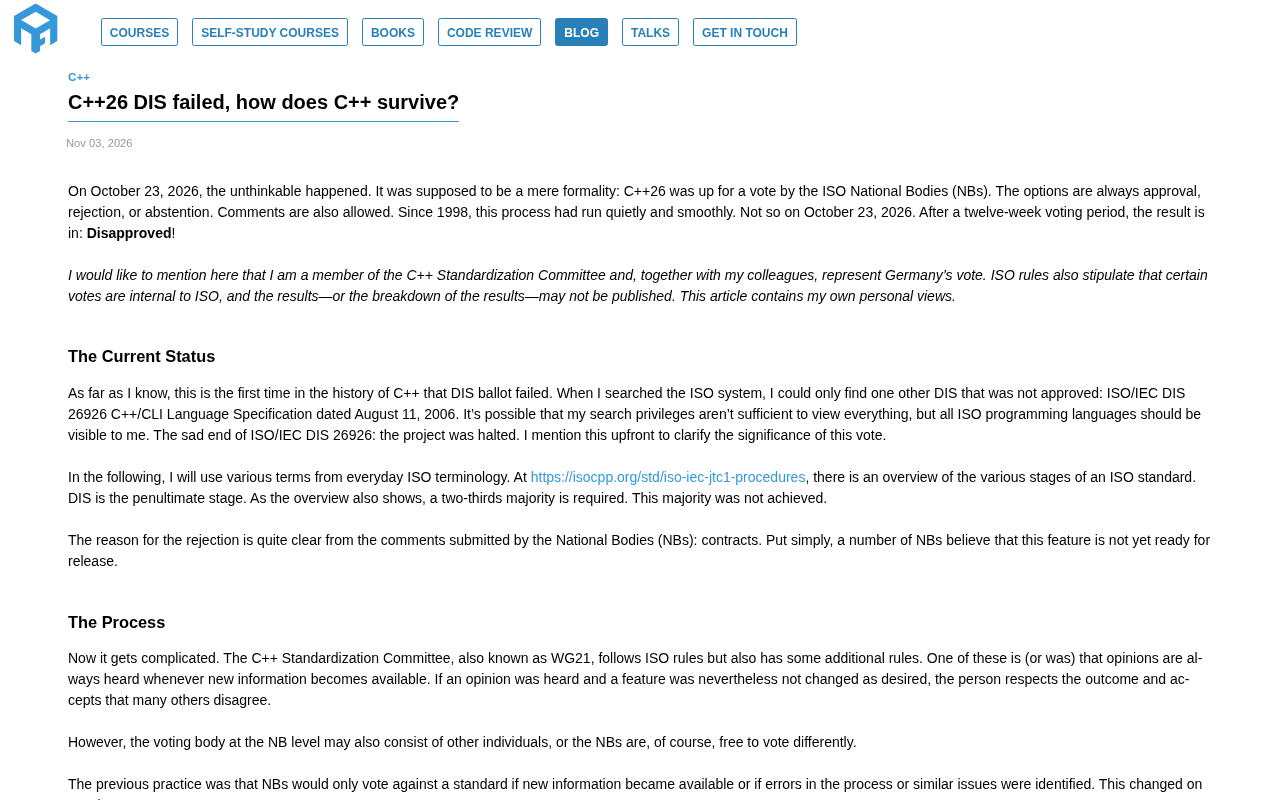
A report from a tech blog has stirred up quite a discussion in the developer community: the C++26 standard draft failed to pass the voting stage. The discussion on Hacker News quickly accumulated 286 points and 171 comments, demonstrating how closely the C++ community watches the direction of the standard. Rather than "some feature got cut," this rejection touches on a deeper issue—how should a language standard with decades of history, driven by committee consensus, maintain its vitality in a rapidly changing technical environment?
Behind the Rejection: A Debate Over "Who Gets to Decide"
According to the title of Andreas Fertig's blog post, "C++26 Disapproved: How Does C++ Survive?", this rejection is not aimed at a single technical detail but is a public challenge to the entire standard-setting process. The evolution of the C++ standard has long relied on voluntary collaboration within the WG21 committee, requiring multiple rounds of discussion, voting, and wording refinement from proposal to finalization. This mechanism ensures the language's stability and backward compatibility, but it also makes the decision cycle lengthy and unpredictable.
The density of 171 comments on Hacker News shows that the community's disagreements are far from trivial. Some developers believe the rejection reflects the committee's commitment to a quality baseline—better to delay than to introduce changes that could break the ecosystem. Others worry that frequent procedural deadlocks will leave compiler vendors and library authors uncertain about how to proceed, thereby weakening C++'s competitiveness in the systems programming domain.
The "Consensus Trap" of Standard-Setting
The C++ committee adopts a consensus-driven decision-making model, where any significant proposal needs to accumulate sufficient support through face-to-face meetings and electronic voting. The advantages of this model are obvious: it prevents powerful vendors from unilaterally pushing self-serving features. But the cost is that when the community cannot form an overwhelming consensus on a certain direction, the release pace of the entire standard gets held up. The fate of C++26 is a microcosm of this structural contradiction.
What Is WG21
WG21 is the official designation of the C++ standards committee working group under the International Organization for Standardization (ISO) and the International Electrotechnical Commission (IEC), with the full name ISO/IEC JTC1/SC22/WG21. It consists of volunteers from compiler vendors, academic institutions, and industry, responsible for proposal review and text compilation of the C++ language standard. WG21 has multiple sub-working groups (such as Core Language CWG, Library LWG, Concurrency SG1, etc.), and proposals are submitted with Paper numbers (such as P2300) and advanced level by level. A proposal typically goes through a complete chain from SG discussion, EWG/LEWG direction confirmation, to LWG/CWG wording refinement, and is ultimately decided by a plenary vote on whether to include it in the standard draft. Understanding this hierarchical structure helps clarify why the rejection of a single proposal often affects the entire release pace.
What It Means for Developers
Standard delays or rejections first affect frontline developers' technology choices. For teams relying on the latest language features, if a long-awaited feature gets stuck, they can only continue using compiler extensions or third-party libraries to fill the gap in the short term. This not only increases the portability risk of the code but also makes teams more hesitant when upgrading their toolchains.
From an ecosystem perspective, the uncertainty of the standard amplifies differences between compiler implementations. Mainstream compilers usually provide experimental support before the standard is finalized, but once the standard's direction changes, these implementations need to be rolled back, and early adopters may face migration costs. For enterprises that use C++ as a long-term infrastructure language, this volatility is a real engineering burden.
Two Sides of Community Sentiment
Interestingly, the Hacker News discussion contains both criticism of process efficiency and defenses of the committee's cautious attitude. Some commenters pointed out that C++'s complexity means any hasty standard change could bring unpredictable chain reactions, and rejecting a controversial proposal may be more responsible in the long run than forcing it through. This view forms a sharp contrast with the demand for "efficiency first," and also shows that the community has not reached a unified definition of a "good standard."
The Timing Relationship Between Standard Finalization and Compiler Implementation
C++ standards typically span more than a year from Committee Draft to official release, during which mainstream compilers (GCC, Clang, MSVC) provide experimental support based on the draft, exposing new syntax through compilation options like -std=c++2c or feature test macros. This approach allows developers to try things out early, but it also means implementations may lag behind proposal revisions. Once the standard's direction changes, experimental implementations that have already landed need to be rolled back or have their semantics modified, and early adopters' code may fail to compile or behave differently. Therefore, the uncertainty of the standard not only affects the committee internally but also directly translates into migration costs for toolchain maintainers and enterprise users.
What Keeps C++ Alive
Returning to the question raised by Andreas Fertig: how should C++ survive? Several clues can be read from this incident.
First, the transparency of the standard process needs to be improved. Developers not only want to know "what passed" but also want to understand the trade-off logic behind decisions. When a rejection occurs, if the committee can clearly explain the points of disagreement and the subsequent roadmap, the community's anxiety will be significantly reduced.
Second, continuous refinement of already-landed features such as modules and concepts may do more to consolidate C++'s foundation than chasing new proposals. A language's competitiveness comes not only from new syntax but also from toolchain maturity and clarity of migration paths.
Third, C++'s alternatives are growing in number. The offensive of languages like Rust in the systems programming domain makes the C++ community particularly sensitive to "stagnation." But conversely, C++'s massive existing codebase and performance advantages remain irreplaceable assets, and the debate over the pace of standard evolution is essentially a long-term game between "stability" and "speed."
This rejection may not necessarily be a bad thing. It brings a long-avoided question to the table: how can a consensus-based standards organization maintain caution while not letting the process itself become an obstacle to language progress? The answer will not be revealed in a single vote, but the discussion itself is already part of the C++ community's self-correction.
One-line Summary
C++26 standard draft rejected in a vote, sparking intense community discussion about the WG21 consensus mechanism and the language's future.
Paragraph Summary
The C++26 standard draft failed to pass the voting stage, and the discussion on Hacker News quickly heated up to 286 points and 171 comments. This rejection is not aimed at a single technical detail but exposes the structural contradiction of the WG21 consensus-driven decision-making model: caution and efficiency are hard to achieve simultaneously. The uncertainty of the standard will transmit to compiler vendors and frontline developers, increasing migration and portability costs. Community evaluations are polarized: some praise the committee's commitment to a quality baseline, while others worry that procedural deadlocks will weaken C++'s competitiveness. Citing Andreas Fertig's question, the article proposes three survival clues: improving process transparency, refining already-landed features, and responding to competition from languages like Rust.
Related articles

How Cold and Heat Exposure Activate Brown Fat to Improve Metabolism: Dr. Søberg's Research Explained
Dr. Søberg on Huberman Lab explains cold-heat exposure and metabolic health: how brown fat is activated by temperature changes, the dosing basis for 11 minutes of cold water and 57 minutes of sauna weekly, and the Søberg principle of ending with cold.

Claude Code Cracks AirPods 3 Head Tracking Protocol, Linux User Successfully Controls Mouse with Earbuds
Developer uses Claude Code to reverse engineer the AirPods 3 head tracking protocol, discovers it differs from the Pro model, and that Linux hid the sensor due to Bluetooth packet size settings. After adjustment, data streams at 200Hz, with results open-sourced as the mousepods project.

RadianX Perovskite Solar Cells: Making Charging a Thing of the Past?
RadianX claims its perovskite solar cells can free some portable devices from charging. We analyze the technical basis, real-world limits, and likely low-power use cases, noting stability and mass-production data remain unverified.