RadianX Perovskite Solar Cells: Making Charging a Thing of the Past?

RadianX says perovskite cells can end charging for some portable devices, but public evidence is thin and deployment remains unverified.
RadianX proposes perovskite solar cells to completely free some portable devices from charging, but public information offers only directional claims—no efficiency, product form, or mass-production timeline. The article explains why traditional photovoltaics output only a trickle indoors, notes perovskite's theoretical edge in low light and flexible thin forms, yet flags long-term stability as an industry-wide hurdle. Engineering-wise, "never needs charging" requires cell output to cover average device power, low device power draw, and matching lifespans. Milliwatt-level IoT sensors and wearables are likelier early beneficiaries than phones; efficiency, low-light performance, and stability data are key indicators.
Title
RadianX Perovskite Solar Cells: Making Charging a Thing of the Past?
Meta Description
RadianX claims its perovskite solar cells can free some portable devices from charging. This article examines the technical basis, real-world limits, and plausible low-power use cases, and notes that stability and mass-production data remain key unverified factors.
Article Content
Almost everyone suffers from battery anxiety with portable devices—phones, earbuds, sensors; charging once or even several times a day has become the norm. A company called RadianX has put forward a rather bold claim: use perovskite solar cells to eliminate charging entirely for some devices.
It should be noted that publicly available information is quite limited. RadianX's core promise comes from a highly condensed statement: today's portable devices consume too much power for traditional solar panels to keep up, while its perovskite cells could, in some scenarios, make charging unnecessary. As for specific product form factors, conversion efficiency, and mass-production timelines, the original material discloses none of these.
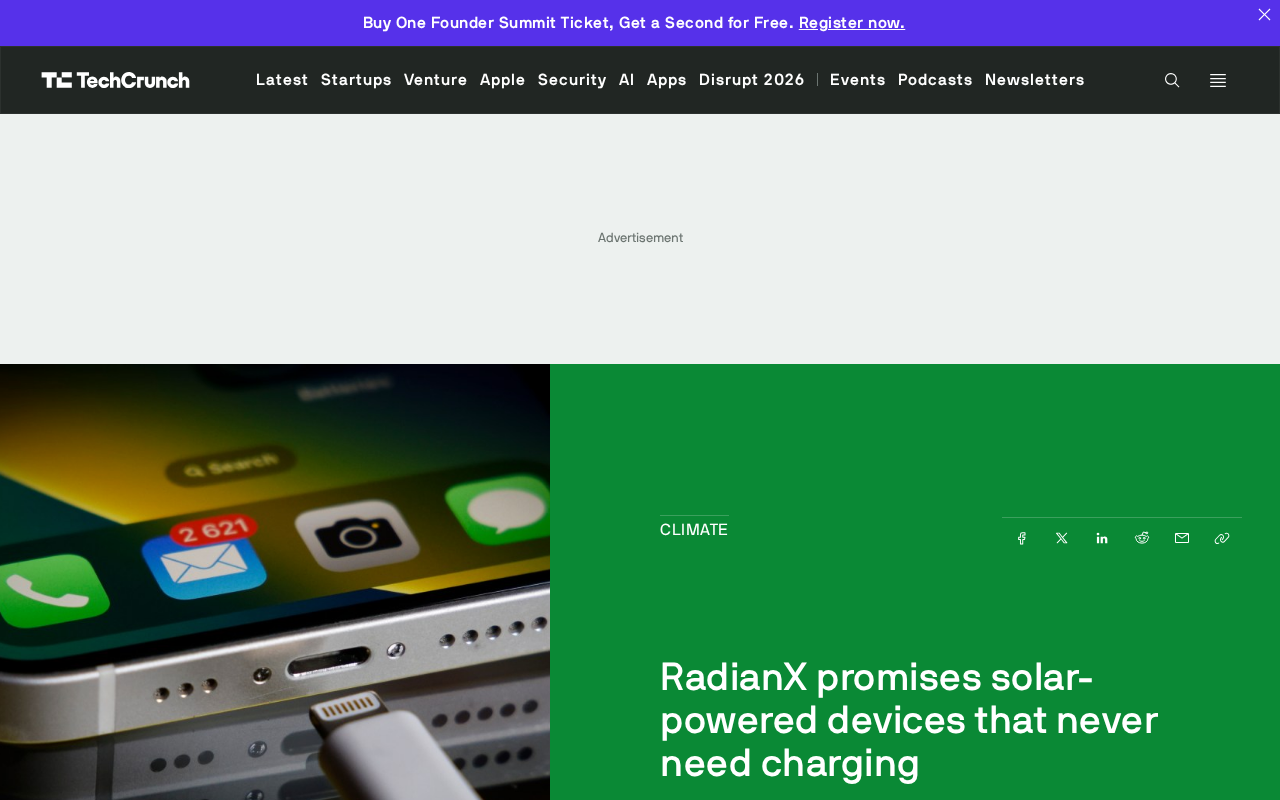
Why Traditional Solar Panels Can't Keep Up with Portable Devices
To understand RadianX's angle, you first need to look at the awkward position of traditional photovoltaics in small devices. Indoor light intensity is typically only a few hundredths of sunlight, while portable devices draw considerable power. Combined, the result is that traditional solar panels indoors often provide only a trickle that is barely worth mentioning.
Perovskite materials are highly anticipated because they respond relatively well to low light and can be made into flexible, thin forms, making them theoretically better suited for embedding into the casings of small devices. RadianX's claim is built precisely on this material property: not to keep devices away from power sources, but to redefine "power supply" under specific conditions.
Perovskite materials are a class of compound semiconductors with an ABX₃ crystal structure, where the A site is typically an organic cation (such as methylammonium or formamidinium), the B site is a metal cation (such as lead or tin), and the X site is a halide ion. This structure gives them a tunable direct bandgap, enabling efficient absorption of photons from the visible to near-infrared range. Compared with crystalline silicon, perovskite thin films are prepared at lower temperatures, with shorter process flows, and can be deposited on flexible substrates—which explains why they are seen as a candidate material for lightweight photovoltaics. In recent years, lab-scale small-area cell conversion efficiency has risen from about 3.8% to over 26%, approaching the level of crystalline silicon. However, the commercialization bottleneck is not efficiency but environmental stability—moisture, oxygen, ultraviolet light, and thermal stress all cause material degradation, making encapsulation technology critical.
Technical Optimism and Uncertainty Behind the Promise
"Never needs charging" is an extremely strong statement. From an engineering perspective, it must simultaneously satisfy at least three conditions: the cell can continuously output the device's average power consumption under the target lighting environment, the device itself has sufficiently low power consumption, and the cell lifespan matches the device lifespan. If any link fails, the promise shrinks to "reduced charging frequency."
Perovskite itself also has this shortcoming that needs no elaboration—long-term stability. Lab efficiencies keep hitting new highs, but scaled reliability validation for consumer electronics remains a challenge shared by the entire material system. RadianX has not addressed these details in public information, which is both a suspense and a key observation point for judging its quality.
Matching device average power consumption with cell output power under lighting conditions is the fundamental calculation for judging self-powering feasibility. Take an indoor office environment as an example: illuminance is about 300–500 lux, only a few thousandths of standard sunlight (about 100,000 lux). A business-card-sized traditional amorphous silicon cell under these conditions often outputs less than 100 microwatts, while a Bluetooth Low Energy chip's average power during intermittent operation is typically in the range of tens of microwatts to several milliwatts. If device power consumption exceeds cell output, it must rely on energy storage components (such as micro lithium capacitors or solid-state batteries) for buffering, thereby forming an intermittent power supply模式 of "charge during the day, discharge at night." The so-called "never needs charging" actually requires that the cell's daily power generation under target lighting continuously cover the device's average daily power consumption, plus additional compensation for storage degradation—a system-level constraint far more demanding than simply lighting an LED once.
Where Such Products Could Realistically Land
Compared with high-power devices like phones, low-power scenarios are more likely to benefit first: IoT sensors, smart labels, wearable health monitoring modules, remote-control peripherals. These devices typically consume milliwatts, tolerate lighting conditions better, and are more receptive to the power-supply logic of "install it and forget it."
From this perspective, RadianX's narrative is closer to the long-term vision of "passive devices" rather than fitting a solar back panel to a flagship phone. If it can prove that perovskite's degradation curve in real environments is acceptable, then there is indeed room to rewrite the power supply for edge devices and distributed sensor networks.
Passive devices refer to electronic nodes that do not rely on the grid or periodic battery replacement, instead harvesting energy from the environment to operate. Energy sources include photovoltaics, radio frequency, thermoelectrics, and vibration, among which photovoltaics is the most mature for indoor scenarios. Passive IoT labels (such as electronic shelf labels and asset-tracking patches) are designed to push average power consumption down to the microwatt level and keep devices asleep most of the time through duty-cycle control. If perovskite cells can stably output a power density of tens of microwatts per square centimeter under indoor low light, they have a chance to replace button cells in such devices. This route also competes with mature amorphous silicon and dye-sensitized cells, the latter two having lower efficiency but long-validated stability. Therefore, for perovskite to win, it must present convincing curves on both lifespan and cost.
Conclusion: Intriguing Concept, Awaiting Evidence
RadianX's proposition is worth attention, but for now it is closer to a directional statement than a verifiable product promise. For practitioners focused on photovoltaic materials and low-power hardware, the milestones worth tracking are clear: conversion efficiency, low-light performance, stability data, and the categories of the first deployed devices. Until then, cautious optimism is the more appropriate attitude.
One-line Summary
RadianX claims perovskite cells can free some portable devices from charging, but public evidence is limited and real-world deployment remains unverified.
Paragraph Summary
RadianX proposes using perovskite solar cells to completely free some portable devices from charging, but public information contains only directional statements, lacking key data such as efficiency, product form factors, and mass-production timelines. The article analyzes why traditional photovoltaics output only a trickle under indoor low light, and notes that perovskite has theoretical advantages thanks to its low-light response and flexible, thin form—yet it also faces the industry-wide challenge of long-term stability. From an engineering perspective, "never needs charging" requires simultaneously satisfying three conditions: cell output covering the device's average power consumption, low device power consumption, and cell lifespan matching device lifespan—any missing link shrinks the promise. The article concludes that milliwatt-level low-power devices such as IoT sensors and wearable monitors are more likely to benefit first than phones, and that conversion efficiency, low-light performance, and stability data are key indicators for judging the promise's credibility.
Related articles

DeepSeek Harness Quick Start Guide: From Installation to 5 Real-World Cases
What is DeepSeek Harness? Based on a Bilibili tutorial, this article covers how this AI Agents software works, installation and setup, four working modes, and five real-world cases: a 3D racing game, official website, music player, science animation, and self-developed plugin—plus token money-saving tips.

Breaking Down DeepSeek's Super-agent Architecture: How Router+Worker Solves the Multi-Session Management Bottleneck
An analysis of DeepSeek's Super-agent paper: how the Router+Worker two-tier architecture uses Fast Pass, Chain of Recall, and storage-compute separation to solve multi-AI-session management bottlenecks, and how much it truly alleviates the human attention bottleneck and what engineering trade-offs it makes.

19K Stars in 5 Days: Why DeepSeek's Open-Source AI Programmer Went Viral
DeepSeek's open-source AI programmer hit 19K GitHub stars in 5 days. Why it went viral: the agent boom, AI writing its own code, and the shift from Q&A tools to AI employees.