Cal.com v7 Major Update: Events, Discover, and AI Assistant Launch Together

Cal.com v7 releases Events, Discover, and Cal.ai Assistant, shifting from a scheduling tool to a comprehensive scheduling platform.
Cal.com released v7 on Product Hunt, launching three products—Cal.com Events, Cal.com Discover, and Cal.ai Assistant—with a new brand identity. Events expands from one-on-one booking to event organization, Discover introduces a public discovery layer, and Cal.ai Assistant brings AI into schedule management. Together they form a "production–distribution–intelligent coordination" chain, marking Cal.com's transition from an open-source Calendly alternative to a comprehensive scheduling platform. The launch received 86 votes, ranking 7th on the day, but feature details and AI boundaries are not yet public.
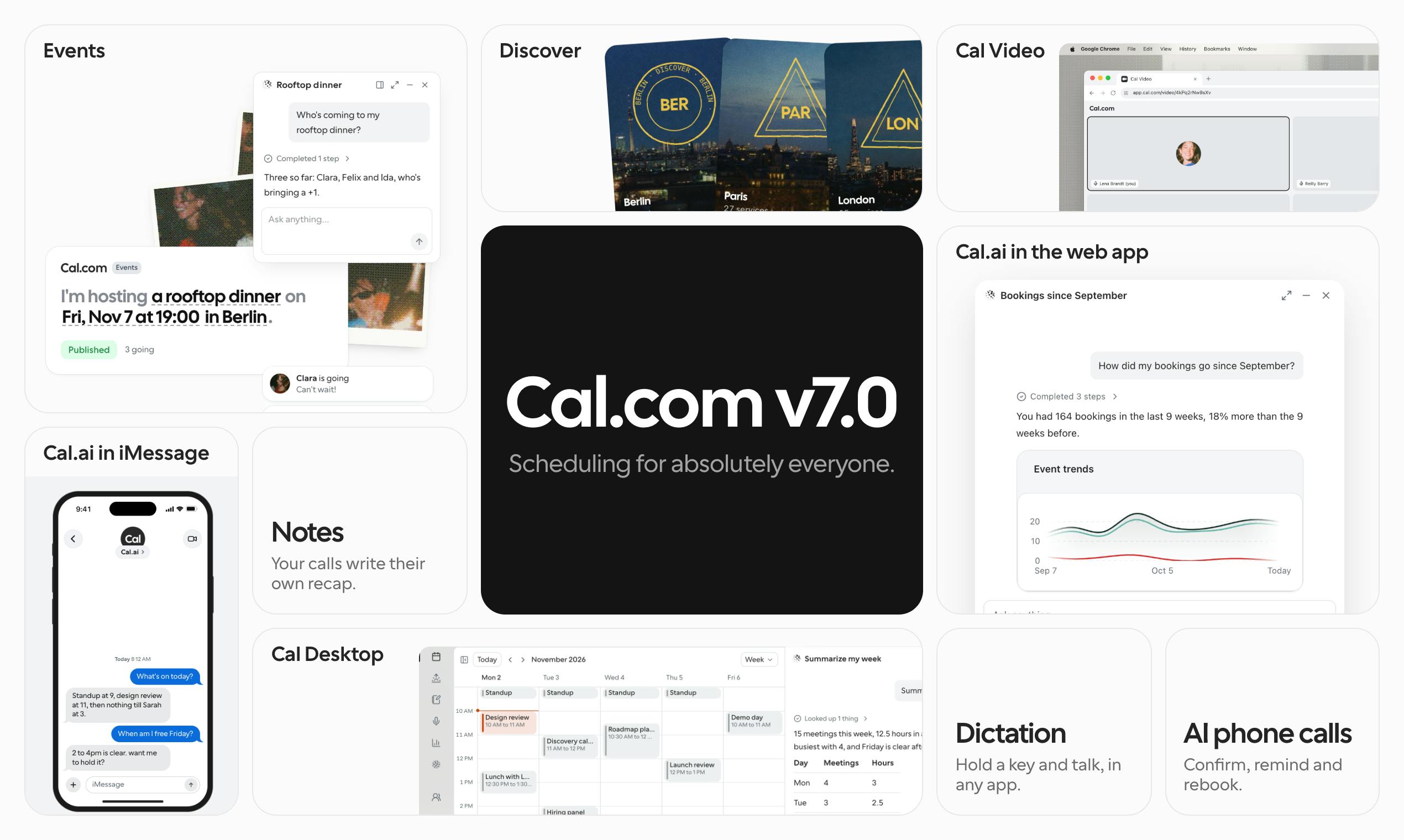
Cal.com has released its v7 major version on Product Hunt, launching three new products at once—Cal.com Events, Cal.com Discover, and Cal.ai Assistant—along with a refreshed brand identity. The launch post received 86 votes, ranking 7th on the day's leaderboard. Although there are only 5 comments, the discussion centers on the logic behind the product line expansion. For a tool that started as open-source scheduling, this marks a shift from a single-point "meeting booking" tool toward a more complete scheduling and event collaboration platform.
From Scheduling Tool to Event Platform: Cal.com Events Arrives
Cal.com first became known among developers for providing self-hostable scheduling infrastructure that can replace closed-source services like Calendly. The most notable addition in v7 is Cal.com Events—it extends capabilities from "one-on-one meeting booking" to "event organization."
This means users can create event pages, manage registrations and schedules, rather than just sharing a booking link. For users who frequently organize online sharing sessions, community meetups, or team workshops, this reduces the cost of switching between multiple tools. How Events integrates with the existing calendar system is key to judging its practicality: if event schedules can flow directly into participants' calendars, then it truly integrates into workflows rather than being just another isolated event page.
Cal.com's core open-source model deserves elaboration: it uses the AGPLv3 license, allows enterprises to self-host, and gives full data autonomy, which has given it a differentiated advantage in privacy-sensitive industries and developer communities. Compared with closed-source SaaS like Calendly, Cal.com offers APIs, Webhooks, and embeddable components for easy integration into existing systems. The v7 Events feature is built on this foundation—it reuses the existing calendar connectors (Google Calendar, Outlook, etc.) to link event registration with schedule synchronization, avoiding the disconnect between event management and personal calendars.
Discover: Giving the Scheduling Platform a Discovery Dimension
Cal.com Discover is positioned more toward platformization. It attempts to add a "discovery" step before the booking action, allowing users to browse and find events to join or service providers to book.
This is an ambitious direction. Traditional calendar tools are purely private and purely utilitarian, while Discover introduces a layer of public content distribution. The challenge is obvious: a discovery mechanism needs sufficient supply density to work, otherwise the page will look empty. Whether Cal.com can quickly accumulate content through its open-source community and event organizers will determine whether Discover becomes a real traffic gateway or remains at the level of brand narrative.
From a product logic perspective, Events is responsible for producing content, and Discover is responsible for distributing it; the two support each other. This "tool + marketplace" combination is not uncommon in SaaS, but in the open-source calendar space, Cal.com is a relatively early mover.
The "tool + marketplace" model has precedents in SaaS, such as Shopify expanding from a website-building tool to an app marketplace, and Fiverr evolving from service listings to a transaction platform. The core challenge is solving the cold-start problem: the platform needs enough supply (events or service providers) first to attract demand. Cal.com's Discover can leverage its open-source community and existing event organizer network to accumulate initial content, but ensuring content quality and activity remains difficult. In addition, the discovery layer needs to seamlessly connect with the booking process; otherwise, users may jump to other platforms to complete transactions.
Cal.ai Assistant: Bringing AI into Schedule Management
Among the three launches, Cal.ai Assistant has the most direct connection to the AI field. Officially, it is positioned as an intelligent assistant that helps users handle schedule-related tasks.
Given Cal.com's product form, the most natural role for an AI assistant is to reduce communication friction during scheduling—for example, understanding vague time preferences, helping organize event information, and simplifying repeated confirmations in the booking process. Product Hunt categorizes this product under Meetings, Calendar, and Artificial Intelligence simultaneously, confirming that AI is one of its core selling points.
That said, the original launch information did not disclose the assistant's specific capability boundaries, model selection, or integration approach. For readers interested in AI application implementation, these details are worth further verification in subsequent official documentation or hands-on trials. Whether the AI assistant can truly reduce scheduling back-and-forth rather than adding a new interaction layer that users must learn is the dividing line for its success.
The technical implementation of an AI scheduling assistant typically involves natural language processing (NLP) and calendar API integration. For example, by parsing time intentions in user emails or messages, it can automatically suggest meeting times and generate booking links. Cal.com's AI assistant may be based on a large language model (LLM) to enable multi-turn conversations, but the official announcement did not disclose the specific model or whether self-hosting is supported. For enterprise users, data privacy and model controllability are key considerations—if AI processes schedule data, the data flow and compliance must be clarified. These details will affect the assistant's adoption in the open-source community.
Synergy Between the New Brand and Product Line
v7 also completes a brand refresh. Packing three new products plus a visual identity system into a single launch shows that Cal.com is redefining its category: it is no longer just "an open-source Calendly alternative," but aims to cover the entire chain from discovering events and organizing events to intelligent coordination.
This expansion also brings trade-offs. As the product line broadens, the maintenance effort for the open-source version, the degree of data integration between modules, and the learning curve for new users will all be tested. 86 votes and 5 comments indicate that this launch received basic exposure on Product Hunt, but real reputation will depend on user feedback after hands-on use.
Key Takeaways
- Events completes the event organization capability, the core addition of this update, expanding Cal.com's use cases.
- Discover attempts to introduce a public discovery layer; its success depends on supply density—a typical platform bet.
- Cal.ai Assistant brings AI into schedule management; the direction is reasonable, but specific capability details are not yet public.
- Brand refresh and three products launched together indicate that Cal.com is moving from a single scheduling tool to a comprehensive scheduling platform.
For teams already using Cal.com, the direct value of v7 is a more complete event management chain; for users still evaluating, it is worth doing a small-scale trial around Events and the AI assistant first, then deciding whether to migrate core scheduling workflows over.
One-line Summary
Cal.com v7 launches Events, Discover, and Cal.ai Assistant, shifting from a scheduling tool to a comprehensive scheduling platform.
Paragraph Summary
Cal.com released its v7 major version on Product Hunt, launching three new products—Cal.com Events, Cal.com Discover, and Cal.ai Assistant—along with a refreshed brand identity. Events extends capabilities from one-on-one meeting booking to event organization, Discover attempts to introduce a public discovery layer, and Cal.ai Assistant brings AI into schedule management. Together they form a "content production–content distribution–intelligent coordination" chain, marking Cal.com's transformation from an open-source Calendly alternative to a comprehensive scheduling platform. The launch received 86 votes, ranking 7th on the day, but specific feature details and AI capability boundaries are not yet public, and real reputation awaits user validation.
Related articles

RePlan-VLA: Progress-Aware Replanning Breakthrough for Long-Horizon Robotic Manipulation
The RePlan-VLA framework converts VLA models' short-horizon capabilities into reliable long-horizon execution through progress-aware adaptive replanning, improving success rates by 21.9% and 10.4% on RoboCasa365 and CALVIN, and validating real-world deployment on a Franka Research 3 robot.

Geometric Bridge Flow Matching: A New Breakthrough in Blind Rigid Motion Correction
Geometric bridge flow matching enables blind rigid motion correction in head CBCT, achieving 37.1 dB PSNR and 0.27 mm RPE on simulated data in ~9.1 minutes, outperforming existing methods.

Google Releases Gemini 4 Hydrogen: 2.5x Faster Without Sacrificing Intelligence
Google releases the lightweight Gemini 4 Hydrogen: 2.5x faster task completion, AA Intelligence Index of 54 beating its flagship sibling, 7.3s single-step on Agent Arena faster than Claude and GPT rivals, four thinking levels with pay-as-you-need pricing, now available across AI Studio and more.