Calendly's AI Transformation: From Scheduling Tool to Full Meeting Lifecycle Platform

Calendly launches AI products to evolve from scheduling tool to full meeting lifecycle platform.
Calendly has unveiled two AI products—Notetaker for automated meeting notes and Callie as a full-lifecycle intelligent assistant—marking its strategic shift from a standalone scheduling tool to an AI productivity platform covering pre-meeting, in-meeting, and post-meeting workflows. Leveraging its unique metadata advantage as the scheduling gateway, Calendly aims to differentiate from competitors like Otter and Zoom AI Companion, though it faces challenges from market saturation, tech giant competition, and data privacy concerns.
From Scheduling Tool to Full Meeting Lifecycle Assistant
When most people think of Calendly, they picture that handy tool for solving the age-old problem of "when are you free?" You send a link, the other person picks a time, and the meeting lands on your calendar—simple, efficient, but that's where it ends. Now, Calendly is trying to break through that boundary.
Calendly was founded in 2013 by Nigerian-American entrepreneur Tope Awotona, headquartered in Atlanta, USA. The company reached a valuation of approximately $3 billion during its Series D funding round in 2021 and boasts over 20 million users. Its success stems from addressing an extremely common pain point: coordinating meetings across time zones and organizations often requires multiple rounds of email back-and-forth, while a simple availability link compresses that entire process into a single click. Built around a freemium model, the free tier covers basic scheduling needs, while paid tiers offer team collaboration, CRM integrations, and other advanced features.
On Product Hunt, the all-new Calendly made its official debut with 115 upvotes, ranking 4th on the daily leaderboard. Its core tagline says it all: "Handle all of the work before, during, and after meetings." This marks Calendly's transformation from a standalone scheduling tool into an AI productivity platform covering the entire meeting lifecycle.
The meeting lifecycle refers to the complete workflow surrounding a meeting from initiation to post-meeting follow-up: pre-meeting scheduling coordination, agenda preparation, and attendee background research; in-meeting real-time note-taking, key point capture, and action item tagging; post-meeting summary distribution, task assignment, CRM updates, and follow-up actions. Research shows that knowledge workers spend an average of approximately 11.5 hours per week in meetings, while the preparation and follow-up work surrounding those meetings often consumes equal or even more time.
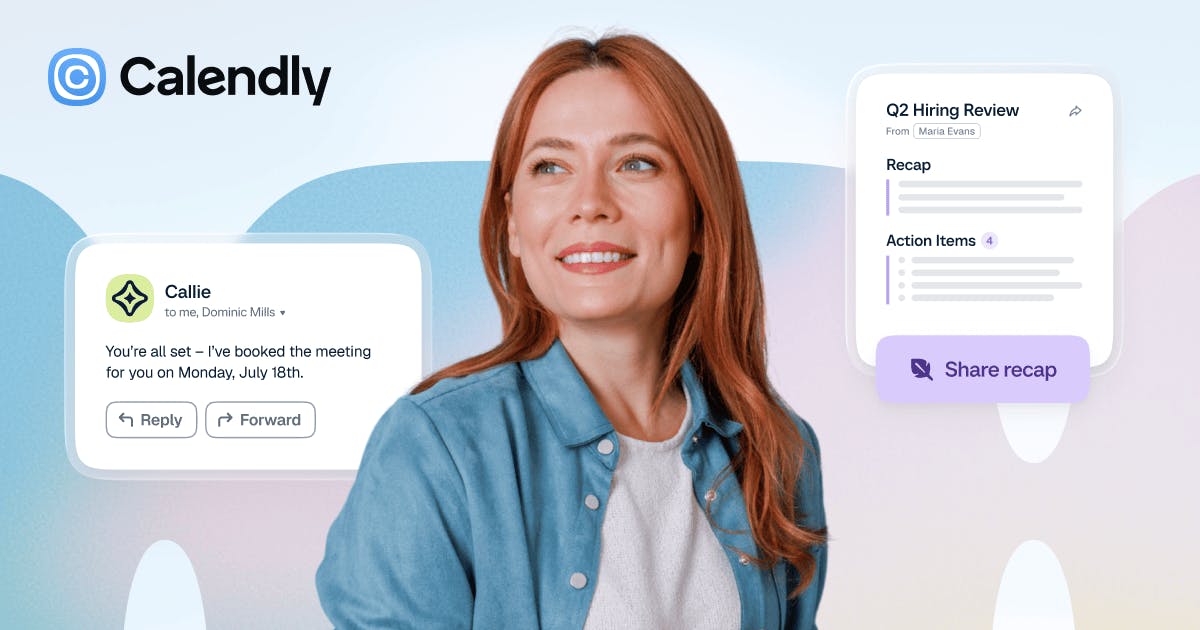
Founder Tope Awotona articulated the product logic in the launch: "Meetings are necessary, but the work that piles up around them is staggering." This statement precisely hits the pain point of knowledge workers—what truly drains energy is often not the meeting itself, but the preparation beforehand, the note-taking during, and the follow-up afterward.
Calendly's Two New AI Products: Notetaker and Callie
Calendly launched two AI products at once, forming the core of its new release.
Calendly Notetaker: AI Meeting Note Automation
The first is Calendly Notetaker (meeting note assistant). As the name suggests, it focuses on the "during meeting" phase, automatically recording meeting content and organizing key points. This frees attendees from the struggle of listening while frantically taking notes, and ensures meeting information isn't lost due to gaps in manual documentation.
From a technical implementation perspective, AI meeting note assistants typically involve multiple technology layers: Automatic Speech Recognition (ASR) converts audio streams into text in real time—current leading models like OpenAI's Whisper have achieved transcription accuracy approaching human levels; Speaker Diarization identifies and distinguishes different speakers; a Natural Language Processing layer extracts key topics, decision points, and action items from lengthy conversations; and finally, a generative AI layer uses large language models to restructure raw content into structured meeting summaries. The entire process involves engineering challenges such as real-time audio stream processing, low-latency inference, and multilingual support.
For sales professionals, customer success managers, and business development staff who attend multiple meetings daily, automated meeting summaries mean they can devote their full attention to the conversation itself rather than being distracted by typing.
Callie AI Assistant: An Intelligent Agent Spanning the Entire Meeting Lifecycle
The second is Callie AI Assistant, a more ambitious product. It's positioned as an intelligent assistant covering "before, during, and after meetings." Combined with Calendly's existing scheduling capabilities, Callie can theoretically help you prepare materials and agendas before meetings, assist with note-taking during meetings, and automatically generate follow-up tasks and summaries after meetings.
From a product categorization standpoint, the new Calendly covers multiple scenarios including Android, Chrome extensions, notes, meetings, and calendars—demonstrating its intent to connect multiple platforms and permeate entire workflows.
Why Calendly's AI Transformation Deserves Attention
The Inevitable Path from "Point Tool" to "Full-Workflow Platform"
Calendly's transformation isn't an isolated case—it's a textbook example of how SaaS tools are evolving today. Scheduling as a single feature is naturally susceptible to being absorbed by larger ecosystems (such as Google Calendar or Microsoft Outlook). If a point solution doesn't extend upstream and downstream, its moat will gradually erode.
In the SaaS industry, point solutions face a systemic risk known as "platform engulfment." When a feature is sufficiently universal and technically achievable, large platforms tend to offer it as a built-in feature for free—just as Google Calendar has already built in basic appointment booking functionality. This phenomenon is called "feature demotion," where an independent product is reduced to a sub-feature of a larger platform. Common countermeasures include deepening vertical industry focus, expanding into upstream and downstream workflows, building network effects and ecosystem barriers, or establishing brand loyalty through exceptional user experience.
By extending its capabilities to "before and after meetings," Calendly is effectively redefining its value boundary—upgrading from "helping you book a meeting" to "helping you run meetings well and follow through." This is a strategic leap from feature to workflow.
AI Technology Makes Capability Expansion Possible
Here's a key detail: the technological foundation for this expansion is AI. Tasks like meeting recording, content summarization, and task extraction were difficult to automate before large language models matured—they typically required significant human effort. Today, AI Notetaker products have formed a fiercely competitive market segment—Otter, Fireflies, Zoom AI Companion, and others are all vying for this space.
Calendly's differentiating advantage lies in its gateway position: as the scheduling starting point for meetings, it naturally possesses meeting metadata (who, when, and why the meeting is happening), providing the AI assistant with richer context than pure recording tools can offer.
It's worth understanding what "metadata advantage" really means here. In meeting scenarios, metadata includes attendee identities and their organizational roles, meeting type (initial outreach/quarterly review/technical assessment, etc.), the business context behind the meeting invitation, historical interaction records, and more. This information is critical for AI to generate high-quality outputs. For example, when AI knows this is a sales demo meeting, it can automatically focus on objections and needs raised by the customer; when it understands the seniority levels of attendees, it can adjust the level of detail in the summary. Pure audio transcription tools require users to provide this context separately, whereas Calendly as a scheduling gateway naturally possesses this structured information—forming its data-layer differentiation, often called the "data flywheel" effect.
When scheduling, recording, and follow-up are integrated into a single platform, user switching costs and data fragmentation issues are also reduced.
Competitive Landscape and Potential Challenges Facing Calendly
Despite a clear strategic direction, Calendly still faces significant challenges.
First is a crowded market. AI meeting assistants are already a red ocean, and as a latecomer, Calendly needs to prove its product experience is outstanding enough—not just "a recording feature tacked on as an afterthought."
Second is pressure from tech giants. Zoom, Microsoft, and Google are all natively integrating AI meeting capabilities. These platforms are both the venues where meetings take place and possess massive user bases and data resources. For Calendly to establish independent value in the gaps between these giants will test the depth of its product refinement and ecosystem integration.
Finally, there's user trust. Having AI participate in meeting recording means sensitive business conversation data must be processed by a third party—privacy and compliance will be unavoidable topics.
Specifically, AI participation in meeting recording involves multiple layers of privacy and compliance challenges. Regarding recording consent, different jurisdictions have different requirements—some U.S. states (like California) require two-party consent, while the EU's GDPR imposes strict legal basis requirements for personal data processing. Regarding data storage, meeting content may contain trade secrets, personal health information, or financial data, requiring compliance with frameworks such as HIPAA, SOC 2, and ISO 27001. Additionally, users are broadly concerned about whether their meeting content is being used to train AI models, and enterprise customers typically require data residency options and end-to-end encryption. These are all issues Calendly must clearly address and resolve as it expands into the enterprise market.
Conclusion
The launch of the new Calendly is a clear signal of scheduling tools evolving into AI productivity platforms. As Tope Awotona stated, the hidden work surrounding meetings is being progressively taken over by AI, allowing users to "focus on what truly matters."
For everyday users, this may mean meetings will become less burdensome in the future. For industry observers, this represents a classic case study of "a point tool leveraging AI to expand across the full workflow." Whether Calendly can succeed on this path depends on the actual experience delivered by Notetaker and Callie, and whether it can defend its unique position as the "meeting gateway."
Related articles

DeepCell: One-Click AI Generation of Documents, Spreadsheets, and Slides
DeepCell tops Product Hunt with one-click generation of documents, spreadsheets, and slides, using the .deepcell format for linked updates, designed for System 2 tasks like modeling and sales reviews.

Doneas: 15-Minute Daily Accountability Calls That Keep Indie Developers From Procrastinating
Doneas is a daily accountability tool for indie developers: plan tasks on Monday, join a 15-minute call with five builders each day, and log deliveries on a public progress page. This article analyzes its core mechanics, effectiveness, and potential issues around retention and matching.

Fastlane 2.0: Fully Automated AI Ad Campaigns, From Creative to Optimization
Fastlane 2.0 is an AI ad automation tool: enter your website and it learns your brand, generates video and image ads, and runs and optimizes them on Meta, TikTok, Instagram, and YouTube.