Calibra v0.7.1: A Detailed Guide to Pre-Training Data Integrity Detection for Robot Learning

Calibra v0.7.1 detects data integrity issues in robot learning datasets before training begins.
Calibra v0.7.1 introduces a new integrity workflow for robot learning that catches data problems—timestamp anomalies, motion jitter, camera frame defects, and incomplete episodes—before training starts. Supporting LeRobot v1, HDF5/Isaac Lab, and robomimic formats, it helps teams establish data trust, reduce debugging costs, and avoid wasted compute on flawed datasets.
A Tool Philosophy Starting from "Can We Trust the Data?"
In the field of robot learning, an easily overlooked yet critical question is: can the training data actually be trusted? The author of the open-source tool Calibra distilled an interesting insight during development—before robot teams ask "is the dataset quality good enough," they tend to ask a more fundamental question first: "Can I trust this dataset?"
This insight may seem simple, but it strikes at the heart of robot learning engineering practice. Compared to traditional image classification or text tasks, robot data (especially demonstration data in imitation learning and reinforcement learning) is structurally complex with numerous modalities, involving timestamps, joint trajectories, multi-camera feeds, and more. Any issue in any component can silently contaminate the entire training process.
Imitation Learning is one of the core paradigms in robot learning. The basic idea is to let robots learn task execution strategies by observing human expert demonstrations, rather than through trial-and-error exploration as in reinforcement learning. Demonstration data is typically collected by human operators through teleoperation devices, motion capture systems, or directly guiding robot joints by hand. This type of data is inherently multimodal—at any given moment, it needs to record visual frames, force/torque sensor readings, joint angles and velocities, end-effector poses, and other multi-channel signals. Data quality directly determines whether the learned policy can execute stably in real environments, making data integrity verification particularly critical in this domain.
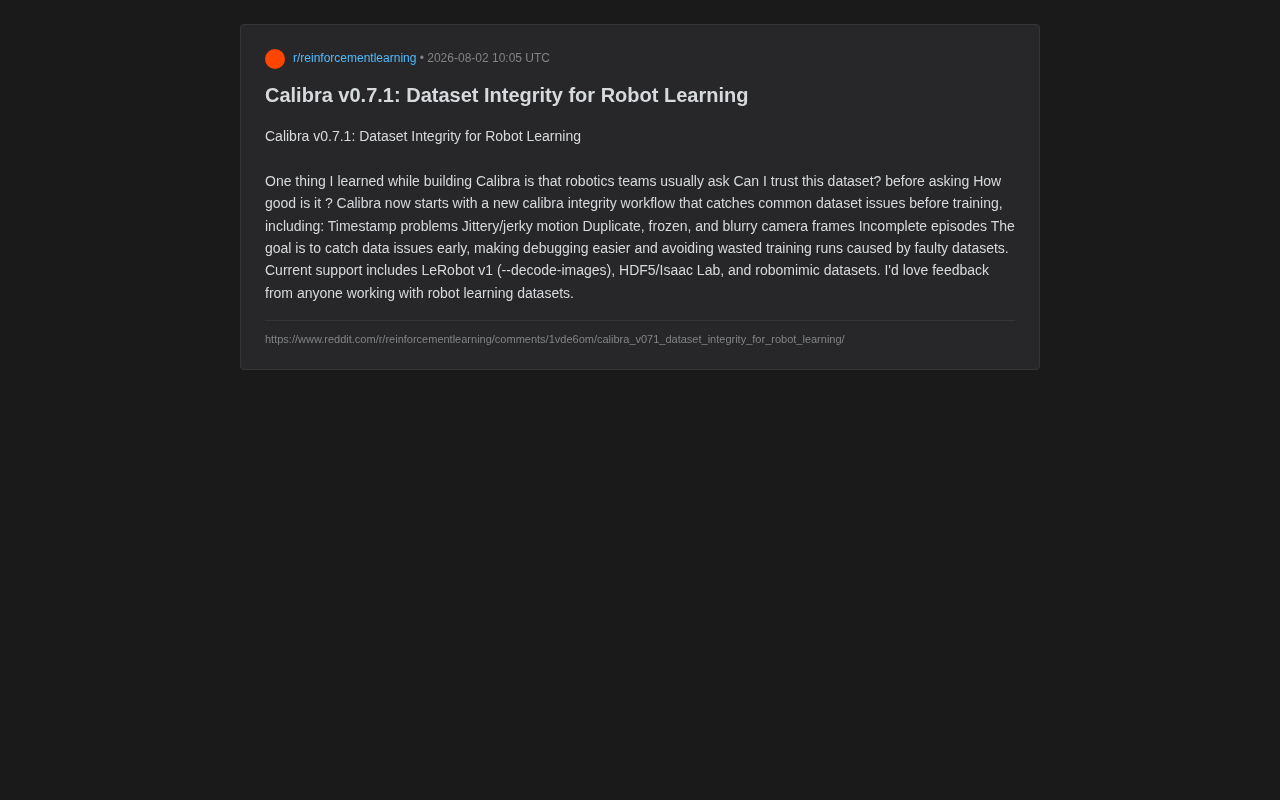
The newly released Calibra v0.7.1 addresses precisely this need, introducing a brand-new calibra integrity workflow aimed at catching common data problems before training begins.
What Robot Data Issues Can Calibra v0.7.1 Detect?
According to the author, the v0.7.1 integrity detection workflow can identify several categories of high-frequency yet subtle problems in robot datasets:
Timestamp Anomaly Detection
Robot data is typically collected by multiple sensors at different frequencies. Timestamp misalignment, jumps, or gaps directly break the correspondence between actions and observations. Calibra proactively scans for these temporal synchronization issues, preventing models from learning incorrect causal relationships.
In multi-sensor robot systems, different devices often run on different clocks and sampling frequencies—for example, cameras may capture at 30Hz, force sensors at 1000Hz, and joint encoders provide feedback at 500Hz. The core challenge of temporal synchronization is aligning these heterogeneous signals to a unified timeline. Common synchronization approaches include hardware trigger synchronization, NTP/PTP network time protocols, and interpolation alignment in post-processing. If timestamps exhibit drift, jumps, or loss, the model may associate visual observations from one moment with actions from another, leading to incorrect state-action mappings. Such problems are nearly impossible to detect by visual inspection in offline data and require systematic detection tools.
Jittery and Jerky Motion Identification
If jittery or abrupt, discontinuous (jerky) movements appear in demonstration trajectories, they often indicate noise or annotation errors in the collection process. Such data not only reduces policy smoothness but may also teach robots dangerous or unstable behavior patterns.
From a signal processing perspective, trajectory jitter can be quantified by calculating acceleration changes between adjacent frames (i.e., jerk, the third derivative of displacement). Normal human demonstration trajectories typically have smooth velocity curves conforming to the minimum-jerk motion model. When abnormal high-frequency oscillations appear in trajectories, they often stem from teleoperation device communication jitter, sensor noise, or operator hesitation and correction movements. If this anomalous data enters training unfiltered, the policy network may output discontinuous action sequences that cause impacts or even damage to robot hardware during real execution.
Camera Frame Defect Detection
Visual input is central to modern robot learning. Calibra can detect duplicate frames, frozen frames, and blurry frames. These visual defects are extremely difficult to spot during quick manual browsing but can severely mislead visual encoder learning.
A visual encoder is the front-end component of end-to-end robot policy networks, responsible for compressing raw images into compact feature representations for downstream policy head decision-making. Common visual encoder architectures include pre-trained ResNet, Vision Transformer (ViT), and robot-specific models like R3M and MVP. If input images contain duplicate frames, the encoder may mistakenly believe the scene is stationary; frozen frames may cause temporal models (such as Transformers or LSTMs) to lose motion cues; blurry frames reduce the discriminative power of spatial features. These defects won't cause training to immediately crash but instead implicitly degrade policy generalization and execution precision, making troubleshooting exceptionally difficult.
Incomplete Episode Flagging
For robot datasets organized around "episodes" as their basic unit, truncated episodes break trajectory completeness. Calibra flags these incomplete segments to prevent them from mixing into the training set.
In robot learning datasets, an episode represents a complete trajectory from task start to task end (success or failure). It is the basic training unit for most imitation learning and offline reinforcement learning algorithms. A complete episode contains an initial state, a series of state-action pairs, and a final termination condition or reward signal. If an episode is truncated—due to communication interruption, storage failure, or abnormal exit of the collection script—the model may learn a trajectory without a clear conclusion, causing the policy to fail at correctly determining when to terminate actions or switch sub-goals during execution. In large-scale datasets (typically containing thousands or even tens of thousands of episodes), manually checking completeness one by one is virtually impossible, making automated flagging tools indispensable.
Pre-Training Data Health Check: Early Detection, Early Prevention
Calibra's core value proposition can be summarized in one sentence: catch data problems early to avoid wasting training resources.
In practical robot learning engineering, a complete training run often consumes substantial compute and time. If training fails or underperforms due to underlying data defects, teams often spend even more effort on reverse debugging—suspecting everything from model architecture and hyperparameters all the way to the data itself, making debugging costs extremely high.
Calibra's approach is to front-load this "health check" before training begins. By performing integrity verification at the data entry point, engineers can:
- Dramatically reduce debugging difficulty and quickly locate problem sources;
- Avoid wasted training runs caused by data defects;
- Establish basic trust in the dataset before further evaluating its quality.
This layered approach of "verify trustworthiness first, then assess quality" shares the same philosophy as unit testing in software engineering and data validation in data pipelines, but applied specifically to the robot data domain. Calibra's design philosophy is highly consistent with broader MLOps (Machine Learning Operations) practices. In traditional ML pipelines, Google's TFX framework proposed in 2020 already included a data validation component (TensorFlow Data Validation) for detecting data distribution shifts, missing values, and anomalous patterns before training. Open-source tools like Great Expectations and Pandera provide similar capabilities in the structured data domain. However, robot data requires domain-specific validation logic due to its temporal nature, multimodality, and physical constraints (such as joint limits and dynamic feasibility). Calibra essentially adapts the mature "data contract" concept from MLOps to the unique requirements of robot learning.
Supported Data Formats and Ecosystem Compatibility
Calibra v0.7.1 currently supports mainstream data formats in the robot learning community, with quite broad coverage:
-
LeRobot v1: Requires the
--decode-imagesparameter. LeRobot is an open-source robot learning framework launched by Hugging Face in 2024, aimed at lowering the barrier to robot policy training and data management. It provides standardized data formats (based on Parquet and video encoding), pre-trained policy models, and seamless integration with Hugging Face Hub, making it easy for researchers to share and reuse robot datasets. The LeRobot v1 format stores image data as video files to save space, so when using Calibra for integrity detection, the--decode-imagesparameter must be explicitly used to decode video frames for single-frame quality inspection. -
HDF5 / Isaac Lab: HDF5 (Hierarchical Data Format version 5) is a file format supporting large-scale heterogeneous data storage, widely used in scientific computing, meteorology, and robotics. It supports hierarchical data organization, compressed storage, and random access, making it ideal for storing multidimensional array data in robot trajectories (such as joint sequences and image tensors). NVIDIA Isaac Lab (successor to Isaac Gym) is a robot learning platform built on Isaac Sim that supports massively parallel simulation environments, capable of simultaneously running thousands of robot instances for policy training. Isaac Lab uses HDF5 format by default for exporting simulation data, giving Calibra's support for this format significant practical importance.
-
robomimic: An imitation learning benchmark dataset framework developed by Stanford and other teams, widely used in academia. robomimic provides standardized data collection, policy training, and evaluation pipelines, containing manipulation tasks across multiple difficulty levels (such as lifting, placing, assembly, etc.), and has become one of the de facto standards for comparing imitation learning algorithms.
This multi-format compatibility means Calibra is not tied to any single ecosystem but instead aims to be a cross-framework data quality inspection layer—particularly friendly for researchers and engineers who frequently need to migrate data between different toolchains.
Implications for Robot Learning Data Engineering Practice
From a broader perspective, the emergence of tools like Calibra reflects robot learning's maturation from an "algorithms-first" era toward a "data infrastructure-first" stage.
With the rise of imitation learning, large-scale demonstration data, and end-to-end policy learning, data scale and complexity are growing rapidly, and data quality's impact on final model performance is becoming increasingly significant. The industry is increasingly recognizing that a reliable data quality inspection step is no less valuable than an elegant model architecture. This trend echoes the broader AI industry's "Data-Centric AI" movement—the core argument championed by Andrew Ng and others is that in today's era of maturing model architectures, systematically improving data quality often yields greater performance gains than adjusting the model itself. In robotics, this argument is especially applicable: a single high-quality demonstration trajectory may have more training value than ten noisy ones.
The author specifically mentioned at release that they hope to receive feedback from robot learning data practitioners. This is also the typical growth path for open-source tools—continuously improving detection rules and format support through real-world usage feedback. For teams currently building robot data pipelines, incorporating this type of integrity detection into standard pre-training workflows could save considerable time on downstream troubleshooting.
Summary
Calibra v0.7.1 takes "data integrity" as its entry point, providing a pre-training data health check tool for robot learning. It focuses on high-frequency issues including timestamp anomalies, motion jitter, camera frame defects, and incomplete episodes, while supporting mainstream formats like LeRobot, HDF5/Isaac Lab, and robomimic. Its underlying engineering philosophy of "verify trustworthiness first, then assess quality" is worth adopting for every robot data team.
Related articles

Python 3.15 New Feature: Is the sentinel Type Better Than None?
Python 3.15 adds the sentinel type, using named unique sentinel objects to replace None and bare object(), resolving confusion among missing values, explicit emptiness, and invalid input while avoiding type hint failures.

Deep Learning's Three Architectures and the Universal Approximation Theorem: A Complete Guide to MLPs, CNNs, and Transformers
Explaining the inductive bias differences among MLP, CNN, and Transformer, the existence meaning of the Universal Approximation Theorem (UAT), and the role of Taylor expansion in approximation analysis, while clearing up common misconceptions.

GitLab Emergency Patch Release: Analysis of Critical Security Fixes
GitLab releases critical patch 19.5.1, sparking 355 points of discussion on Hacker News. This article analyzes the background, upgrade steps for self-hosted instances, and verification points to help DevOps teams respond quickly to security updates.