California Governor Newsom's Push for AI 'Emergency Kill Switch' Sparks Debate

Newsom signs executive order pushing for emergency kill switches on frontier AI models in California.
California Governor Gavin Newsom signed an executive order directing an expert panel to deliver frontier AI model regulatory recommendations within two months, with a core focus on whether to mandate "emergency kill switches" for such systems. The move comes as federal AI legislation stalls and California — home to OpenAI, Google, and Anthropic — seeks to leverage its influence to set industry rules. The kill switch concept faces technical hurdles around distributed deployment and cascading failures, and defining "frontier models" remains contested. Given California's history of turning state regulations into de facto industry standards, this policy development warrants close attention.
California Takes Aim at Frontier AI Model Regulation
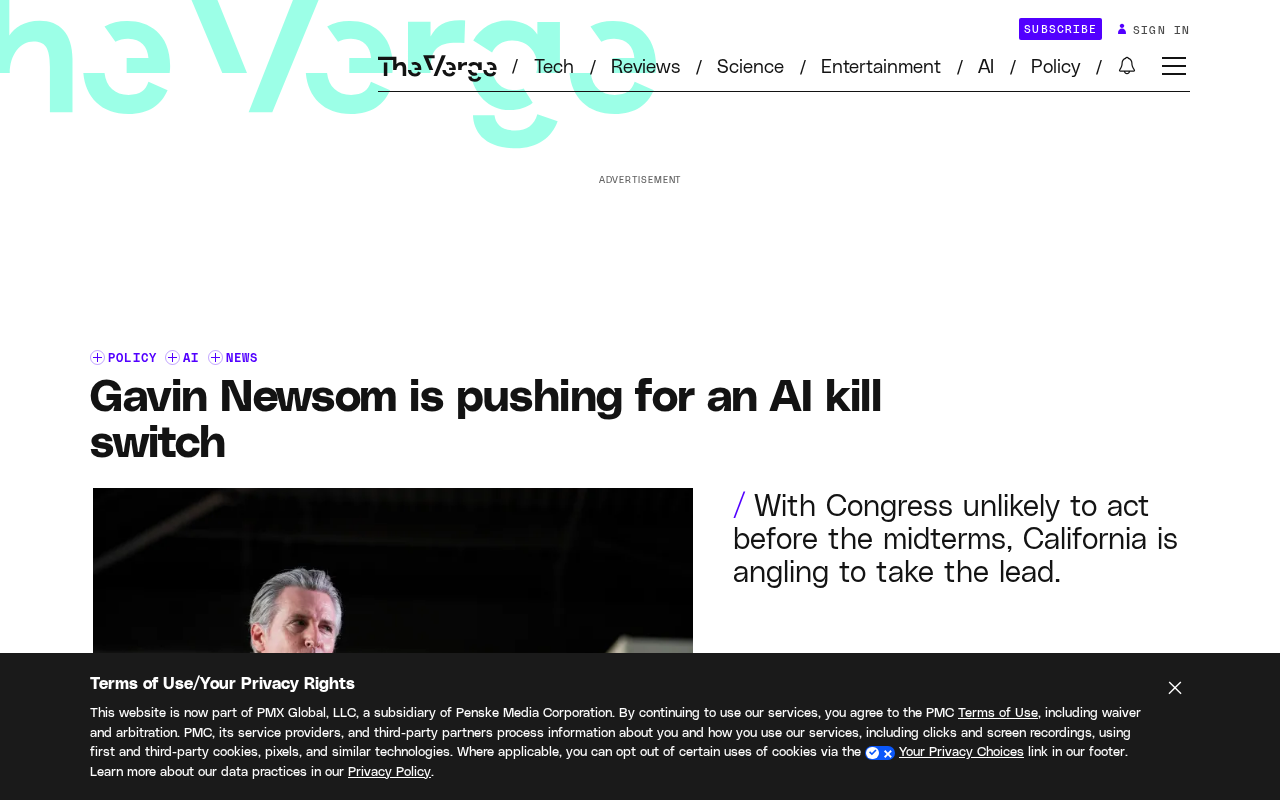
California Governor Gavin Newsom (D) is pushing to put the state at the forefront of AI regulation in the United States. Under an executive order he recently signed, California may require frontier AI models to be equipped with a so-called "emergency kill switch."
A "kill switch" refers to a mechanism that can rapidly shut down an AI system if it goes out of control or causes serious harm. This concept has long been discussed in AI safety circles, but having it formally placed on the policy agenda is still relatively rare. Newsom's move signals that state-level government is attempting to establish a governance framework for the most powerful AI systems before federal regulation has taken shape.
"Frontier AI models" typically refers to the largest, most capable foundational models at the current edge of technology — such as GPT-4, Claude, and Gemini. These models, which cost hundreds of millions of dollars to train and whose capability limits remain unclear, are considered to carry the highest potential risks and sit at the center of AI safety regulation discussions worldwide. The UK, EU, and other regions have already singled out "frontier models" as a distinct regulatory priority, requiring developers to conduct safety evaluations and register with authorities before deployment. By explicitly targeting this category rather than AI systems broadly, California's executive order reflects a "focus on the biggest risks" regulatory philosophy — concentrating resources on high-risk, high-capability systems while avoiding excessive interference with the broader AI ecosystem.
Core Content of the Executive Order
Under the executive order issued last Friday, Newsom directed California to convene an expert panel that must deliver specific recommendations on how to regulate frontier AI models within two months. This relatively tight timeline signals California's desire to move quickly on policy development.
The expert panel's mandate goes beyond evaluating the "kill switch" mechanism alone — it will likely encompass a comprehensive assessment of the potential risks posed by frontier models, the definition of regulatory boundaries, and actionable implementation plans. Handing technical details to experts for evaluation before translating findings into policy recommendations largely sidesteps the common legislative pitfall of non-experts regulating highly technical domains.
Why State-Level Regulation Is Moving Ahead of the Federal Government
The United States has long faced a structural problem in AI regulation: federal-level legislation has progressed slowly, with deep divisions over how to balance innovation and safety. As the region with the highest concentration of AI industry players globally, California is home to OpenAI, Google, Anthropic, and many other leading AI companies — giving the state both a practical need for regulation and natural leverage to shape industry rules.
Newsom's choice to act via executive order rather than legislation allows him to bypass lengthy legislative battles and signal regulatory intent quickly. However, executive orders generally carry weaker legal force and durability than formal legislation, and whether these recommendations ultimately translate into binding requirements will still depend on subsequent legislative action.
Notably, over the past year Newsom has actually vetoed multiple AI regulation bills passed by the California legislature. Most prominently, he vetoed the 2024 SB 1047 bill — which would have required developers of large AI models to conduct safety evaluations before training and establish shutdown mechanisms — citing concerns that it could hinder innovation and that its regulatory boundaries were unclear. His pivot to advancing a similar direction through an executive order has been interpreted by some observers as a recalibration of political signals: against a backdrop of federal regulatory vacuum and rising public concern over AI safety, California needs to reassert its proactive stance on the issue, while using the "form an expert panel first" approach to preserve policy flexibility and avoid repeating the SB 1047 controversy.
The Controversy and Practical Challenges of a "Kill Switch"
An "emergency kill switch" sounds intuitive and forceful, but it faces considerable controversy at the technical and practical levels. On one hand, proponents argue that preserving a means of human termination is a basic safety baseline when dealing with potentially uncontrollable powerful AI systems. On the other hand, critics point out that large AI models are often deployed in a distributed fashion and deeply embedded across various applications — making an "instant shutdown" potentially infeasible from an engineering standpoint, and one that could even trigger cascading service disruption risks.
Beyond that, how to define a "frontier model," who gets to decide when to press the switch, and whether the mechanism could be misused or accidentally triggered are all critical questions the expert panel will need to answer. The fact that California is tasking experts with assessing these questions within two months itself signals that the relevant technical standards and regulatory benchmarks are far from settled consensus.
Potential Impact on the AI Industry
If California ultimately introduces a mandatory "kill switch" requirement, its impact would extend far beyond state lines. Because many of the top AI companies are headquartered in California, any local regulation could effectively become a de facto industry standard — similar to the role California has historically played in automotive emissions, data privacy, and other domains.
For developers and companies, this would mean building safety intervention interfaces into model design from the outset, raising compliance costs. But looking further ahead, a clear regulatory framework could also reduce uncertainty in the industry's development trajectory. The battle over AI safety governance has only just begun, and where California's next steps lead is well worth watching closely.
California's historical precedent for imposing de facto standard regulation on other industries is well established. Take automotive emissions: California has long held a federal waiver allowing it to set stricter emissions standards than the federal government. Given California's massive market size, automakers often design their entire vehicle lineup to California standards rather than maintaining two separate product lines — effectively spreading California's standards across the country and even globally. The California Consumer Privacy Act (CCPA) followed a similar path in the data privacy space. If California ultimately legislates a requirement for built-in AI model shutdown mechanisms, developers would face the same choice: comply separately for California, or incorporate the requirement into the design standards for all their products. Given the unified nature of model training and deployment, the latter is the more likely outcome — meaning California's regulatory reach would effectively extend well beyond its own administrative jurisdiction.
Related articles

AI Agents and MCP in Practice: Master Autonomous Agent Architecture in 6 Minutes
From the four core structures of AI Agents to the MCP protocol, Tool Calling, vector memory, multi-agent collaboration, and security, this covers seven key steps of autonomous agent development, plus practical FastMCP deployment tips.

The AI Reverse Engineering Era: What Makes an Engineer Competitive Is Being Redefined
Senior engineer Satya argues AI is shifting from generating code to understanding systems. A 300K-star GitHub reverse-engineering project can clone the Adobe suite. An engineer's edge is no longer frameworks or prompt tricks, but end-to-end system understanding, verifying AI findings, debugging failure cases, and business abstraction.

Walmart Opens AI Shopping Agents, Amazon Blocks Them: A Clash of Two Approaches
Walmart launches Agent Gateway allowing AI agents to shop; Amazon blocks external agents. Analysis of security design, business logic, and impact on the AI agent ecosystem.