Walmart Opens AI Shopping Agents, Amazon Blocks Them: A Clash of Two Approaches

Walmart opens AI shopping agent access while Amazon blocks external agents—two strategies collide, signaling a new e-commerce landscape.
Walmart launched Agent Gateway based on the MCP protocol, allowing approved AI agents to access its inventory and place orders for users, with guardrails like independent profiles, per-purchase approval, and spending limits. Amazon chose to block external shopping agents to protect data, experience control, and competitive barriers. This reflects the different strategic mindsets of challengers and leaders in the AI agent ecosystem: Walmart uses openness to attract developers and users, Amazon uses closure to maintain dominance. The outcome depends on users' trade-off between convenience and security, and Walmart's agent profiles launching next month will be a key test.
Walmart and Amazon have made diametrically opposite choices regarding AI shopping agents. Walmart has launched Agent Gateway, allowing approved AI agents to search inventory and complete purchases on users' behalf; Amazon, meanwhile, is blocking external shopping agents. Behind this is a collision between open and closed strategies, foreshadowing the competitive landscape of the e-commerce AI agent era.
Walmart's Open Strategy: Agent Gateway and MCP Server
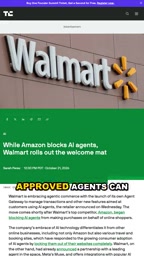
Walmart's Agent Gateway is essentially an MCP server that allows approved AI agents to access Walmart and Sam's Club inventory systems, enabling agents to search for products and place orders directly for users. According to the YouTube channel Hot Reload News, Walmart's move aims to bring AI shopping agents into its own ecosystem rather than shutting them out as Amazon does.
MCP (Model Context Protocol) is a protocol that lets AI models interact with external tools and data sources. Walmart's choice of MCP as the standard for agent access signals its intention to build a standardized, governable agent access layer. This differs from simply opening an API—MCP provides a more structured way of tool invocation, allowing agents to understand available operations and execute them safely.
Walmart's openness is not unconditional. Only approved agents can connect, leaving room for subsequent security and compliance management.
MCP (Model Context Protocol) is an open protocol proposed by Anthropic in late 2024 to standardize how AI models interact with external tools and data sources. Its core idea is to abstract tool invocation into a "server-client" model: external services expose resources (such as product inventory and ordering interfaces) as MCP servers, and AI agents act as clients to discover and invoke these capabilities through a unified protocol. Compared with traditional REST APIs, MCP emphasizes the introspectability of tool descriptions—agents can dynamically understand available operations and their parameter constraints, enabling safe task execution without hardcoding. Walmart's adoption of MCP means its agent access layer is generic; in theory, any agent framework supporting the protocol can connect, reducing integration costs for third-party developers.
Security Guardrails: Per-Purchase Approval and Spending Limits
The most noteworthy aspect of Walmart's approach is its security design. Each agent gets its own profile, and users can set per-transaction approval requirements or a spending limit. This means users don't have to fully trust the agent—they can retain ultimate control.

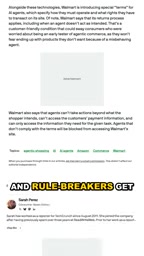
Agents cannot see users' payment information, reducing the risk of payment fraud at the source. Meanwhile, agents that violate rules are banned, forming a complete mechanism of prior authorization, in-process control, and post-hoc penalties. According to Hot Reload News, these profiles will roll out next month.
This design is akin to giving an intern a company card with a credit limit—you can have the intern buy things for you, but they can't see the full picture of the company account, and every expense is monitored. While opening agent access, Walmart uses technical means to keep risk within acceptable bounds.

Amazon's Closed Stance: Blocking External Shopping Agents
In stark contrast to Walmart, Amazon is blocking external shopping agents. Rather than opening access, Amazon is shutting external agents out. This strategy may stem from multiple considerations regarding user experience, data security, and competitive barriers.
As one of the world's largest e-commerce platforms, Amazon possesses vast product data and user behavior data. Opening access to external agents could bring data leakage risks and weaken Amazon's control over the shopping experience. Moreover, if external agents can shop on Amazon on users' behalf, Amazon may lose direct interaction opportunities with users, potentially hurting its advertising and recommendation businesses.
However, the closed strategy has its costs. If AI shopping agents become mainstream, users may gravitate toward platforms that support agent access. Walmart's open strategy could attract users who want to simplify shopping with AI agents, giving it an edge in user experience.
A shopping agent is an AI program that can autonomously complete the entire process of product search, price comparison, adding to cart, and even payment on behalf of users. Its technical foundation typically includes web automation (such as browser control), API calls, and decision planning based on large language models. Unlike traditional price-comparison plugins or crawlers, shopping agents possess goal-oriented autonomy and can migrate across multiple platforms to execute complex tasks. Amazon's blocking of external agents essentially restricts such programs from accessing its product pages and transaction interfaces through automated means; common technical measures include detecting non-human traffic, requiring CAPTCHAs, and banning suspicious IPs. This practice has precedents in the industry—Amazon has taken legal action against price crawlers—but banning AI shopping agents is a first, reflecting platforms' concerns that agents may bypass their recommendation algorithms and advertising systems.
The Deeper Logic Behind the Two Approaches
The choices of Walmart and Amazon reflect two different strategic mindsets. As a challenger, Walmart is more willing to attract users and developers through openness, leveraging external forces to enrich its ecosystem. As the leader, Amazon prefers to protect its data and market position through closure.
From a technical perspective, Walmart's MCP server approach offers a reusable model for agent access. If successful, other retailers may follow suit, accelerating the adoption of AI shopping agents. Amazon's blocking strategy, meanwhile, may push agent developers to seek alternative platforms or prompt regulators to intervene.
From the user's perspective, Walmart's approach strikes a balance between security and convenience. Users can save time through agents while retaining control over payments. Amazon's closed strategy may prevent users from using their preferred AI agents, reducing convenience.
Challenger vs. leader strategy is a classic analytical framework in industrial organization theory. Challenger firms with lower market share tend to adopt open strategies to attract complementors and expand their ecosystem, thereby challenging the leader's position; leaders with large user bases and data assets tend to maintain control and prevent value capture by outsiders through closure. This logic is common in the tech industry: early Android countered iOS's closed model with openness, and Tesla opened its patents to promote the EV ecosystem. Walmart lags behind Amazon in e-commerce, and its open stance with Agent Gateway fits the challenger logic; Amazon's blocking reflects a leader's protection of its core traffic gateway and experience consistency. The relative merits of the two strategies depend on the comparative strength of network effects and user lock-in effects.
Impact on the AI Agent Ecosystem
Walmart's open strategy could accelerate the adoption of AI shopping agents. Developers can build agents based on the MCP protocol, connect to Walmart and Sam's Club product catalogs, and offer users cross-platform shopping assistants. This could spawn new entrepreneurial opportunities, such as middleware services specifically optimizing shopping agents.
Amazon's closed strategy may delay the application of AI shopping agents on its platform, but it could also prompt Amazon to develop its own agent system. If Amazon chooses to build its own agents, it may leverage its data advantages to offer more precise recommendations and a smoother experience.
The outcome of this competition will depend on user choices and technological evolution. If users value convenience and openness more, Walmart may gain market share; if users value security and consistency of experience more, Amazon may maintain its advantage.
Currently, Walmart's agent profiles will roll out next month, which will be the first step in testing the viability of its strategy. Whether Amazon will adjust its closed strategy is also worth watching.
This article is based on reporting from the YouTube channel Hot Reload News, combined with analysis of the AI agent ecosystem.
One-line Summary
Walmart opens AI shopping agent access while Amazon blocks external agents—a collision of two strategies foreshadowing a new e-commerce landscape.
Paragraph Summary
Walmart has launched Agent Gateway based on the MCP protocol, allowing approved AI agents to access its inventory systems and place orders for users, while controlling risk through guardrails such as independent profiles, per-purchase approval, and spending limits. Amazon, by contrast, has chosen to block external shopping agents to protect its data, control over user experience, and competitive barriers. The article argues this reflects different strategic mindsets of challengers and leaders in the AI agent ecosystem: Walmart uses openness to attract developers and users, while Amazon uses closure to maintain dominance. The outcome will depend on users' trade-off between convenience and security, and Walmart's agent profiles rolling out next month will be a key test.
Related articles

LLaMA-Factory in Practice: A Complete No-Code Guide to Fine-Tuning Large Models
An introduction to LLaMA-Factory, the open-source fine-tuning tool: its 60.1K-star background, supported models and algorithms, local vs. cloud deployment, and CUDA setup steps.

Zeng Ming's Deep Retrospective: Why OpenAI May Not Be the Ultimate Winner — and Why the Corporate System Will Disappear
Zeng Ming's deep retrospective on the AI endgame: model companies are just infrastructure, OpenAI and Anthropic won't be the final winners; the next battle is the Agent entry point standard; the corporate system will disappear as AI restructures collaboration, and only mission-driven companies can survive the cycle.

OpenHands v1.28.0: OpenCode and PI Added as Built-in Agents, API Keys Requestable In-Conversation
OpenHands ships 5 releases in 21 days: v1.27.0 adds OpenCode and PI as built-in agents, v1.28.0 enables in-chat key requests. ACP integration, credential reuse, model list changes, and upgrade advice.