California's Seismic Retrofit Program: A Case Study in the Absence of Data-Driven Decision Making

California's seismic retrofit program draws criticism for lacking data-driven decision making and cost-benefit analysis.
A new report on California's seismic retrofit program reveals significant gaps in data-driven decision making and cost-benefit analysis. Despite advanced technologies available for risk assessment, political factors and weak accountability mechanisms lead to fund misallocation, leaving high-risk buildings without timely reinforcement while lower-priority projects receive funding based on political visibility rather than engineering rationality.
A Disappointing Report on Government Spending
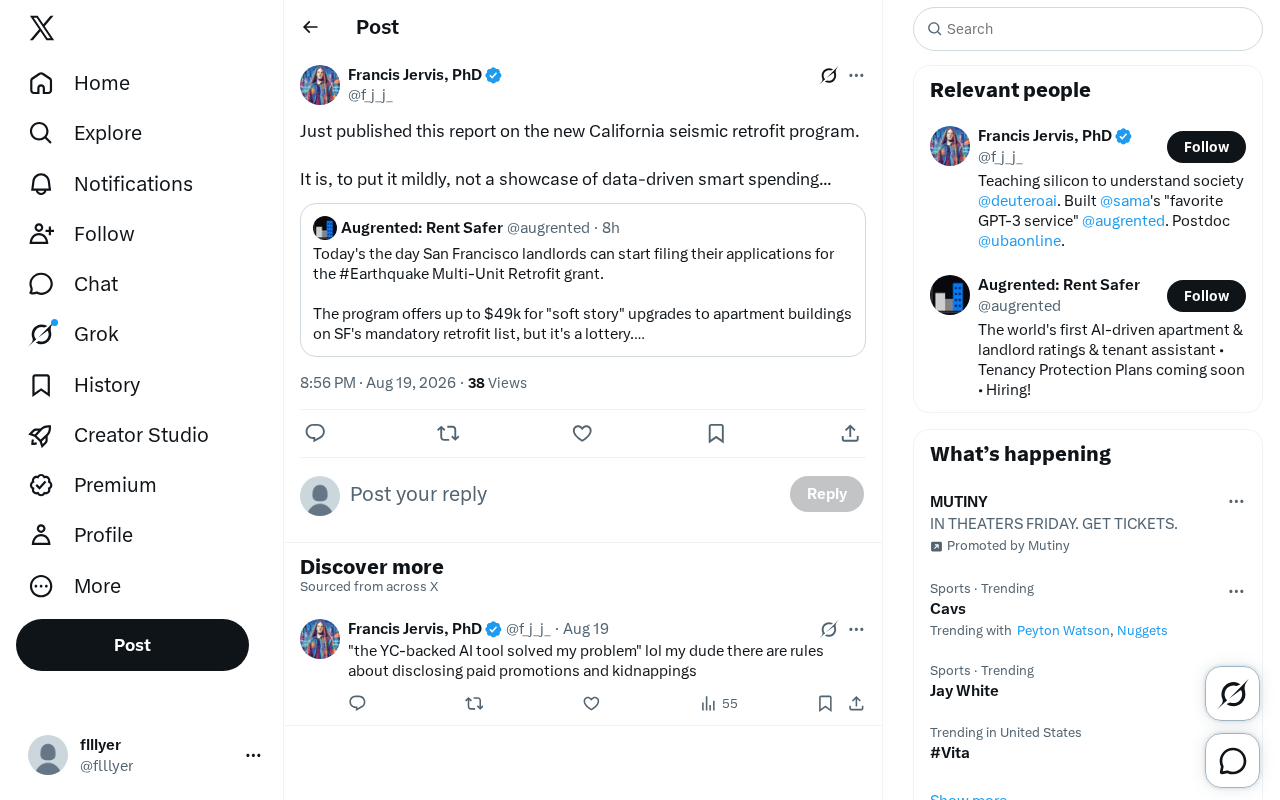
Recently, a report on California's new seismic retrofit program was released, sparking widespread public discussion about the efficiency of government spending. The report's author bluntly characterized the program as, "to put it mildly, not a model of data-driven smart spending."
For a public safety engineering project that should have scientific assessment and risk management at its core, this is undeniably sharp criticism. Seismic retrofitting is inherently a field that relies heavily on data and engineering modeling—from earthquake risk assessment and building vulnerability analysis to cost-benefit trade-offs in fund allocation, every step should be built on a solid quantitative foundation.
The Historical Context of Seismic Retrofitting in California
To understand the weight of this report, one must appreciate the deeper context of seismic retrofitting in California. Situated atop the San Andreas Fault system, California is one of the most seismically active regions in the world. The 1906 San Francisco earthquake (magnitude 7.9) and the 1994 Northridge earthquake (magnitude 6.7) both caused catastrophic consequences. The Northridge earthquake in particular killed 57 people, caused over $20 billion in economic losses, and exposed the structural vulnerability of numerous aging buildings—directly driving the adoption of mandatory seismic retrofit regulations in California. Since then, California has invested billions of dollars in building reinforcement, yet retrofit needs remain far from fully addressed. In this context, the efficiency of every dollar of public funding is critically important.
Why Seismic Retrofitting Demands Data-Driven Decision Making
Prioritization Under Limited Funding
Seismic retrofit programs typically face a core contradiction: the number of buildings requiring retrofitting is enormous, while available public funding is extremely limited. Under these constraints, how to scientifically rank buildings by risk—prioritizing those with the highest collapse probability and most severe casualty consequences—becomes the key to decision making.
An ideal data-driven approach should comprehensively consider multiple dimensions:
- The building's construction era and seismic design standards
- Geological conditions and proximity to fault lines
- Structural type (e.g., soft-story buildings, unreinforced masonry structures)
- Occupant density and building function
Among these, Soft-Story Buildings and Unreinforced Masonry (URM) structures are the two most critical high-risk categories in seismic retrofitting. Soft-story buildings are multi-story structures whose ground floors lack sufficient shear walls or bracing due to open spaces (such as garages or shops), making them extremely prone to lateral collapse at the ground level during earthquakes—during the 1994 Northridge earthquake, over 200 soft-story apartment buildings in the Los Angeles area were severely damaged or collapsed. Unreinforced masonry structures are brick and stone buildings without steel reinforcement; their walls tend to disintegrate under horizontal shaking. California still has thousands of such buildings, mostly constructed before the 1930s and located in older urban areas and historic districts, making retrofitting both technically difficult and complicated by historic preservation concerns.
Only by quantifying and integrating these factors can we ensure that every dollar of public spending goes toward the highest risk-reduction benefit.
The Critical Absence of Cost-Benefit Analysis
The report's criticism of the program as "not a model of smart spending" most likely points to weaknesses in cost-benefit analysis. When a seismic project lacks rigorous cost-benefit evaluation, fund misallocation often follows—pouring substantial budgets into projects with relatively low risk but high political visibility, while truly dangerous buildings go without timely reinforcement.
Applying Cost-Benefit Analysis (CBA) in the seismic domain requires monetizing earthquake risk, which involves multiple complex dimensions: the Value of Statistical Life (VSL) for expected casualties (currently estimated at approximately $11 million per person by the U.S. federal government), building repair or reconstruction costs, economic activity disruption losses, and social function recovery time. FEMA's HAZUS loss estimation software is the standard tool for such analysis, capable of simulating expected losses under different earthquake scenarios. Ideally, the investment in each retrofit project should be less than the discounted present value of expected avoided losses. In practice, the quantification of life safety, the choice of long-term discount rates, and the uncertainty of earthquake occurrence probabilities all make CBA application controversial—but even so, the complete absence of any systematic cost-benefit assessment is clearly unacceptable.
This resource misallocation is particularly dangerous in high seismic risk areas, because the next earthquake won't wait for administrative processes to be perfected.
Common Problems in Public Safety Engineering
The Conflict Between Political Factors and Engineering Rationality
Fund allocation for large-scale public safety projects is frequently distorted by political considerations. District interests, visible vanity projects, and lobbying pressure can all divert funding away from the optimal path based purely on risk. This phenomenon is not uncommon in infrastructure investment, and seismic retrofitting—given the enormous sums involved and wide geographic distribution—is particularly susceptible to such influences.
The U.S. seismic mitigation system involves complex coordination among federal, state, and local governments. FEMA provides retrofit funding to states through the Hazard Mitigation Grant Program and the Building Resilient Infrastructure and Communities (BRIC) program, typically requiring a 25% local match. California's Seismic Safety Commission is responsible for setting statewide seismic policy, while implementation falls to city and county building safety departments. This decentralized governance structure, while respecting local autonomy, also leads to inconsistent enforcement standards and differing priority-setting across jurisdictions, creating systemic efficiency problems in fund utilization—and political factors exert disproportionate influence precisely in these coordination gaps.
The Importance of Transparency and Accountability Mechanisms
The value of independent reports like this lies precisely in their third-party perspective on government spending, revealing potential inefficiencies and opacity in decision-making processes. For taxpayers, knowing whether their money is being used efficiently and whether it truly enhances public safety is a fundamental right to information.
Establishing robust transparency and accountability systems—including regular public disclosure of project progress, detailed fund usage, and risk assessment rationale—is a necessary condition for improving public works efficiency.
Implications of Data Governance for Public Policy
The lessons from this California case extend far beyond the seismic field itself. In an era when big data and artificial intelligence technologies are increasingly mature, public policy formulation should leverage data analysis tools to achieve precision resource allocation.
Modern technology already provides powerful support for seismic risk assessment:
- Satellite remote sensing: Rapid identification of building structural characteristics and surface deformation. Specifically, Interferometric Synthetic Aperture Radar (InSAR) technology can monitor ground deformation at millimeter-level precision, identifying fault activity and land subsidence. The European Space Agency's Sentinel-1 satellite and NASA's upcoming NISAR mission are providing continuous observation data for global earthquake risk research.
- Building databases: Integrating historical construction information with current condition assessment data
- Machine learning models: Automated vulnerability assessment and risk ranking for tens of thousands of buildings in a city. High-resolution optical satellite imagery and street-view images combined with deep learning algorithms can already automatically identify building structural types, number of stories, roof materials, and other characteristics. Research teams at Stanford University and Caltech have demonstrated the feasibility of using such methods for automated seismic assessment of entire cities.
If these technological tools can be truly embedded into decision-making processes, they would dramatically improve the efficiency of public fund utilization.
Comparative Global Practices
Data-driven public decision-making has been practiced in multiple earthquake-prone countries worldwide, offering valuable references. After the 2011 Christchurch earthquake, New Zealand established a national building assessment database, systematically rating each building's seismic capacity (expressed as a percentage of new building standards) and setting mandatory retrofit timelines accordingly—buildings rated below 34% are classified as "earthquake-prone buildings" and must be reinforced or demolished within a specified timeframe. Japan, through its "National Seismic Hazard Maps" and building seismic diagnostic system, has achieved highly data-driven seismic management, with the public even able to query the earthquake risk level of any address online. By comparison, the United States, due to the greater autonomy of states under its federal system, lacks a unified national building seismic database, making it difficult to systematically ensure the scientific basis for cross-regional fund allocation.
However, the existence of technology does not equate to its effective utilization. The problems revealed by this report remind us that data-driven decision-making requires not only technical capability but also institutional design and political will. Without transparent evaluation mechanisms and accountability systems, even the most advanced technology cannot be translated into truly intelligent public spending.
Conclusion
The controversy over California's seismic retrofit program is fundamentally a classic question about how public resources should be scientifically allocated. In a field like disaster prevention and mitigation that directly concerns life safety, any decision that deviates from data and risk assessment may exact a heavy price.
It is hoped that independent reports like this can push relevant agencies to reflect on existing decision-making processes and truly place data analysis at the core of public safety investment. After all, with limited resources, directing every cent to where it's most needed is not merely a matter of efficiency—it's an expression of responsibility toward public safety.
Related articles

AI-Powered SRC Vulnerability Hunting: A Hands-On Guide to Building the Hermes Agent Workbench
Based on a hands-on Bilibili video: how to build an AI-powered SRC vulnerability hunting workbench—three-step method, four report elements, Agent mode vs web chat, and tool selection.

CLI-Anything Complete Beginner's Guide: How AI Operates Software — Principles and Practice
A complete beginner's guide to CLI-Anything: how AI Agents operate professional software via the command line, covering the three-layer architecture, CLI Hub installation, DrawIO practice, generator principles, and limits.

Carbon-X: A 14.8B Open-Source Model That Handles DNA and Text Simultaneously
Carbon-X is a 14.8B open-source multimodal model on Hugging Face where DNA and text share a token stream. 6-mer tokenization, 302B token mid-training, deployable on a single 80GB GPU, 66.7% average on five DNA benchmarks, Apache 2.0 license.