Claude Code Weekly Limit Policy Explained: Developer Reactions and Coping Strategies

Claude Code's new weekly limits spark developer debate over AI tool pricing sustainability.
Anthropic's Claude Code introduced weekly usage limits for May–August 2026, igniting heated discussion on Hacker News. The policy aims to control inference costs and ensure service stability, but developers are divided—some understand the business necessity while others criticize the lack of transparency and workflow disruption risks. The event highlights the broader AI programming tools industry's ongoing struggle to balance user value with commercial sustainability.
Background: Why the Claude Code Weekly Limit Policy Sparked Heated Discussion
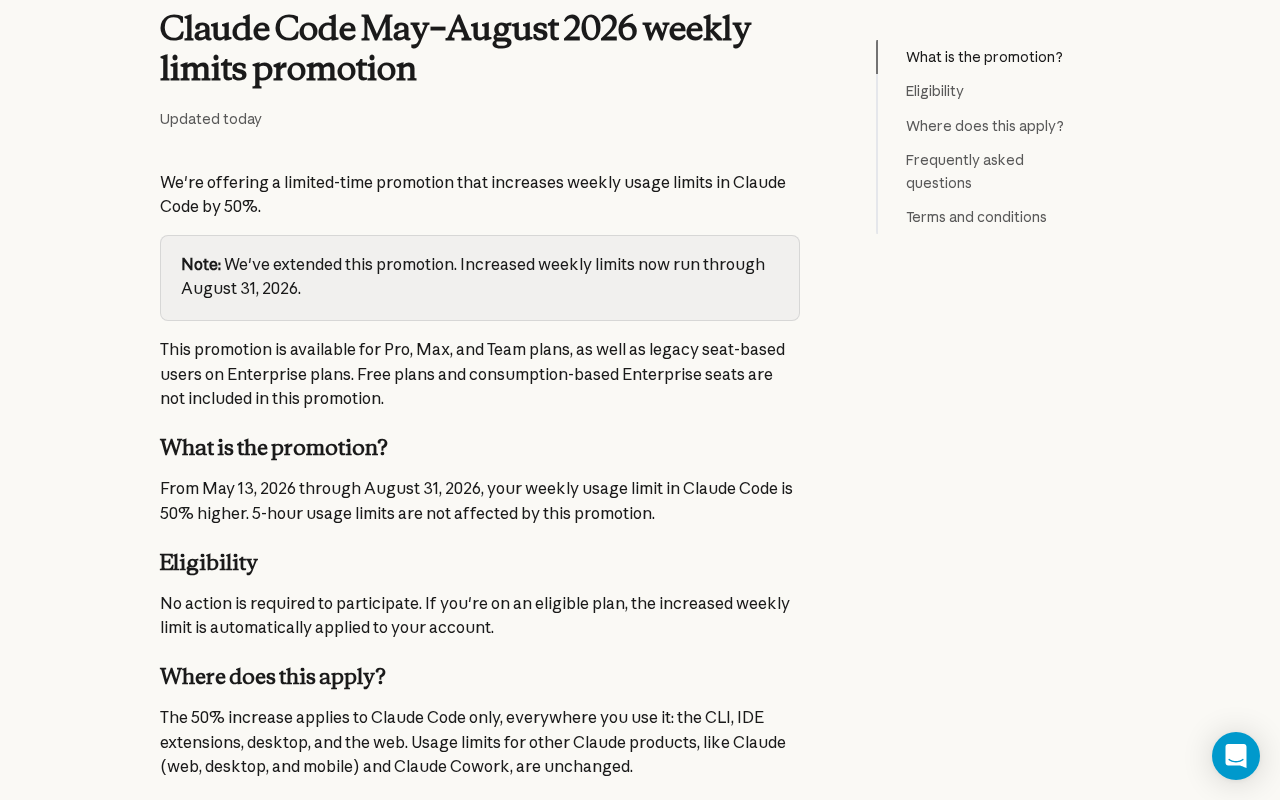
Recently, Anthropic's AI programming tool Claude Code announced a weekly usage limit policy adjustment for the period from May to August 2026. The news quickly ignited intense discussion on Hacker News, with the post garnering 255 upvotes and over 223 comments, making it a focal topic in the developer community.
As a highly regarded AI-assisted programming tool, Claude Code has built a large base of loyal users thanks to its powerful code comprehension and generation capabilities. Claude Code is a command-line AI programming tool built on Anthropic's Claude large language model series. Unlike traditional IDE plugin-style AI assistants (such as GitHub Copilot), it adopts a terminal-native interaction approach that can directly read project files, understand codebase structure, execute commands, and perform multi-step complex programming tasks. Its underlying reliance on the Claude 3.5/4 series models' long-context processing capability (supporting up to 200K token context windows) gives it a unique advantage when handling large codebases, but also means the computational cost per interaction is far higher than simple code completion tools. This policy adjustment concerning weekly limits directly impacts the core interests of paying users, hence the widespread controversy.
Core Changes in the Claude Code Weekly Limit Policy
From Monthly to Weekly: Tighter Limit Granularity
The core of this policy adjustment lies in the introduction of a weekly usage limit mechanism. Compared to the previously more lenient usage policy, the new limit means users now have an explicit cap on the AI programming resources they can access each week.
For heavy users, this change is particularly significant. Many developers have already deeply integrated Claude Code into their daily workflows for code review, refactoring, debugging, and large-scale project development. The introduction of weekly limits effectively requires users to plan their AI resource usage rhythm more carefully.
The Business Logic Behind the Limits
From Anthropic's perspective, the weekly limit policy has its inherent business rationale. Large language model inference costs are substantial, especially for applications like Claude Code that need to process long contexts and complex codebases, which consume enormous computing power.
Specifically, the inference cost of large language models is determined by GPU compute consumption, primarily influenced by three factors: input token count, output token count, and model parameter size. Taking a typical Claude Code use case as an example, a single code review might require inputting tens of thousands of tokens of code context and then generating several thousand tokens of analysis and modification suggestions—the computational overhead on GPU clusters far exceeds ordinary conversational scenarios. Industry estimates suggest that frontier model inference costs are approximately $3-15 per million tokens on the input side and $15-75 per million tokens on the output side, which explains why an unlimited usage model is economically unsustainable.
By setting weekly limits, Anthropic can:
- Control operational costs: Prevent a small number of power users from consuming excessive computing resources
- Ensure service stability: Prevent resource over-utilization from degrading overall service quality
- Optimize pricing strategy: Pave the way for future tiered subscription models
Developer Community Reactions to Claude Code Limits
Supporters: Understanding the Need for Business Sustainability
Some developers expressed understanding of the policy. They believe AI service providers need to find a balance between user experience and business sustainability. An unlimited usage model is difficult to maintain long-term commercially, especially given the persistently high costs of AI inference.
Some comments pointed out that rather than letting the service degrade overall or raise prices due to cost pressures, a reasonable limit mechanism is actually a fairer way to allocate resources—making heavy users pay accordingly for intensive usage.
Opponents: Transparency and Workflow Disruption in Focus
However, a significant portion of users expressed strong dissatisfaction, with concerns centering on the following points:
Insufficient transparency: Users want Anthropic to more clearly explain the specific calculation methodology for limits, as well as the handling mechanism when limits are reached. Vague policies easily create uncertainty in the user experience.
Workflow disruption risk: For professional developers who use Claude Code as a core productivity tool, suddenly hitting a limit could force workflow interruptions, directly impacting project delivery timelines.
Value reassessment: Some users are beginning to reevaluate the cost-effectiveness of their Claude Code subscriptions, even considering switching to other AI programming tools like GitHub Copilot or Cursor, or locally deployed open-source models as alternatives.
Implications for the AI Programming Tools Market
The Industry Is Still in a Business Model Exploration Phase
This incident reflects that the entire AI programming tools industry is still in an exploratory phase regarding business models. How to achieve profitability while providing quality service is a challenge all vendors must face.
The current AI programming tools market has formed a multi-polar competitive landscape. GitHub Copilot, backed by the Microsoft and OpenAI ecosystem, provides code completion and chat functionality as an IDE plugin; Cursor, as an AI-native IDE, deeply integrates AI capabilities into the editor experience; and there are additional players like Codeium, Tabnine, and Amazon CodeWhisperer. These tools differ in model capability, context understanding depth, workflow integration, and pricing strategy, and user migration costs also vary depending on the degree of ecosystem lock-in. Tools like Claude Code, GitHub Copilot, and Cursor are all constantly adjusting their pricing and usage policies. Experiments with limits, tiered subscriptions, and usage-based billing are all fundamentally searching for the optimal balance between user acceptance and business sustainability.
Practical Coping Strategies for Developers
Facing potentially tightening usage policies, the developer community is actively exploring coping strategies:
- Multi-tool combination approach: No longer relying on a single AI programming tool, flexibly switching between Claude Code, Copilot, Cursor, and others based on task characteristics
- Local model deployment: As open-source code model capabilities improve, some users are beginning to try local solutions to circumvent limit constraints. However, it's worth noting that while locally deploying open-source code models can bypass cloud-based limits, there are significant technical and performance barriers. The current strongest open-source code models (such as DeepSeekAd Coder V2, CodeQwen, etc.) typically range from 7B to 70B parameters, with a noticeable capability gap compared to closed-source frontier models like Claude, especially in complex reasoning, long-context understanding, and multi-file collaboration. Running a 70B model locally requires at least a professional GPU with 48GB of VRAM (such as an NVIDIA A6000 or dual RTX 4090s), making the hardware investment considerable for individual developers. Quantization techniques (such as 4-bit quantization in GGUF format) can lower the hardware barrier but sacrifice some inference quality.
- Optimized prompting strategies: Organizing prompts more concisely, reducing unnecessary token consumption, and improving the efficiency of each interaction
Conclusion: The AI Programming Tool Pricing Game Has Just Begun
The discussion sparked by the Claude Code weekly limit policy is essentially a microcosm of the AI service commercialization process. It reveals a core contradiction: the democratization of AI capabilities requires massive computing investment, and these costs must ultimately be passed on or distributed in some way.
For developers, this event reminds us that while AI programming tools are powerful, they remain commercial products whose cost and value need to be carefully evaluated. While enjoying the efficiency gains AI brings, we also need to prepare contingency plans for policy changes.
For Anthropic and its competitors, how to establish transparent, stable, and predictable service policies to win user trust while maintaining technological leadership will be a key factor in determining long-term competitiveness. This discussion about limits may be just the beginning of the AI programming tool pricing game.
Related articles

Apple HomeView Hands-On Review: Is the $300 Smart Home Hub Worth It?
Apple HomeView hands-on: a $300 smart home hub with facial recognition for quick account switching, but no App Store or voice recognition. Is the wall-mounted version worth it? Should you buy the first generation?

Meta Muse Wonder Launch: What It Means for Meta's Return to the Frontier AI Race
Meta releases Muse Wonder and WonderFull, benchmarks reach the frontier, community feedback is polarized. An in-depth look at Meta's return to the frontier AI race, its personal agent strategy, and Zuckerberg's different path.

Apple Home Smart Home Lineup Leaked: LG and Schneider Team Up, UWB Door Lock on Board
Apple Home ecosystem gains new LG and Schneider devices: UWB smart lock with proximity unlock, 2.5K dual-camera doorbell, privacy indoor camera, and AirPods-like seamless pairing.