California Sets New Rules: Robotaxi Operators Face Fines for Blocking Emergency Vehicles

California will fine robotaxi operators whose vehicles block emergency responders, raising the bar for AV safety compliance.
California has enacted new regulations requiring robotaxi operators to pay fines when their autonomous vehicles block emergency responders such as fire trucks and ambulances. The law was prompted by over 60 documented incidents in San Francisco where Waymo and Cruise vehicles froze and impeded emergency response. The rules push operators to improve emergency vehicle detection, upgrade remote takeover systems, and coordinate with local emergency departments — raising compliance costs but potentially rebuilding public trust in autonomous driving technology.
California Draws a New Line for Robotaxis
California has introduced new regulations targeting autonomous vehicle operators, with the most closely watched provision being this: when a robotaxi blocks the path of emergency vehicles — including fire trucks, ambulances, and police cars — the operator will face fines. This marks a significant moment as regulators begin to seriously address the real-world safety risks exposed by the commercialization of autonomous driving.
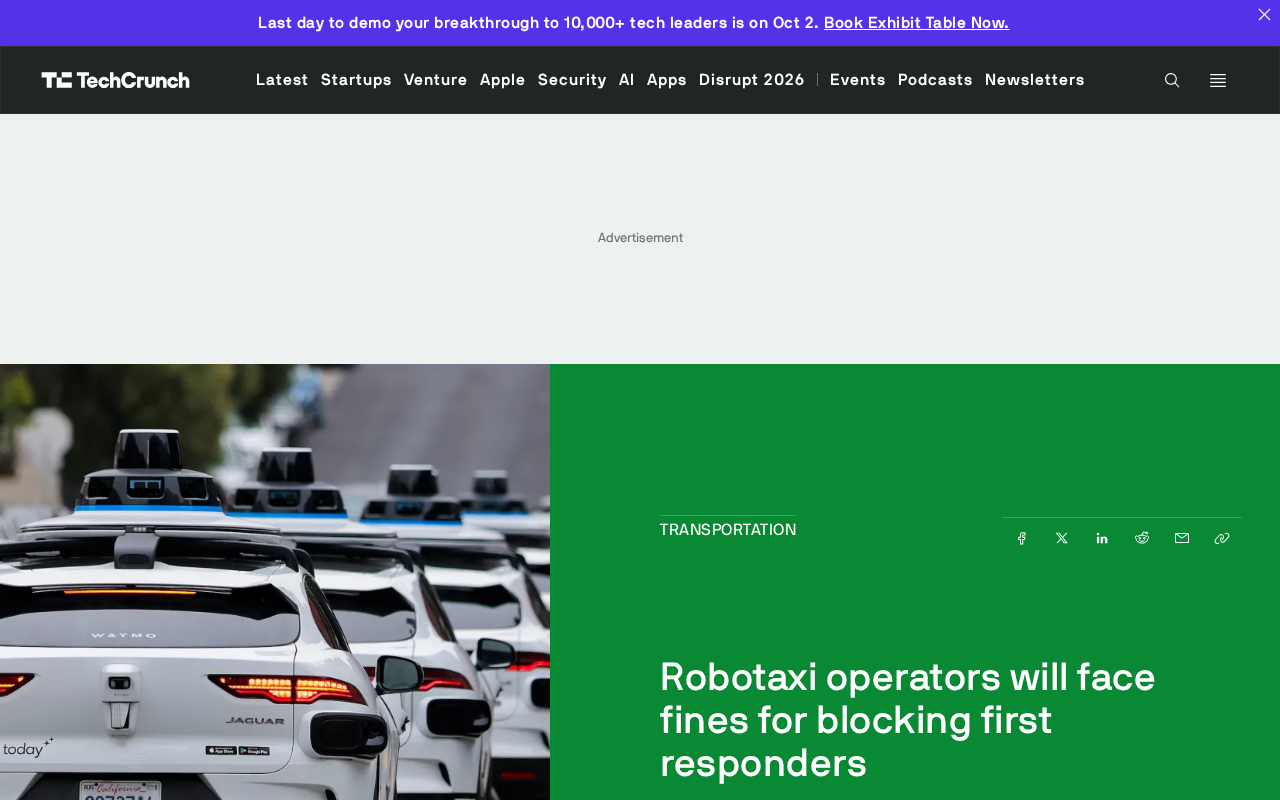
As operators like Waymo and Cruise expand their service areas in cities such as San Francisco and Los Angeles, friction between robotaxis and urban emergency response systems has become an increasingly public concern. Multiple incidents have already been reported in which autonomous vehicles suddenly froze when encountering unexpected road situations, failed to interpret hand signals from traffic officers or firefighters, and ended up blocking roads and delaying emergency responses. These incidents are exactly what this legislation aims to address.
Why Emergency Vehicle Access Became a Regulatory Priority
The right of way for emergency vehicles is a matter of life and death — a delay of just a few minutes can have serious consequences. Human drivers, upon hearing the siren of an ambulance or fire truck, can use common sense to pull over, temporarily stop in a no-parking zone, or even reverse to clear a path. Current autonomous driving systems, however, tend to behave conservatively — or even freeze entirely — when faced with these non-standard, highly context-dependent scenarios. The system's default response is often to stop and wait in place, which can paralyze an intersection rather than resolve the situation.
This is precisely why regulators focused specifically on the act of "blocking emergency vehicles" rather than addressing safety in vague, general terms. By establishing a clear fine structure, California places responsibility squarely on operators, compelling companies to improve their algorithms, refine remote takeover procedures, and build more effective coordination mechanisms with local fire and law enforcement departments.
The San Francisco Fire Department (SFFD) has publicly documented numerous specific cases of robotaxis obstructing emergency response. Between 2022 and 2023, Cruise and Waymo vehicles were recorded in more than 60 incidents of "impeding emergency response," including cases where fire trucks could not reach fire scenes and ambulances were forced to detour. These events led the SFFD to file formal complaints with the California Public Utilities Commission (CPUC), which served as a direct catalyst for this legislation. Technically, the "freezing" behavior of autonomous systems in emergency scenarios stems from insufficient training data — scenarios involving emergency command gestures and unconventional vehicle behavior are far rarer in datasets compared to everyday driving situations. This limits the model's ability to generalize, causing it to default to the most conservative strategy (stopping and waiting) when faced with rare situations — which only amplifies the risk.
What This Means for the Industry
This regulation sends a clear signal: the commercial expansion of autonomous driving must keep pace with public safety responsibilities. For operators, the fines themselves may not be the biggest pressure — the real challenge lies in demonstrating that their vehicles can reliably operate in complex urban emergency scenarios.
Several areas of impact are foreseeable:
- Technical: Companies will need to enhance their ability to detect and recognize emergency vehicles, optimize yielding strategies, and improve the response speed of remote operators for rapid intervention.
- Compliance: Operators will need to establish incident reporting and data-sharing channels with local emergency departments — a new ongoing operational cost.
- Industry Landscape: Stricter regulations may raise barriers to entry. Established players with mature safety systems stand to benefit relatively, while smaller operators may find their expansion pace constrained.
Remote Assistance (or Teleoperation) is currently the primary fallback mechanism for robotaxis navigating complex, unexpected scenarios: when the vehicle's autonomous system cannot make a judgment call, it sends a request to a backend operator, who remotely takes over or provides decision-making guidance. However, this mechanism has inherent limitations — network latency, operator response time, and the capacity to simultaneously handle requests from multiple vehicles all affect real-world performance. California's new rules effectively set higher implicit requirements for the efficiency of remote takeover. If a vehicle blocks an emergency lane and cannot be intervened on in time, the operator bears direct legal liability — forcing companies to reassess their operator-to-vehicle ratios and the real-time processing capabilities of their backend systems.
Finding the Balance Between Regulation and Innovation
California has long been a bellwether for autonomous driving policy in the United States, and its legislative moves are frequently adopted by other states. This new regulation is not meant to suppress the development of robotaxis — rather, it adds an institutional safeguard for public safety as commercial deployment accelerates.
From a longer-term perspective, clear rules actually support healthier industry growth. When operators know exactly which behaviors will be penalized and what responsibilities they must bear, R&D investments and operational decisions can be made with greater precision. For the public, seeing regulators actively respond to real-world problems also helps rebuild trust in autonomous driving technology.
Given that publicly available details on the regulation remain limited, the specific fine amounts, criteria for determining violations, and enforcement mechanisms still need to be clarified. How this legislation will be implemented in practice — and whether it will trigger pushback or legal challenges from operators — remains worth watching closely.
Related articles

JobRunner MCP Server: AI Agents Can Now Fix Failed Java Jobs
JobRunner launches an open-source MCP server enabling AI agents to view cluster status, diagnose failures, and recover Java jobs—incident response from any cloud coding environment or existing agent.

MLAI Digital Launches 9 Security Agents: MCP Server Safeguards the Full Lifecycle of Agentic AI
MLAI Digital launches Security MCP Server with nine built-in specialized security agents covering vulnerability discovery, attack simulation, prompt injection detection, API and infrastructure assessment, and accelerated remediation—embedding security validation across the full Agentic AI lifecycle from development to production.

Running Isaac Lab on H100 GPUs: Exploring Better Approaches
Exploring optimization methods for running Isaac Lab on NVIDIA H100 GPUs, including MIG configuration, mixed precision, TensorRT acceleration, and community experience to improve robotics simulation and reinforcement learning efficiency.