CALL-E: The Voice Agent That Lets AI Assistants Make Calls for You

CALL-E lets AI assistants make real phone calls, completing tasks like ordering food and getting quotes via a "plan first, execute later" flow.
CALL-E is a product launched on Product Hunt, positioned as "the phone line for AI agents," letting assistants like ChatGPT and Claude dial real US and Canadian numbers after user confirmation to complete tasks like ordering food, getting quotes, rescheduling, and checking inventory. Its interaction is split into three steps: asking for missing information, presenting a call plan, and dialing after confirmation—setting a human gate for the irreversible act of calling. Technically, it can navigate IVR menus, hold times, and voicemail, returning a summary and full transcript afterward. Developers can integrate it into tool-call workflows like Claude Code and Cursor via a single prompt, and new users get 100 free credits. The article argues voice agents are an underrated direction but notes that retry strategies, billing details, and compliance issues like AI call disclosure remain unclear.
When AI Assistants Pick Up the Phone
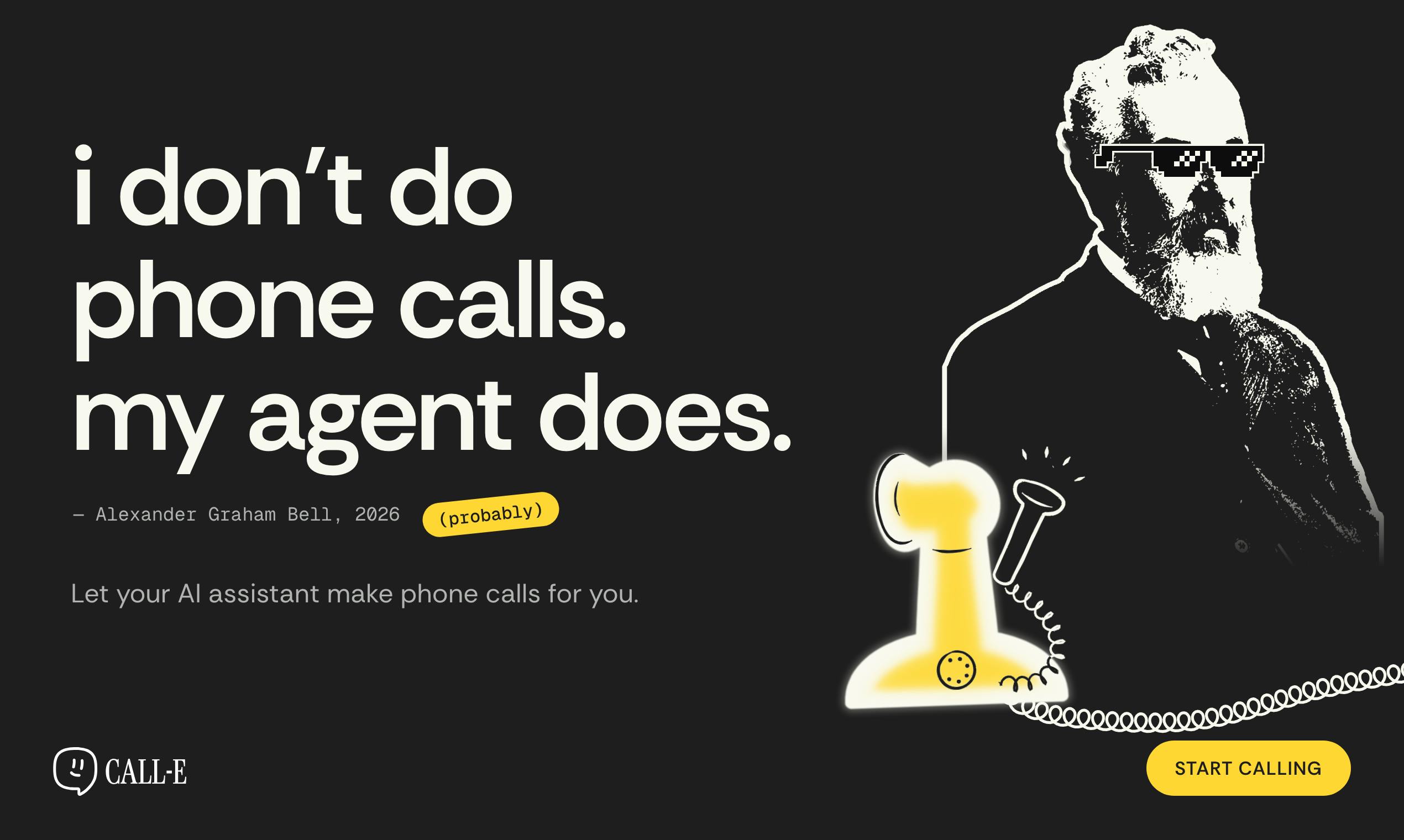
A product called CALL-E has appeared on Product Hunt with a blunt tagline: "The phone line for AI agents." The problem it aims to solve is this: ChatGPT and Claude can write code and look up information, but they can't call to order food, ask for quotes, reschedule appointments, or check inventory for you—because the phone remains one of the most stubborn interfaces in the human world. CALL-E serves as exactly this "phone line," letting AI assistants actually dial numbers after getting confirmation.
The product launched on Product Hunt under the Productivity, Artificial Intelligence, and Virtual Assistants categories, earning 101 votes and 15 comments, and ranking #3 for the day.
The Full Chain from Request to Call
CALL-E's interaction design isn't "one sentence and it dials." Instead, it's broken into several verifiable steps. After a user submits a request to ChatGPT or Claude, CALL-E first asks for any missing information (such as party size, time, or location preferences), then presents a call plan. Only after the user confirms does it actually dial real numbers in the US and Canada.
This "plan first, execute later" flow is essentially adding a human gate to an irreversible physical action. Once a call is placed and a conversation happens, it can't be undone—a completely different risk level from generating a piece of text.
Navigating Phone Menus and Voicemail
The real difficulty of a live call was never the opening line—it's IVR phone menus, hold music, transfers, and voicemail. CALL-E's selling point is that it can "walk through" this whole process on its own—navigating keypad options, waiting for an agent, and leaving a message when necessary, rather than hanging up the moment it hears "please press 1." After the call ends, it returns a summary, a full transcript, and what actually happened.
For scenarios that need a paper trail (rescheduling, getting quotes, filing complaints), the transcript is more valuable than the summary because it preserves the other party's verbal commitments word for word.
IVR (Interactive Voice Response) systems are automated menu systems that businesses deploy on the phone side, guiding callers to press keys through pre-recorded voice prompts (e.g., "Press 1 for sales, press 2 for support"). For AI voice agents, IVR is one of the biggest technical obstacles: it requires real-time recognition of what the options in a voice prompt mean, figuring out which level of the menu tree it's currently on, correctly sending DTMF (dual-tone multi-frequency) key signals, and making sensible decisions when encountering multi-level nesting or timeout replays. Traditional auto-dialing systems can only handle simple single-level menus, while CALL-E claims it can "walk through" the entire flow—meaning it has conversational state tracking and real-time voice understanding, which is far more complex than mere script generation.
Developer Integration
CALL-E isn't just for ordinary users—it also offers a developer path: integration with Claude Code, Codex, Cursor, or OpenClawAd via a single prompt. This means call capability is embedded as a tool call into existing coding and agent workflows, rather than forcing users to switch to a separate standalone app.
New users get 100 free credits, lowering the barrier to try it out.
Why This Kind of Tool Is Worth Watching
Voice agents may be one of the most underrated directions in this wave of AI applications. Web pages, APIs, and apps have long been permeated by AI, while phone systems remain stuck in the era of manual human operation—a large number of local businesses, clinics, and government offices don't offer online booking interfaces and can only be reached by phone. Products like CALL-E are effectively using AI to bridge the other side of the "digital divide."
At the same time, its design embeds an important judgment: when handing "irreversible actions" to AI, the confirmation step can't be skipped. This isn't a technical limitation—it's product ethics.
Tool call is the core mechanism through which large language models interact with external systems. In agentic coding environments like Claude Code and Cursor, models can do more than generate text—they can invoke functions registered as "tools," such as reading files, executing commands, or making API requests. CALL-E's integration into these environments via a single prompt essentially registers itself as a tool the model can call: when the model determines a call is needed, it automatically triggers CALL-E's call flow. This way, developers don't need to write complex phone integration code—they just declare the requirement in the prompt, and the model orchestrates the call. It also means call capability can be composed into multi-step agent workflows just like any other tool—for example, an automated chain of "check inventory → call supplier to confirm → record the result."
The digital divide has taken on a new meaning in the AI context. The traditional digital divide refers to gaps in internet access between different groups, while the divide in the AI era lies in this: some services already offer well-built APIs and online booking interfaces that AI can easily connect to, but a large number of local businesses, clinics, and government offices still retain the phone as their only channel. This means the entities AI can efficiently serve are precisely those that are "already digitized," while the offline scenarios that most need automation assistance are left out. Voice agents attempt to bridge the gap on this side—extending AI's capabilities to those long-tail service providers with no digital interfaces. This not only expands the practical boundaries of AI but also gives users who can't wait on hold for long periods or who face language barriers more equal access to services.
Questions That Remain
The product page doesn't explain retry strategies after failed calls, billing details, or the differences in capability boundaries between ordinary users and developers. Whether the person on the other end of the line knows, and whether they'll be told this is an AI call, is also an unavoidable compliance issue for voice agents. For teams considering integration, these details are worth asking about before the feature list.
One-line Summary
CALL-E lets AI assistants make real phone calls, completing tasks like ordering food and getting quotes through a "plan first, execute later" flow.
Paragraph Summary
CALL-E is a product launched on Product Hunt, positioned as "the phone line for AI agents," letting assistants like ChatGPT and Claude dial real US and Canadian numbers after user confirmation to complete tasks like ordering food, getting quotes, rescheduling appointments, and checking inventory. Its interaction is split into three steps: asking for missing information, presenting a call plan, and dialing after user confirmation—setting a human gate for the irreversible act of calling. Technically, it can navigate IVR menus, hold times, and voicemail, returning a summary and full transcript after the call. Developers can integrate it into tool-call workflows like Claude Code and Cursor via a single prompt, and new users get 100 free credits. The article argues that voice agents are an underrated direction but also notes that retry strategies for failed calls, billing details, and compliance issues like disclosing AI calls remain unclear.
Related articles

RePlan-VLA: Progress-Aware Replanning Breakthrough for Long-Horizon Robotic Manipulation
The RePlan-VLA framework converts VLA models' short-horizon capabilities into reliable long-horizon execution through progress-aware adaptive replanning, improving success rates by 21.9% and 10.4% on RoboCasa365 and CALVIN, and validating real-world deployment on a Franka Research 3 robot.

Geometric Bridge Flow Matching: A New Breakthrough in Blind Rigid Motion Correction
Geometric bridge flow matching enables blind rigid motion correction in head CBCT, achieving 37.1 dB PSNR and 0.27 mm RPE on simulated data in ~9.1 minutes, outperforming existing methods.

Google Releases Gemini 4 Hydrogen: 2.5x Faster Without Sacrificing Intelligence
Google releases the lightweight Gemini 4 Hydrogen: 2.5x faster task completion, AA Intelligence Index of 54 beating its flagship sibling, 7.3s single-step on Agent Arena faster than Claude and GPT rivals, four thinking levels with pay-as-you-need pricing, now available across AI Studio and more.