CALVIN-MAX: The Timing of Harm from Changes During Robot Policy Execution

CALVIN-MAX separates the cost of mid-execution changes into world change and timing, revealing a negative timing effect for visual changes.
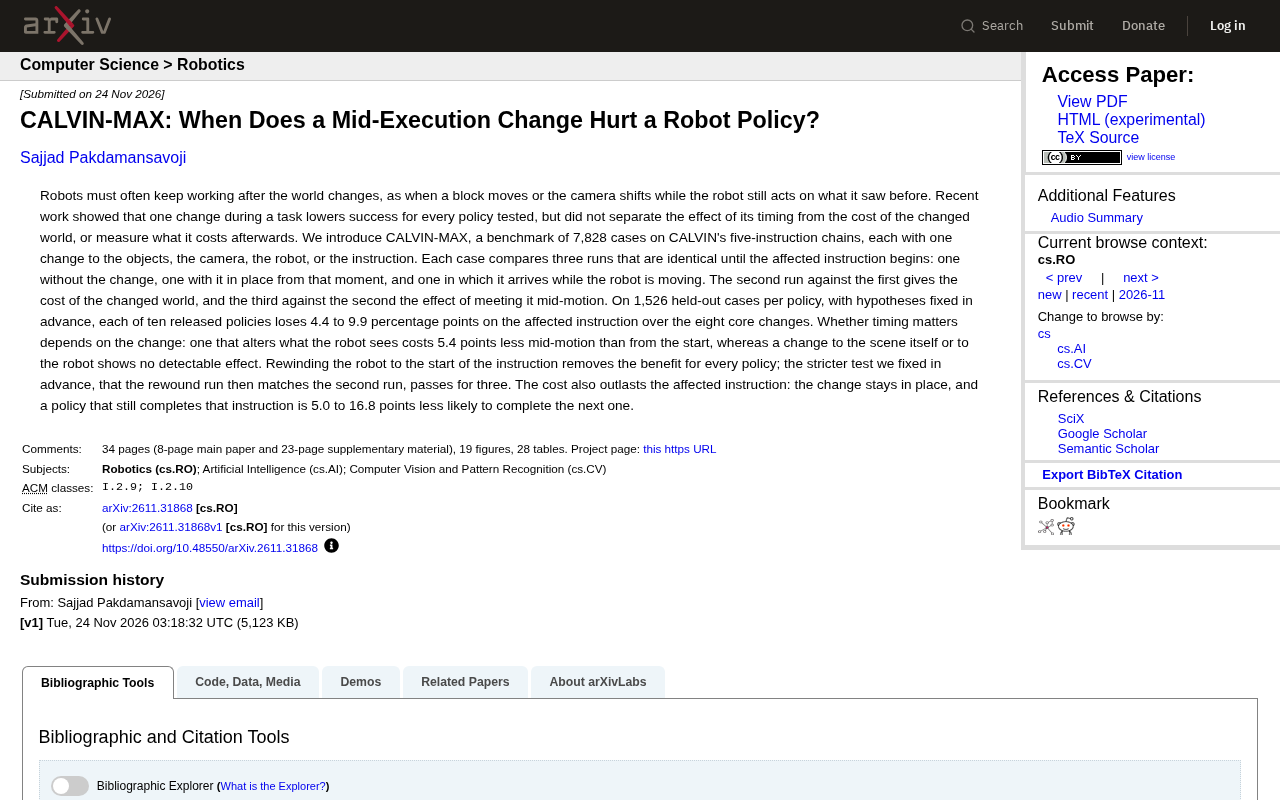
CALVIN-MAX is a new benchmark built on CALVIN's five-instruction chain task with 7,828 cases, designed to distinguish whether the cost of mid-execution changes comes from the changed world itself or from the change arriving mid-motion. Through three run comparisons—no change, change from start, and change mid-motion—the team found across ten published policies that affected instruction success rates drop by 4.4 to 9.9 percentage points. The key finding is that the timing effect depends on change type: visual changes cause 5.4 percentage points less loss when arriving mid-motion, while scene or robot changes show no significant timing effect. Moreover, the cost of changes persists to subsequent instructions, with success rates dropping a further 5.0 to 16.8 percentage points. Rewind experiments show most policies cannot eliminate the timing effect by starting over.
When robots execute tasks, the world often doesn't stay still—blocks may be moved, cameras may get knocked askew, and the robot is still acting on information it saw earlier. Does the harm to policy success rates from changes during execution come from the change itself, or from when it occurs? The newly introduced CALVIN-MAX benchmark attempts to provide an answer.
Background: The Cost of Mid-Execution Changes Has Not Been Disentangled
Existing research shows that a single change during a task reduces the success rate of all tested policies, but prior work has not distinguished two factors: the cost brought by the changed world itself, and the additional impact of the change arriving mid-motion. In other words, we don't know whether a policy fails because it "sees a different world" or because it is "interrupted at the wrong time."
This distinction is crucial for robot learning. If the harm mainly comes from the changed world, then improving policy robustness is key; if the harm mainly comes from the timing of the change, then the policy's online adaptation capability and reaction speed are the bottleneck. CALVIN-MAX is designed precisely to measure these two separately.
CALVIN (Composing Actions from Language and Vision) is an open-source robot manipulation benchmark platform that uses language instructions to have a robot complete a series of manipulation tasks in a simulated environment, such as opening and closing drawers and pushing blocks. CALVIN's core feature is the "five-instruction chain" task: the robot must execute five consecutive language instructions, where the result of executing one instruction affects the initial state of subsequent instructions, thus placing high demands on the policy's long-horizon coherence. CALVIN-MAX introduces controlled changes on top of CALVIN, leveraging its chain structure to observe how changes propagate over time.
CALVIN-MAX Design: Three Runs, One Variable
CALVIN-MAX is built on CALVIN's five-instruction chain task and contains 7,828 cases in total. Each case applies a single change to one of the following: an object, the camera, the robot, or an instruction. The core design is a comparison of three runs, which are identical before the affected instruction begins:
- First run: no change is applied.
- Second run: the change exists from the start of the instruction.
- Third run: the change arrives while the robot is in motion.
The difference between the second run and the first run gives the cost of the "changed world"; the difference between the third run and the second run gives the additional effect of "encountering a change mid-motion." This controlled design isolates the timing effect from the world change itself.
On 1,526 held-out cases for each policy, the research team pre-registered their hypotheses. Across eight core changes, ten published policies showed a 4.4 to 9.9 percentage point drop in success rate on the affected instruction.
Pre-registered hypothesis refers to researchers publicly declaring the hypotheses to be tested and the primary analysis plan before the study begins, and then collecting and analyzing data. This practice reduces bias from post-hoc selection of favorable results and increases the credibility of the research. In CALVIN-MAX, the team pre-registered hypotheses on 1,526 held-out cases, meaning they locked in the analysis scope in advance rather than choosing which comparisons to report after seeing results, which strengthens the robustness of the benchmark's conclusions.
Key Finding: Whether Timing Matters Depends on the Type of Change
The experiments reveal a nuanced conclusion: whether the timing of a change causes additional harm depends on what the change alters.
When a change alters what the robot sees (e.g., camera displacement), it loses 5.4 percentage points less when arriving mid-motion than when present from the start of the instruction. This means that for visual-input changes, the robot's reliance on old visual information actually gives it some buffer during motion—or rather, a mid-motion change gives it a chance to adjust while moving.
In contrast, changes to the scene itself or to the robot show no significant timing effect. Such changes incur roughly comparable costs regardless of when they occur.
This divergence suggests we cannot broadly claim that "mid-execution changes are always worse." Visual changes and physical-state changes affect policies through different mechanisms and need to be treated separately.
Held-out cases refer to a subset of data that is not used for any tuning, model selection, or policy development throughout the experiment. In CALVIN-MAX, these 1,526 cases are used only for final evaluation, ensuring that the reported success rate drops are not artifacts of overfitting or selection bias. The size and composition of the held-out set were determined at the pre-registration stage, further constraining the degrees of freedom in the analysis.
Costs Persist to Subsequent Instructions
More noteworthy is that the impact of a change does not stop at the affected instruction. Because the change persists, policies that still completed the affected instruction had a 5.0 to 16.8 percentage point lower success rate on the next instruction. This shows that the cost of mid-execution changes is persistent and drags down subsequent task performance.
The study also tested the effect of rewinding the robot to the instruction's starting position. Rewinding eliminated the benefits that all policies gained under mid-motion changes; and the stricter pre-specified test—that the post-rewind run should match the second run (change present from the start)—was passed by only three policies. This result indicates that most policies cannot simply "start over" to eliminate the timing effect, and the benefits they gain under mid-motion changes do not come from a better starting state.
Rewind here refers to resetting the robot and its environment state to the position before the affected instruction began executing, equivalent to letting the robot "redo" that instruction. If the benefits a policy gains under mid-motion changes came purely from a more favorable starting state, then this benefit should disappear after rewinding, and the results should match the case where the change was present from the start. The study uses this operation to test whether policies truly possess online adaptation capability rather than merely relying on initial conditions.
Implications for Robot Policy Research
The value of CALVIN-MAX lies in providing a reproducible measurement framework that separates the two factors of "the world changed" and "it changed at the wrong time." For policy developers, this means evaluating robustness requires finer-grained diagnostics:
- The timing effect for visual changes is negative (mid-motion changes cause less loss), which may point to the policy's handling of outdated visual information as worthy of further study.
- Changes to the physical scene and the robot body show no timing effect, indicating that the cost of these changes mainly comes from the state difference itself.
- The performance drop on subsequent instructions reminds us that single-instruction success rates are insufficient to reflect the true cost of changes; cumulative effects across multi-step tasks need to be evaluated.
These findings are based on pre-registered hypotheses across ten published policies and 1,526 held-out cases, providing a comparable baseline for future research. How to use these insights to design more robust policies remains an open question.
One-line Summary
CALVIN-MAX decomposes the cost of mid-execution changes into world change and timing factors, revealing a negative timing effect for visual changes.
Paragraph Summary
CALVIN-MAX is a new benchmark built on CALVIN's five-instruction chain task, containing 7,828 cases, designed to distinguish whether the cost of mid-execution changes comes from the changed world itself or from the timing of the change arriving mid-motion. Through three run comparisons—no change, change present from instruction start, and change arriving mid-motion—the team found across ten published policies that the affected instruction's success rate drops by 4.4 to 9.9 percentage points. The key conclusion is that the timing effect depends on the change type: visual changes cause 5.4 percentage points less loss when arriving mid-motion, while scene or robot changes show no significant timing effect. Moreover, the cost of changes persists to subsequent instructions, with success rates dropping a further 5.0 to 16.8 percentage points. Rewind experiments show that most policies cannot eliminate the timing effect by starting over.
Related articles

Michael Nielsen Takes Down His Classic Neural Network Textbook, Sparking Community Discussion
Michael Nielsen's classic free textbook Neural Networks and Deep Learning has been taken offline, sparking discussion on Hacker News about the reasons and impact.

Inside the AI Training Data Market: The Trade-off Between Exclusivity and Discounts
G2i founder Gabe Greenberg reveals the dual-track pricing of the AI training data market: labs pay a premium for exclusive data or accept discounts that allow others to buy it.

SessionGraph: Unifying All Coding Agent Sessions in One Interactive Graph
SessionGraph aggregates coding agent sessions into an interactive graph, helping developers review, debug, and manage AI coding workflows across sessions. This article examines its positioning, value, and open questions.