Camp Snap Launches CS-8 Micro: A Mini Retro Camera That Clips to Your Keychain

Camp Snap launches the keychain-sized screenless camera CS-8 Micro, continuing its retro blind-shooting approach with extreme miniaturization.
Camp Snap quickly followed its kids' CS-8 with the even smaller CS-8 Micro, small enough to hang on a keychain, continuing the brand's screenless design. The article argues that Camp Snap takes a "subtraction" path opposite to mainstream imaging manufacturers, competing on form and emotional value rather than image quality. Extreme miniaturization brings zero carrying burden but may sacrifice grip comfort and ease of operation. Target users include young people seeking portability and fun, and parents wanting to keep kids away from screens. The original text does not disclose price, battery life, or shooting specs, so practicality remains unverified.
From Kids' Version to Keychain: Camp Snap's Hardware "Shrink" Philosophy
According to RSS sources, Camp Snap just launched a miniaturized screenless camera, the CS-8, last week—half the size of the original, with a smaller grip that's better suited for children's hands. But clearly, the company isn't stopping there. The newly released CS-8 Micro is even smaller than the kids' version—small enough to clip directly onto a keychain.
From a product strategy perspective, Camp Snap is taking a path opposite to mainstream imaging manufacturers: while others stack sensors, add screens, and compete on specs, it keeps subtracting—removing the screen, shrinking the size, and pushing the retro "screenless shooting" experience to the extreme.
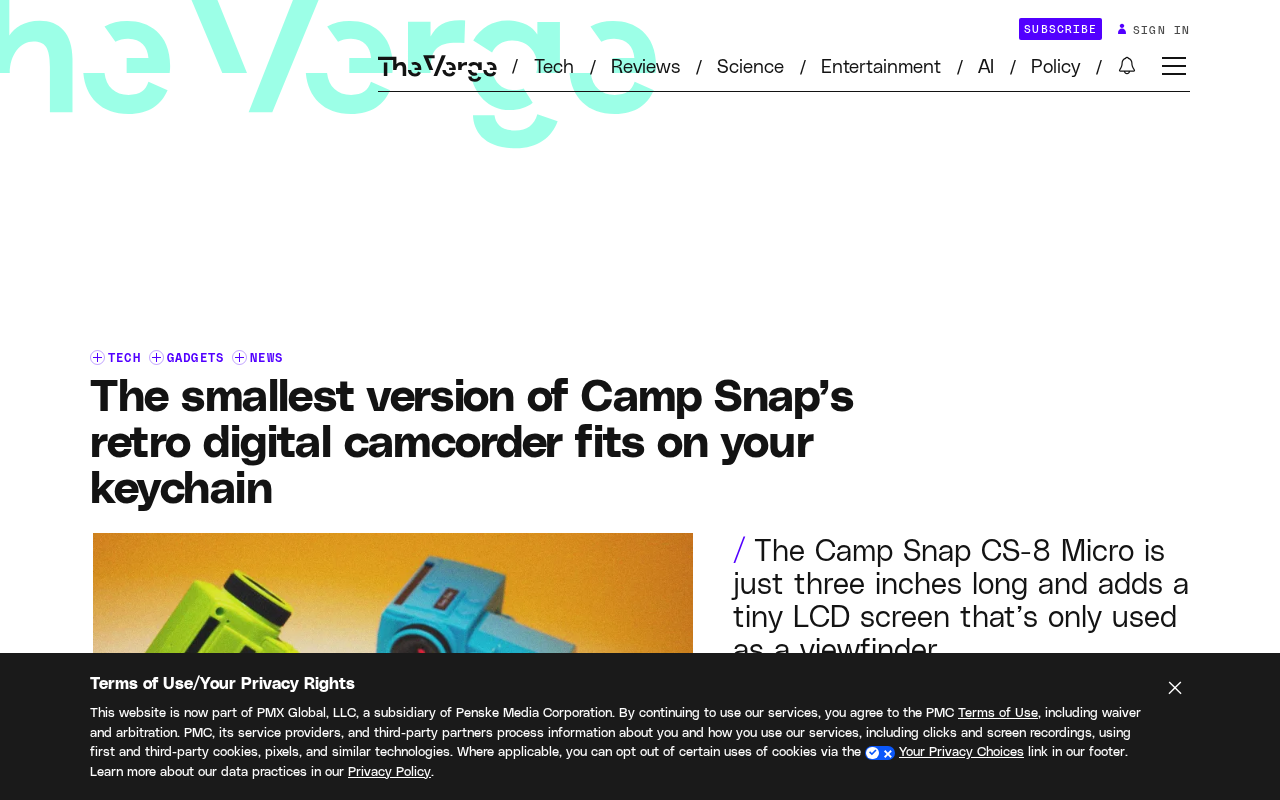
Just How Small Is the CS-8 Micro?
The original text's description of the CS-8 Micro stops at "smaller than the kids' version," with no specific dimensions or weight provided. The known reference points: the CS-8 kids' version is half the size of the original, and the CS-8 Micro shrinks further on that basis. In other words, this product's size is approaching that of an ordinary keychain charm.
The direct benefit of this extreme miniaturization is zero carrying burden—you can attach it to your keys and pull it out to shoot anytime. The cost may be grip comfort and ease of operation; after all, the smaller the body, the more cramped the buttons and grip area. Camp Snap clearly believes that for its target users, "carrying it anywhere" matters more than "shooting comfortably."
The Trade-offs of a Screenless Design
Camp Snap's entire product line adheres to a screenless design, and the CS-8 Micro continues this tradition. No screen means you can't review composition while shooting—users can only press the shutter by feel and export photos or videos afterward through other means. This "blind shooting" experience deliberately mimics how early film cameras were used, and it's also the core of Camp Snap's brand identity.
For users accustomed to the instant preview of smartphones, this design may be hard to accept; but for parents seeking a retro sense of ritual, or wanting to keep their kids away from screens, screenless becomes a selling point instead. The positioning of the CS-8 kids' version already makes this clear—Camp Snap treats children and "screen anxiety" as its target scenario.
Screenless cameras are not a new invention. Early film cameras all lacked instant preview screens; users composed through optical viewfinders and had to develop the film to see results. Screenless cameras in the digital age go further—even the viewfinder is often omitted, relying entirely on "blind shooting." The technical implementation of such products typically uses a fixed-focus wide-angle lens with a large depth of field to reduce focusing difficulty, allowing users to get usable photos without precise framing. Brands like Camp Snap also deliberately add film simulation filters and shutter sound effects to enhance the retro sense of ritual. From market feedback, the core users of screenless cameras are not photography enthusiasts, but those seeking "digital detox" or providing children with low-screen-dependency shooting tools.
The "Miniaturization Race" in the Retro Camera Market
Camp Snap isn't the only company making retro screenless cameras, but its aggressiveness in miniaturization is relatively rare. From the original CS-8 to the kids' version, and then to the CS-8 Micro, three generations of products have completed continuous size reductions in a very short time—a remarkably fast pace.
Behind this is a clear product logic: competition in the retro camera market isn't about image quality, but about "form" and "emotional value." Whoever can make a product more unique, more portable, and more buzzworthy is more likely to gain traction on social media. A keychain-sized camera itself has strong shareability—it doesn't look like a camera, but more like a trendy accessory.
Who Needs a Keychain Camera?
Judging from available information, the CS-8 Micro's target audience includes at least two groups: first, young users seeking portability and fun, who treat it as a toy for capturing life's fragments; second, parents buying it for their children—the kids' CS-8 already marketed "sized for small hands," and the Micro version further lowers the carrying threshold.
However, the original text does not disclose the CS-8 Micro's price, battery life, storage method, or specific shooting specs—information crucial for judging the product's practicality. Before official details are released, our evaluation can only remain at the form level.
Emotional value in consumer hardware refers to the emotional satisfaction and psychological identification a product brings to users, rather than pure functional utility. The rise of the retro camera market is a typical example of emotional value driving consumption: what users buy is not just a shooting tool, but a nostalgic experience, social talking point, and identity expression. The keychain form further amplifies this attribute—it turns the camera from a "device" into an "accessory," lowering the psychological threshold for purchase decisions and increasing the probability of spreading on social platforms. However, repeat purchases and word-of-mouth for emotionally driven products depend heavily on whether the actual experience matches expectations. If shooting quality or durability falls short, the product can easily become idle clutter once the novelty fades.
Summary
The core selling point of the Camp Snap CS-8 Micro is one word: small. It continues the brand's screenless retro approach, compressing the camera to keychain level, targeting portability and emotional value rather than professional shooting. Whether this product can sustain the popularity of its predecessors depends on whether the price and actual user experience live up to its gimmick.
Related articles

RePlan-VLA: Progress-Aware Replanning Breakthrough for Long-Horizon Robotic Manipulation
The RePlan-VLA framework converts VLA models' short-horizon capabilities into reliable long-horizon execution through progress-aware adaptive replanning, improving success rates by 21.9% and 10.4% on RoboCasa365 and CALVIN, and validating real-world deployment on a Franka Research 3 robot.

Geometric Bridge Flow Matching: A New Breakthrough in Blind Rigid Motion Correction
Geometric bridge flow matching enables blind rigid motion correction in head CBCT, achieving 37.1 dB PSNR and 0.27 mm RPE on simulated data in ~9.1 minutes, outperforming existing methods.

Google Releases Gemini 4 Hydrogen: 2.5x Faster Without Sacrificing Intelligence
Google releases the lightweight Gemini 4 Hydrogen: 2.5x faster task completion, AA Intelligence Index of 54 beating its flagship sibling, 7.3s single-step on Agent Arena faster than Claude and GPT rivals, four thinking levels with pay-as-you-need pricing, now available across AI Studio and more.