Campfire: An Open-Source Shared Workspace for Human and Coding Agent Collaboration
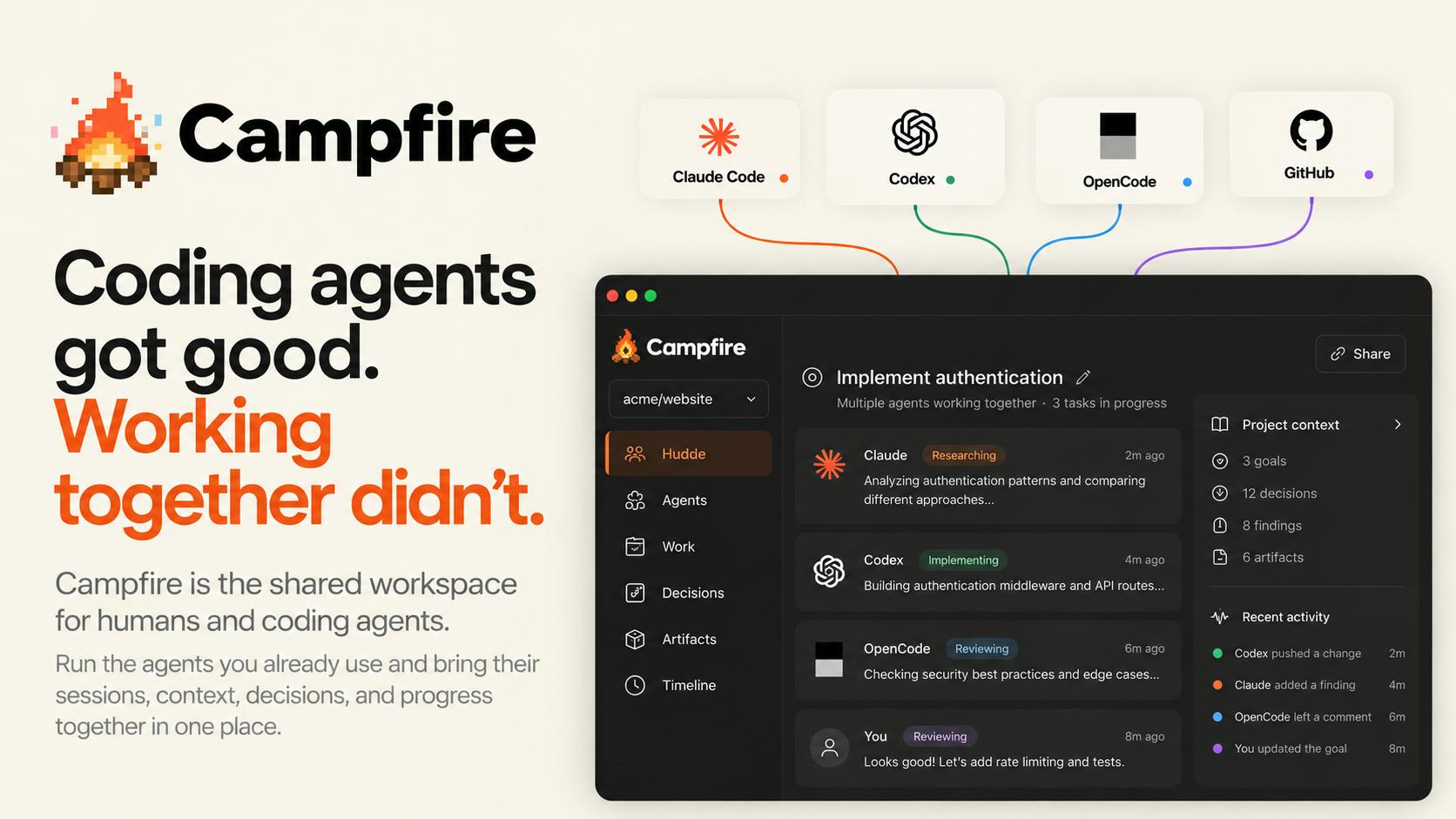
Campfire is an open-source shared workspace that unifies multiple coding agents' sessions and context into one collaboration hub.
As coding agents like Cursor and Claude Code proliferate, running multiple agents simultaneously has become the norm — but their sessions, context, and decisions remain siloed. Campfire positions itself as "the shared workspace for humans and coding agents," aggregating rather than replacing existing agents: unifying session views, preserving decision records, and keeping humans in control of the big picture. It emphasizes being open source and harness-independent, avoiding lock-in to any specific agent framework. Its 81 first-day upvotes on Product Hunt confirm real demand, though as an early-stage project, its stability and supported agent range are still to be validated.
When More Coding Agents Mean Less Collaboration
Over the past year, coding agents have evolved from experimental curiosities into everyday tools for developers. Cursor, Claude Code, and various CLI agents have proliferated rapidly, and developers often run multiple agents simultaneously. But an overlooked pain point has emerged: the sessions, context, decisions, and progress of these agents are completely siloed — each runs in its own sandbox, making it difficult for human developers to consolidate all this fragmented work into one place.
That's exactly the problem Campfire aims to solve. It launched on Product Hunt positioned as "the shared workspace for humans and coding agents," earning 81 upvotes and ranking 12th on its first day, categorized under open source, developer tools, and artificial intelligence.
What Campfire Actually Does
According to its official description, Campfire provides a common place where humans and coding agents can work together. Its core idea isn't to build yet another agent — it's to serve as an "aggregation and coordination" layer:
- Reuse the agents you already use: Campfire doesn't lock you into specific tools; you can keep running whatever coding agents you currently use.
- Consolidate sessions and context: It brings together sessions and context from different agents into a single workspace, preventing context from getting lost across multiple terminals and windows.
- Preserve decisions and progress: Decisions made and progress achieved by agents during development are uniformly recorded and surfaced, allowing humans to take over or review at any time.
In other words, Campfire acts as a "collaboration hub" — pulling scattered agent workflows into a single space so humans always maintain a view of the big picture.
"Harness-Independent" Is the Key Differentiator
Campfire specifically emphasizes being both open source and harness-independent. Both terms are worth unpacking.
A "harness" refers to the execution framework or wrapper layer that drives an agent. Many collaboration tools on the market lock you into a specific agent ecosystem — switching tools means starting the integration process all over again. Campfire's "harness-independent" approach means it doesn't presuppose which agent you use, and in theory remains neutral across different agents. This is quite attractive for teams that don't want to be locked into a single vendor.
The open-source nature further lowers the trust barrier. For tools that handle sensitive information like code, context, and architectural decisions, the ability to audit source code and self-host deployments is often what determines whether a team adopts a tool at all.
"Agent orchestration" is a hot topic in AI engineering right now. Typical orchestration frameworks like LangGraph, AutoGen, and CrewAI define at a low level how agents pass messages, share state, and trigger next steps. Once your workflow is deeply tied to one of these frameworks, migration costs are steep. Campfire's claimed harness-independent positioning aims to make it a "transparent middle layer" that doesn't intervene in execution logic but only handles presentation and aggregation — similar to how a CI/CD system doesn't care what language you write in, only that it can schedule and visualize the pipeline. This design philosophy has real practical value in today's fragmented toolchain landscape, but it also means Campfire needs to build individual integrations with each agent, which presents non-trivial long-term maintenance challenges.
The Trend It Taps Into
Campfire's emergence reflects a shift in AI coding tools from "single-point efficiency gains" to "multi-agent collaboration." When a developer might be orchestrating several agents at once, workflow coordination, context sharing, and human-agent handoffs become the new bottlenecks.
Products in the "agent orchestration" or "shared workspace" category are essentially filling a missing collaboration layer in the current AI coding stack. They don't aim to make any single agent smarter — they help humans avoid getting lost in a multi-agent environment.
That said, a realistic assessment is warranted: publicly available information remains limited, and Campfire's actual user experience, supported agent range, and stability in real-world projects all need more usage feedback to validate. Its 81 first-day votes suggest it's addressing a genuine need, but product maturity remains to be proven over time.
The core challenge of multi-agent collaboration (multi-agent collaboration) lies in the "context boundary" problem. Information accumulated by each agent in its independent session — explored solutions, encountered errors, architectural choices made — is by default invisible to other agents. This forces human developers to act as "manual routers," manually syncing state between different agents. Both academia and industry have explored several approaches: shared vector memory stores, structured agent handoff protocols, and unified task state graphs. Campfire's choice to start from workspace visualization is a relatively lightweight entry point that avoids the difficulty of forcing a unified internal architecture across agents — but as a result, its ability to intervene in agent behavior is comparatively limited.
Who Should Pay Attention to Campfire
If any of the following apply to you, Campfire is worth adding to your watchlist:
- You regularly run multiple coding agents simultaneously and struggle with scattered context and progress;
- You want to preserve decision records in human-agent collaboration for team retrospectives;
- You have a clear preference for open source, self-hostable tools that avoid vendor lock-in.
As an early-stage open-source project built by Sergio Rovira, Campfire currently feels more like a directional product worth trying and contributing to than a mature productivity staple. For developers interested in the future shape of AI coding, it offers a window into observing "human-agent shared workspaces" as an emerging product category.
Related articles

RAG Getting Started in Practice: From Principles to Building an Enterprise Knowledge Base
Bilibili RAG course highlights: from retrieval-augmented generation principles, document chunking and vectorization, to five accuracy factors and enterprise knowledge base boundaries, with fine-tuning vs RAG selection advice.

AI Model Selection Guide: DeepSeek vs. Qwen3 in Practice
How should AI developers choose models? Based on a Bilibili tutorial, this article breaks down the Function Calling differences between DeepSeek V3 and R1, Qwen3's programmatic thinking mode switching and agent capabilities, and outlines a multi-model learning path and practical selection logic.

Anchoring, Loss Aversion, and Nudges: 5 Psychological Tactics Retailers Use to Make You Spend
Behavioral economics reveals how retailers use anchoring, framing, loss aversion, and nudge theory to manipulate your spending decisions. This article breaks down 5 common psychological tactics and offers counterstrategies like slowing down decisions and setting your own anchors to see through the pricing design behind discounts.