Can a Mixture of Experts Beat a Single Large Model? A Deep Dive into the Hermes 2.0 Architecture

Deep dive into the Hermes 2.0 hybrid multi-agent system: can multi-model MoE collaboration beat a single top LLM?
This article breaks down the Hermes 2.0 hybrid multi-agent system, examining how its system-level Mixture of Experts architecture, AgentOS layer, and model-agnostic design work. It rationally assesses the system's performance claims and marketing boundaries, helping AI developers extract genuinely valuable architectural insights.
From "Chasing Models" to "Building Systems": A New Approach to Constructing AI
A recent technical demonstration video from Bilibili has sparked discussion about AI agent architecture. The author showcased a solution called the "Hermes Multi-Agent Hybrid System 2.0," whose core claim is fairly disruptive: rather than anxiously waiting for GPT-5.6 or another closed frontier model to be released, why not "stack" multiple existing models together to work collaboratively—winning through smarter system architecture rather than a larger single model.
The author summarized the entire system's design philosophy in a single sentence: "Don't chase models—build systems." This statement highlights a trend worth pondering in current AI application development—when models iterate faster and faster while their availability remains uncertain, binding your business logic to a single model becomes a risk in itself.
It should be noted that this article is based on a single-source demonstration video, in which a great deal of test data and model names (such as "GoldieBench," "Cloud Opus 4.8," "Nexus Research," etc.) lack cross-verification through public channels. Readers should maintain a cautious and critical mindset.

Mixture of Experts Architecture: Do Multiple Brains Beat a Single Genius?
Core Operating Principles
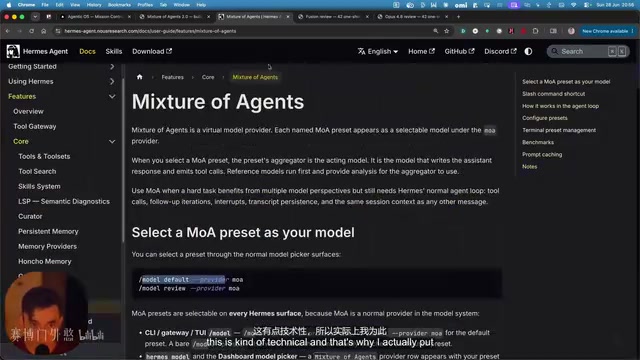
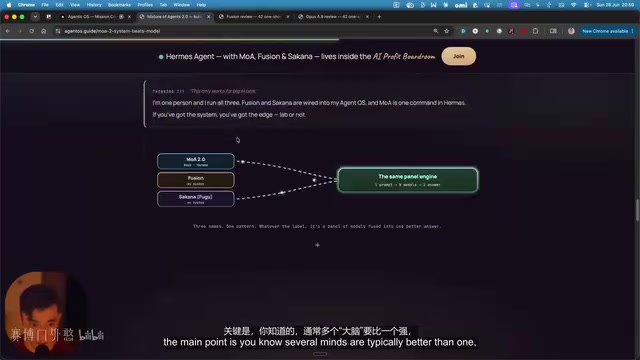
According to the presenter's explanation, the technical foundation of this system is the "Mixture of Experts (MoE)" architecture. But unlike traditional MoE, which routes within a single model internally, here it refers to organizing multiple independent models at the system level to work collaboratively "like a panel of experts."
The technical origins of the MoE architecture: The mixture-of-experts architecture can be traced back to the neural network ensemble theory proposed by Jacobs et al. in 1991. Its core idea is to decompose a complex problem across multiple "expert" sub-networks, with a gating network dynamically deciding which experts participate in processing a given input. In the field of large language models, MoE has become one of the mainstream scaling paradigms: Google's Switch Transformer replaced the feed-forward layer with sparse expert layers, achieving an order-of-magnitude increase in parameter count under the same compute budget; Mistral's Mixtral 8x7B brought this architecture to the open-source community, activating only 2 of 8 experts per inference, substantially lowering inference cost while maintaining capabilities approaching a 70B dense model. According to multiple reports, GPT-4 similarly adopts a comparable sparse MoE design. The core advantage of these "in-model MoE" approaches is that total parameter count determines the upper bound of knowledge capacity, while activated parameter count determines the cost of a single inference—decoupling the two. In contrast, what the video demonstrates is "system-level MoE," i.e., treating multiple complete, independent models as expert nodes, with task routing and result aggregation handled by an external orchestration layer. This approach is closer to the Mixture of Models paradigm in ensemble learning, with a lower engineering barrier since it requires no changes to the model's internal structure. However, designing efficient routing strategies (getting the right model to handle the right task type) and result fusion mechanisms (how to weight and arbitrate the outputs of different models) remains the core challenge that determines the system's actual effectiveness.
The specific workflow is: a user inputs a prompt, which is processed by multiple different models, and the system ultimately consolidates the results into a "better" answer. The metaphor the author repeatedly uses is—"If one genius competes against five geniuses, the five-person team usually gives a better answer."
Existing practices in multi-model collaboration: This idea is not unfamiliar in engineering practice, and several well-documented studies provide theoretical support for it. On improving reasoning quality, the "Self-Consistency" method was published by Wang et al. at Google Brain in 2022, which conducts multiple independent samplings of the same question and takes a majority vote, boosting accuracy by more than 17 percentage points on benchmarks such as GSM8K; the statistical intuition behind it is that a single generation may drift toward the wrong path due to randomness, while the aggregated result of multiple samplings better approximates the true answer. Going further, the "LLM Debate" paradigm (Du et al., 2023) has multiple model instances review each other's answers and raise objections, which has been shown to improve the accuracy of final outputs on fact-checking and mathematical reasoning tasks. In industrial practice, Microsoft's open-source AutoGen framework supports multi-agent conversational collaboration for tasks like code writing, debugging, and research by defining roles such as "AssistantAgent" and "UserProxyAgent"; Stanford University's "Generative Agents" experiment had 25 GPT-4 instances autonomously interact in a simulated town, giving rise to social behaviors such as plan coordination and information propagation. These cases collectively support the argument that "multiple reasoning perspectives outperform a single perspective," but the key precondition is that the coordination overhead of a multi-model system—including additional API call latency, cost stacking, and the accumulation and amplification of errors across chained calls—must be lower than the quality gains it brings. This balance point is not always naturally met in real-world deployment, and the assumption that different models complement each other by excelling at different tasks also requires rigorous empirical evaluation for specific task types, rather than naively assuming "more is better."
Deep Integration with Agent Capabilities
Another focus of the video is combining the mixture-of-experts system with the autonomous execution capabilities of the Hermes Agent. The author claims that the Hermes Agent is "the world's most popular and most powerful open-source free agent," and that when its Agent capabilities (such as computer operation, browser control, and voice interaction) are layered on top of multi-model hybrid reasoning, it can build quite powerful automated workflows.
AgentOS: Packaging Complex Commands into a Visual Workspace
To lower the barrier to use, the author developed an operating-system layer called "Hermes AgentOS." Hybrid agent commands that originally had to be run in the terminal are now packaged into a graphical interface, greatly reducing the learning cost for ordinary users.
Industry background of the AI operating system layer: The concept of "AgentOS" reflects an important evolutionary direction in current AI applications: a migration from a single conversational interface toward a complete "AI operating system" layer. Understanding this trend requires tracing the expansion of LLM capability boundaries—early ChatGPT was primarily text-based dialogue, with its capabilities stopping at language generation; as capabilities such as Function Calling (introduced by OpenAI in June 2023), Code Interpreter, and Computer Use landed one after another, models began to acquire the ability to call external tools, execute code, and manipulate GUIs, and the interaction paradigm evolved accordingly from a "chat box" toward an "operating system shell." Representative examples include: Cognition AI's Devin, which attempts to build a complete software engineering agent environment capable of autonomously handling the full pipeline from requirements analysis to code deployment; Adept AI's ACT-1, which focuses on GUI operation automation by directly parsing screen pixels to operate any desktop application; and OpenAI's Operator and Anthropic's Computer Use, which extend model capabilities directly to browser and desktop control. The common goal of these systems is to package the low-level "prompt + tool call" interaction into user-friendly visual workflows, lowering the barrier for non-technical users. However, this packaging also introduces a new layer of risk: the permission boundaries of automated operations (which system resources can the Agent access?), error recovery mechanisms (how to roll back when an intermediate step fails?), and audit trails (who is responsible for the consequences of automated operations?) are all core engineering challenges that such systems must confront when deployed in enterprise scenarios, and the industry has yet to form unified best practices.
Main Functional Modules
Based on the demonstration, this AgentOS integrates a rich set of functional modules:
- Hybrid Reasoning Panel: Input a prompt to invoke multi-model collaboration, with no terminal commands needed
- Automatic Workspace Saving: All generated content is automatically saved, making it easy to preview and revisit
- Chat and Voice Modes: Includes a built-in "Hermes Jarvis" that supports voice control, computer operation, and browser automation
- Content Creation Tools: Includes modules such as Studio and a language machine (retrieving the latest news and drafting content)
- Full OS Experience: The system can build Windows-style application interfaces on its own, complete with File, Edit, Terminal, and other menus
The author gave a practical use case: for sales outreach, you can use this system to build a SaaS tool with one click, obtain potential customers, construct an email marketing campaign, and send it automatically—the entire chain integrated and completed on a single platform.
This "end-to-end integration" approach aligns with the current development direction of Agent products—moving from single-point tools toward complete automated workflow platforms.

Model Agnosticism: The Core Value of the System Architecture
Not Being Held Hostage by a Single Model
The most noteworthy design philosophy of this system is its "Model-Agnostic" nature. The author repeatedly emphasizes: regardless of which model is invoked—Fable 5, GPT-5, or a soon-to-be-released new version—the working principle remains the same, always a collection of agents operating collaboratively.
The engineering value of model agnosticism: "Model agnosticism" is a concrete embodiment of the software engineering principle of "Separation of Concerns" at the AI system level, and its importance has been repeatedly proven over the past two years by dramatic shifts in the LLM market. Since 2023, the iteration cycle of mainstream models has compressed from years to months or even weeks: OpenAI released multiple major versions within a year, including GPT-3.5, GPT-4, GPT-4 Turbo, and GPT-4o, while Anthropic's Claude series went through three major version leaps from Claude 1 to Claude 3.5 during the same period, with API interface parameters, pricing strategies, context window lengths, and availability all in constant flux. Tightly coupling business logic with a specific model—for instance, hardcoding model names in code or relying on a particular model's output formatting habits—means that every major vendor update could trigger system-level refactoring, increasing maintenance costs and downtime risk. Against this backdrop, mainstream Agent frameworks such as LangChain and LlamaIndex have all made model agnosticism a core design goal: LangChain shields the API differences among vendors through a unified BaseChatModel abstraction layer, so that switching between OpenAI, Anthropic, Cohere, or a local Ollama model requires only a single line of configuration change. From an operational reliability perspective, a model-agnostic architecture also naturally supports a "Model Fallback" strategy—when the preferred model becomes unavailable due to overload, failure, or cost overruns, the system can automatically switch to a backup model. This has become a standard requirement for high-availability design in enterprise AI deployment, mirroring the "Circuit Breaker" pattern in traditional software engineering.
This means that when a new model is released, you simply plug it directly into the system, and the core business logic remains unchanged. The system also comes with a memory feature to ensure that context flows smoothly across different models.
From an engineering perspective, this decoupled design is reasonable: it turns "model selection" into a pluggable configuration item, letting developers focus on the business system itself rather than being exhausted by frequent model changes and availability risks.
Cost Flexibility
The author also raised a practical point: you don't have to use expensive top-tier models. You can use free APIs, local open-source models, or even have multiple low-cost models work collaboratively. The core logic remains "multiple brains beat one"—by mixing multiple lightweight models, you can theoretically surpass a single flagship model in overall output quality while substantially reducing inference costs.
This claim is quite appealing from an economic standpoint: using late-2024 pricing as a reference, GPT-4o's input token cost is roughly $2.5 per million tokens, while local deployment of Llama 3.1 70B, or invoking it through platforms like Groq, can cost as little as $0.59 per million tokens or even less. If the collaborative output of multiple low-cost models can indeed approach flagship-model quality, the cost-performance advantage would be significant. But the "theoretically" premise needs emphasis: collaboration itself introduces additional API calls and orchestration latency, and the cumulative cost effect of multi-model calls must be carefully accounted for on real tasks, rather than simply assuming that "invoking a cheap model a few more times is always more cost-effective."
A Rational Assessment: Architectural Insights and Marketing Boundaries
Parts That Require Cautious Treatment
While the core idea has merit, this demonstration still contains clear marketing overtones, and readers should keep a clear-headed judgment:
Questionable data credibility: The test data mentioned in the video—"tested 42 different models," "crushed everything on GoldieBench," "a 191-page recommendation letter"—all lack verifiable third-party sources. The author himself admits it was "only put together today," and the testing relied entirely on a personal demonstration.
Fabricated model names: Names appearing in the text such as "Cloud Opus 4.8," "GPT-5.6," and "Nexus Research multi-agent hybrid model" are largely nonexistent or unverified products, which directly undermines the credibility of the comparison data.
Obvious commercial conversion intent: The end of the video heavily promotes content such as a "classroom page," "weekly coaching calls," and a "paid community," suggesting the demonstration may serve commercial conversion more than pure technical sharing.
Recognizing marketing patterns in AI demonstrations: The business model that combines video demonstrations with course sales has become a highly templated paradigm in the AI content creation space, and understanding how it operates helps readers build an effective information-filtering framework. The rise of this model has its own context: the AI boom triggered by ChatGPT in 2023 created enormous market demand born of "AI anxiety"—large numbers of practitioners without technical backgrounds are eager to quickly master AI application skills and willing to pay for clear, easy-to-understand tutorials and community support. Against this backdrop, typical "AI guru" content follows several recognizable patterns: creating a perception of differentiation with an exclusively named "system" or "methodology" (such as "Hermes 2.0" or "the X framework"), implying that mastering this method lets you surpass ordinary practitioners; citing performance data that cannot be independently verified (self-built benchmarks, internal tests) to support claims of superiority; showcasing impressive but hard-to-reproduce one-off demonstrations under controlled conditions; and completing continuous commercial conversion through a "community + regular coaching" system. Practical criteria for evaluating the credibility of AI technical demonstrations include: whether performance tests use recognized third-party benchmarks (such as MMLU and HumanEval for reasoning ability, LMSYS Chatbot Arena for dialogue quality, or industry-standard datasets for specific domains); whether the demonstration workflow is transparent enough for independent reproduction; and whether the author candidly discloses the system's failure cases, limitations, and boundaries of applicability. In an era flooded with AI content, this metacognitive ability to scrutinize technical claims has itself become one of the core competencies of developers and practitioners.
Architectural Ideas Worth Borrowing
Setting aside the marketing packaging, the core claim of "building a model-agnostic Agent system" is itself valid. In the multi-model era, decoupling business capabilities from specific models and improving system robustness and output quality through multi-model collaboration is a direction that many serious AI engineering teams are actively exploring. The rapid development of open-source frameworks such as LangGraph, CrewAI, and AutoGen, along with the "model routing" and "model fallback" features commonly built into enterprise-grade AI platforms, all confirm the engineering rationality of this direction. Developers can extract valuable architectural insights from it, but should maintain an independent-verification mindset toward specific performance claims, using their own real-task measurement results as the final basis for judgment.
Conclusion
The Hermes 2.0 hybrid system demonstrates an approach to building AI applications that "wins through system architecture": through multi-model collaborative reasoning, model-agnostic design, and a visual operation layer, it attempts to achieve better overall output without relying on a single frontier model. This concept aligns with the current mainstream trend in multi-agent development and has some reference value.
However, many of its performance claims lack independent verification and are accompanied by clear course-marketing intent. Developers are advised to take the strengths of its architectural ideas, remain cautious about specific data, and ultimately defer to their own measurement results.
Key Takeaways
Key Takeaways
Related articles

ChatGPT Space Launches: Team Collaboration and New Pages Features Explained
ChatGPT Space is OpenAI's new team collaboration feature with Pages, real-time collaboration, and Slack/Google Drive sync. We break down its privacy design, multi-platform integration, and the full workflow from conversation to document.

Migrating Apache Spark UDFs to GPU Acceleration with AI Agents
NVIDIA developer blog explains how AI Agents rewrite Apache Spark UDFs for GPU acceleration, covering migration criteria, agent rewriting and verification workflows, plus pitfalls like result consistency and CPU-GPU transfer overhead.

Zed Editor v0.40.4-rc2 Released: Usage Credits Now Available Without Upgrading
Zed editor releases v0.40.4-rc2, allowing users to use usage credits for AI features without upgrading to a paid plan, lowering the trial barrier.