Can AI Deliver a Real "LK-99 Moment"?

Exploring whether AI can deliver a verified scientific breakthrough like the LK-99 moment promised but failed to be.
Inspired by the 2023 LK-99 superconductor frenzy, this article examines how AI is transforming materials science through massive candidate screening, hypothesis generation, and closed-loop experimentation. It analyzes AI's potential across batteries, catalysts, superconductors, and fusion materials, arguing that while AI excels as an accelerator and filter within known frameworks, true paradigm-shifting discoveries still require human creativity.
The "LK-99 Moment" That Made the World Hold Its Breath
In the summer of 2023, the materials science community experienced a rare collective frenzy. A material called LK-99 was claimed to be a room-temperature, ambient-pressure superconductor — if true, it would be a discovery capable of rewriting the course of human civilization. From power grids to magnetic levitation, from quantum computing to nuclear fusion, room-temperature superconductors carry countless technological dreams.
A superconductor is a material that exhibits zero electrical resistance and complete diamagnetism (the Meissner effect) below a certain temperature. Since Dutch physicist Heike Kamerlingh Onnes discovered superconductivity in 1911, humanity has been searching for materials that can achieve superconductivity at room temperature and ambient pressure. Current practical superconductors (such as niobium-titanium alloys and YBCO high-temperature superconductors) still require extremely low temperatures or ultra-high pressures, severely limiting their applications. If room-temperature, ambient-pressure superconductors were truly realized, power transmission losses would drop to zero (global grid losses are currently about 8-15%), maglev trains would become economically viable, MRI equipment costs would plummet, and the decoherence problem in quantum computers might be solved.
During those few days, physicists, materials scientists, and even hobbyists around the world raced to replicate the experiments, while social media overflowed with "levitation videos" and theoretical analyses. Although LK-99 ultimately failed rigorous scientific replication and was shown not to be a true superconductor, the sense of awe — that "civilization might change because of this" — remains unforgettable.
LK-99 was a lead-apatite structured material (chemical formula Pb₁₀₋ₓCuₓ(PO₄)₆O) claimed to have been synthesized by the team of Lee Sukbae and Kim Ji-Hoon at Korea University, where some lead atoms are replaced by copper atoms. The team claimed the material exhibited superconducting properties below 127°C. However, replication attempts from dozens of laboratories worldwide showed that the observed resistance drops and partial magnetic levitation could be explained by copper sulfide (Cu₂S) phase transitions and ferromagnetic impurities, rather than true superconductivity. This incident also exposed the double-edged nature of scientific communication in the preprint era — unreviewed papers on arXiv can trigger global attention within hours, accelerating scientific discussion but also amplifying the impact of unverified claims.
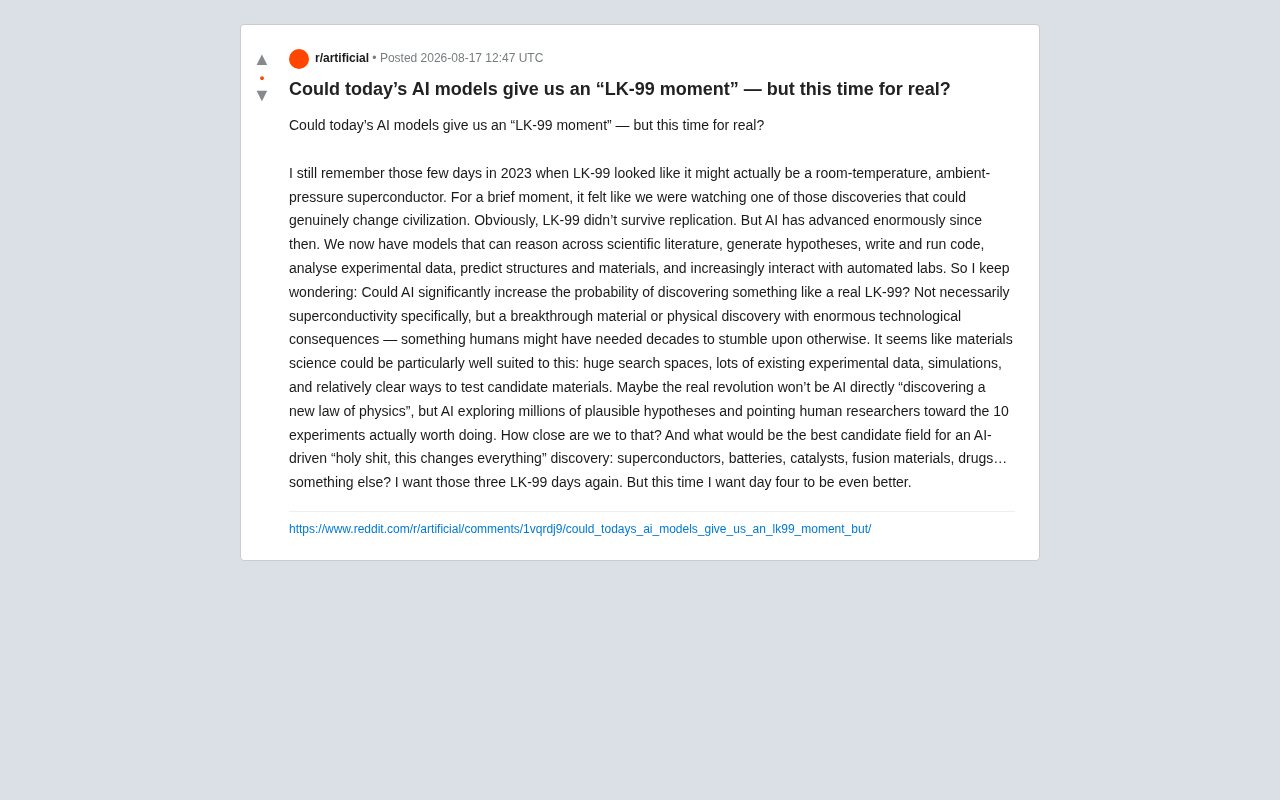
A Reddit user posed a thought-provoking question: In today's era of rapidly advancing AI technology, can we witness a real "LK-99 moment"? Not necessarily a superconductor, but any material or physics breakthrough capable of bringing massive technological change — the kind of thing humanity might need decades to stumble upon by chance.
AI's Role in Scientific Discovery Is Undergoing a Qualitative Shift
Compared to 2023, AI capabilities have undergone a fundamental leap. Today's models are no longer just "chat tools" — they can:
- Reason across scientific literature, extracting hidden connections from massive bodies of papers
- Generate and validate scientific hypotheses, narrowing the scope of experimental exploration
- Write and execute code for numerical simulations and data analysis
- Predict molecular structures and material properties, as in DeepMind's GNoME project
- Interact with automated laboratories, enabling "closed-loop" autonomous research
Why Materials Science Is Particularly Suited to AI-Driven Discovery
The original poster astutely noted that materials science may be one of the fields where AI excels most. The reasons are clear:
First, the search space for materials is astronomically vast. The number of possible compound combinations is staggering, and a human researcher can only test a tiny fraction in a lifetime. For ternary compounds alone, considering just the roughly 90 stable elements in the periodic table, multiplied by different stoichiometric ratios and crystal structures, the candidate space easily exceeds 10¹⁰ possibilities. AI can rapidly screen millions of candidates in virtual space.
Second, materials science has accumulated massive experimental datasets and mature simulation tools. From density functional theory (DFT) to molecular dynamics simulations, these computational methods provide AI with rich training material and validation tools. Density functional theory is the cornerstone method of computational materials science, with its theoretical framework proposed by Walter Kohn and Pierre Hohenberg in 1964 — Kohn received the 1998 Nobel Prize in Chemistry for this work. DFT's core idea is to replace the many-body wave function (a 3N-dimensional function) with electron density (a three-dimensional function) to describe the ground-state properties of a system, reducing computational complexity from exponential to polynomial. Modern DFT calculations can predict crystal structures, band gaps, elastic constants, phonon spectra, and other material properties, but systematic errors remain for strongly correlated systems (including many superconducting materials) — this is one of the technical reasons AI faces challenges in the superconductivity domain.
Third, candidate materials are relatively easy to test. Compared to verifying an entirely new physical law, synthesizing and characterizing a new material has a much clearer experimental pathway.
In fact, DeepMind's GNoME project, released in late 2023, predicted 2.2 million new crystal structures, of which approximately 380,000 were deemed stable — a number several times the total discoveries accumulated by human scientists over the past 800 years. GNoME (Graph Networks for Materials Exploration) uses graph neural networks (GNN) to predict crystal structure stability, with the core metric being a material's decomposition energy on the convex hull. The project employs an active learning strategy, iteratively generating candidate structures, validating them with DFT calculations, and then optimizing the model with the results. Of the 380,000 materials predicted to be stable, hundreds have been synthesized and verified by independent laboratories, confirming the reliability of AI predictions. This marks materials science's transition from "serendipitous discovery" to "rational design."
The Real Revolution: AI as a Research "Experiment Filter"
One particularly valuable insight from the original post is: The real revolution may not lie in AI directly "discovering new physical laws," but in AI exploring millions of reasonable hypotheses and then pointing human researchers to the 10 experiments truly worth conducting.
This perspective is highly pragmatic. The most expensive and time-consuming part of scientific research is often the experimental phase. A single materials science experiment may take weeks or even months and cost a fortune. If AI can compress "candidates worth trying" from millions down to a handful of high-potential options, the improvement in research efficiency would be revolutionary.
From "Needle in a Haystack" to "Precision Strikes"
Traditional materials discovery often relies on scientists' experience, intuition, and even luck. The discovery of LK-99 itself was partly serendipitous. The paradigm shift driven by AI transforms this "serendipity" into "inevitability" — by systematically traversing the possibility space, turning breakthrough discoveries from probabilistic events into predictable outputs.
This "human-AI collaboration" model has already shown early success in drug development. AI predicting protein structures (AlphaFold) and screening candidate drug molecules, followed by human scientists performing validation, has dramatically shortened the drug discovery cycle. AlphaFold, developed by DeepMind, predicted protein three-dimensional structures at near-experimental accuracy in the CASP14 competition in 2020, solving the "protein folding problem" that had plagued biology for 50 years. The AlphaFold2 database released in 2022 contains predictions for over 200 million protein structures, covering virtually all known proteins. This breakthrough reduced what previously required months of X-ray crystallography experiments to minutes of computation time. AlphaFold's success pattern — using deep learning to learn physical laws from existing experimental data, then generalizing to unknown systems — is precisely the paradigm the materials science community hopes to replicate.
Which Field Is Most Likely to Produce the Next AI-Driven Breakthrough?
The original poster listed several candidate fields: superconductors, batteries, catalysts, fusion materials, and drugs. Let's analyze the potential of each:
Battery Materials
This is likely the field closest to real-world output. The explosion in demand for electric vehicles and energy storage provides enormous application pull for new battery materials. Directions such as solid-state electrolytes and sodium-ion battery materials are supported by large amounts of structured data for AI exploration.
Solid-state electrolytes are key materials for next-generation battery technology, replacing the liquid organic electrolyte in traditional lithium-ion batteries with solid materials. In theory, this can achieve higher energy density (>500 Wh/kg, compared to about 250-300 Wh/kg for current commercial lithium-ion batteries), better safety (non-flammable), and longer lifespan. Major candidate materials include sulfides (such as Li₆PS₅Cl), oxides (such as Li₇La₃Zr₂O₁₂), and polymer systems. Sodium-ion batteries replace lithium with sodium, which is about 1,000 times more abundant in the Earth's crust, potentially reducing costs by 30-40% and making them particularly suitable for large-scale energy storage. Both directions have abundant published experimental data and clear performance metrics (ionic conductivity, electrochemical window, cycling stability, etc.), making them ideal for AI screening and optimization.
Catalysts
Catalysts are critical for green hydrogen, carbon capture, and chemical production. Finding cheap, efficient catalysts to replace rare metals is a direction where AI can make significant contributions.
Water electrolysis for hydrogen production is the core technology for green hydrogen, but current high-efficiency catalysts (such as platinum-based materials for the hydrogen evolution reaction and iridium-based materials for the oxygen evolution reaction) rely on rare precious metals at high cost. Global annual platinum production is only about 200 tons, and iridium is even scarcer at less than 10 tons per year. Finding inexpensive transition-metal-based catalysts (such as nickel-iron and cobalt-phosphide compounds) is a global research hotspot. The core challenge in catalyst design is understanding the relationship between the electronic structure of active sites and the adsorption energy of reaction intermediates — this is precisely where DFT calculations can generate large amounts of data, and machine learning can build structure-activity relationship models to enable rapid prediction and optimization of catalyst performance.
Superconductors
While this is the most exciting target, the theoretical mechanisms of room-temperature superconductivity remain incompletely understood, presenting a fundamental challenge for AI modeling. AI excels at searching within known frameworks, but its capabilities are diminished when facing problems with unclear physical mechanisms.
Traditional BCS theory (proposed by Bardeen, Cooper, and Schrieffer in 1957) explains the mechanism of low-temperature superconductors well — electrons form Cooper pairs through the mediation of lattice vibrations (phonons), enabling resistanceless transport. However, for cuprate high-temperature superconductors and iron-based superconductors, the pairing mechanism remains unresolved, meaning AI lacks a reliable "physical prior" to guide its search. Nevertheless, machine-learning-based methods have been used in recent years to predict superconducting transition temperatures (Tc) with good accuracy on known materials, though whether they can extrapolate to entirely new material systems remains unknown.
Fusion Materials
Fusion reactors require materials that can withstand extreme temperatures and neutron irradiation. This is a field with relatively scarce data but enormous significance. The first-wall materials at fusion plasma boundaries must withstand thermal loads exceeding 10 million degrees and bombardment from 14.1 MeV high-energy neutrons. Current candidate materials include tungsten alloys, silicon carbide composites, and reduced-activation ferritic/martensitic steels (RAFM). Because high-energy neutron irradiation experiments are extremely expensive and time-consuming (a single irradiation experiment can take years), AI's value in this field lies in predicting long-term performance degradation of materials under irradiation environments through multi-scale simulations, reducing dependence on actual irradiation experiments.
How Far Are We from "Day Four"?
The original poster's hope is touching: "I want those three days of LK-99 again. But this time, I want day four to be better."
"Day four" refers to the "confirmation moment" that should have followed the LK-99 frenzy but never materialized — the day the discovery is successfully replicated and confirmed as real.
Objectively speaking, we are rapidly approaching that moment, but we must remain rational. Currently, AI's role in scientific discovery is more that of an "accelerator" and "filter" than an independent "discoverer." True breakthroughs still require human scientists' verification, intuition, and creativity.
More importantly, AI's predictive capabilities are limited by the quality of training data and the accuracy of physical models. It can efficiently search within "known frameworks," but for discoveries requiring paradigm shifts — such as entirely new physical mechanisms — AI's contributions remain limited. This is a widely discussed limitation in machine learning: models are essentially interpolating within the "convex hull" of the training data distribution, while truly revolutionary discoveries often require "extrapolation" — jumping beyond the boundaries of known patterns. Of course, this limitation is being mitigated by new methodologies, such as embedding physical constraints into neural network architectures (Physics-Informed Neural Networks) or combining AI with symbolic reasoning systems to discover new physical laws.
Conclusion: Cautious Optimism
LK-99 ultimately did not pass scientific scrutiny, but the passion it ignited — that "civilization might be changed" — is precisely the most precious fuel for scientific progress. And today's AI is providing an unprecedented acceleration engine for that passion.
Perhaps in the near future, we will truly witness an AI-assisted "LK-99 moment" — but this time, day four won't be a disappointing replication failure, but a repeatedly verified real breakthrough. When that day comes, AI won't replace human scientists' curiosity and judgment, but will make every exploration more precise and more efficient.
The excitement of those three days makes day four worth waiting for.
Related articles

@ai-sdk/vue 3.0.306 Patch Release Syncs with [email protected] Update
@ai-sdk/vue 3.0.306 released, synced with [email protected]. A routine patch release for the Vercel AI SDK ecosystem with no public API changes; the Vue adapter layer stays version-aligned with the core package.

Gemini 4 Argon API Launches: The Era of Million-Token Output Begins
Google launches Gemini 4 Argon with sparse MoE architecture, up to 1M output tokens, and a 68.90% Vals Index score, available across API, AI Studio, and the Gemini app.

DukaanAI: Turning Product Photos into Inventory Lists with Open-Source AI
DukaanAI is an AI inventory tool for small retailers that turns product photos into inventory entries using the open-source Gemma 3 model, with local inference, editable fields, and CSV export.