Can AI Models' Self-Descriptions Reproduce Themselves? The Quine Test Reveals the Truth

The Quine Test finds that native model self-descriptions cannot reliably transmit their preference configurations—they influence behavior but lack portable specification.
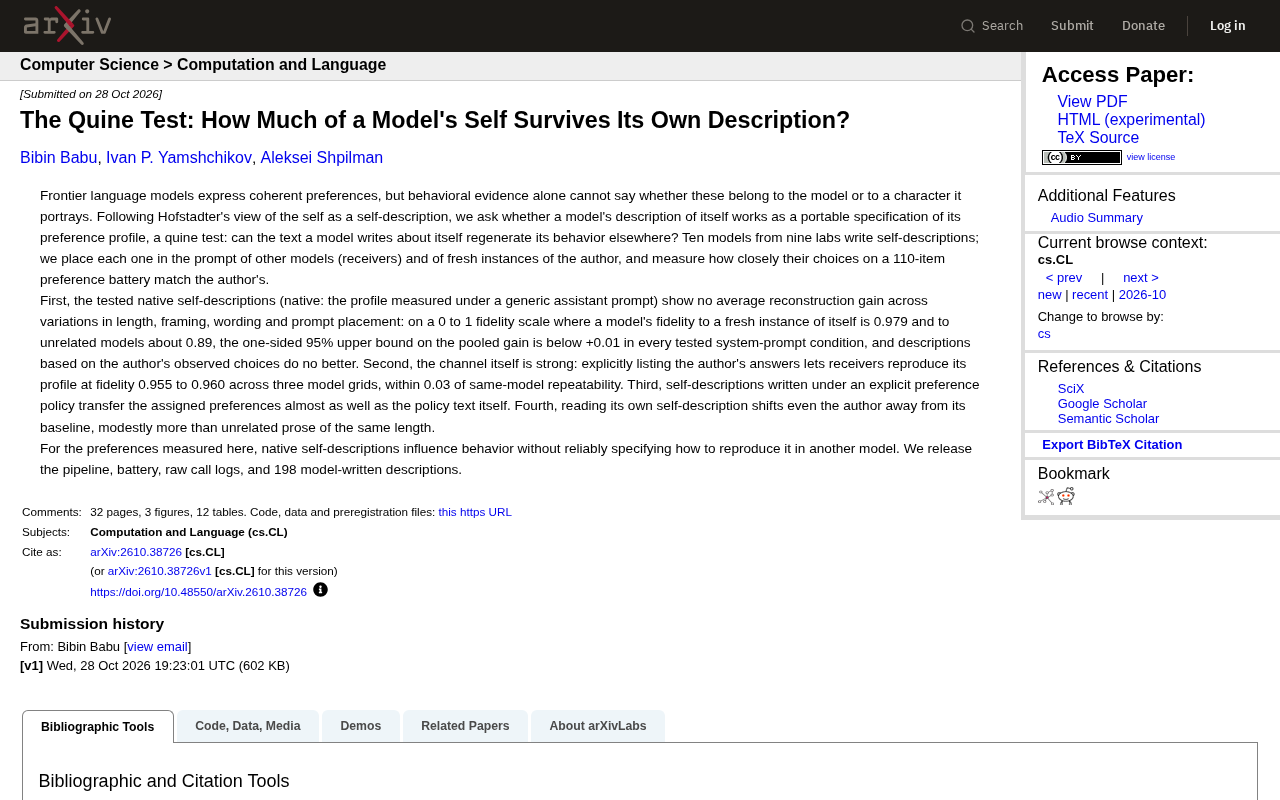
The study proposes the "Quine Test" to examine whether language models' self-descriptions can serve as portable preference specifications: ten models from nine labs wrote self-descriptions, which were then placed into the prompts of other models and new instances of the author, measuring choice match on a 110-item preference test. Results show that native self-descriptions provide no reconstruction gain on average; even varying length, framing, wording, and position, the upper bound of gain remained below +0.01, as did descriptions written based on actual choice behavior. However, the transmission channel itself is powerful: explicitly listing answers achieved fidelity of 0.955 to 0.960; descriptions written under an explicit policy transmitted assigned preferences almost as well as policy text. Additionally, reading self-descriptions caused authors to deviate from baseline behavior, slightly more than unrelated text. The study shows that self-descriptions influence behavior but are difficult to precisely reproduce, serving as a warning for alignment methods based on self-reports.
Introduction: When a Model Describes Itself, Is It Really Describing "Itself"?
Frontier language models can express consistent preferences, but behavioral evidence alone cannot answer a key question: do these preferences belong to the model itself, or to a role it is playing? Hofstadter once proposed that the self is a self-description. Inspired by this, a study called the "Quine Test" attempts to examine whether a model's description of itself can serve as a portable specification of its preference configuration. In other words, can the text a model writes about itself regenerate its behavior elsewhere?
The research team had ten models from nine labs write self-descriptions, placed each description into the prompts of other models (called "receivers") as well as new instances of the author model, and then measured how closely their choices on a 110-item preference test set matched the author's own. The core of this test is that if self-descriptions truly "encode" a model's preferences, then receivers should be able to reproduce the author's choice patterns by reading the description.
The name Quine Test derives from the concept of a "quine" proposed by philosopher W.V.O. Quine—a program that can output its own source code. In computer science, a quine refers to a program that takes no input and directly prints out its complete source code, a classic formalization of "self-reference." This study borrows this metaphor, analogizing "a model writing a description of itself that is sufficient to reconstruct that model's behavioral configuration elsewhere" to a semantic-level quine: the description should function like source code, as a portable, executable specification. It should be noted that this analogy itself carries a strong theoretical load—it presupposes that the model has some kind of "self" that can be fully encoded in text. The study's results precisely call this presupposition into question: the self-descriptions produced by models are closer to self-narratives in natural language than to quine-like, precisely reproducible specifications.
Experimental Design: How to Quantify the Transmission of "Self"?
The study employed a fidelity scale from 0 to 1: a model's fidelity to its own new instances was 0.979, while fidelity to unrelated models was approximately 0.89. This scale provides a baseline for measuring the transmission effect of self-descriptions. Experimental variables included the length, framing, wording, and position in the prompt of the self-description, in order to test its portability under different conditions.
Core Finding: Native Self-Descriptions Provide No Reconstruction Gain
The first key result is that the tested native self-descriptions (i.e., preference configurations measured under a general assistant prompt) showed no reconstruction gain on average. Regardless of how length, framing, wording, or prompt position were varied, under every tested system prompt condition, the one-sided 95% confidence upper bound of the aggregated gain was below +0.01. Even more surprisingly, descriptions written based on the author's actual choice behavior did not perform better. This means that models' spontaneous self-descriptions cannot reliably enable other models to reproduce their preferences.
The fidelity scale is the core metric of this study. Its basic idea is: take the choice agreement rate between two instances of the same model on the 110-item preference test set as the upper-bound benchmark for "self-reproduction" (measured at 0.979), and the agreement rate between unrelated models as the "random baseline" (about 0.89). Any transmission effect from a self-description is positioned between these two endpoints as a normalized gain from 0 to 1. The key to this design is that it distinguishes "absolute agreement rate" from "increment relative to baseline": since different models are already highly similar on general preferences (0.89 is quite high), a description that merely restates universal human preferences cannot demonstrate genuine "self-transmission." Therefore, the study focuses not on whether receivers agree with the author, but on whether the agreement rate significantly exceeds the unrelated-model baseline. This metric also explains why the conclusion of near-zero "reconstruction gain" is persuasive—it rules out false positives caused by general similarity between models.
The Channel Itself Is Powerful: Explicitly Listing Answers Has a Significant Effect
Although native self-descriptions failed to achieve effective transmission, the second finding shows that the transmission channel itself is very powerful. When the author's answers were explicitly listed, receivers were able to reproduce its preference configuration with fidelity of 0.955 to 0.960 across three model grids, which differs from the fidelity of repeated testing of the same model by only within 0.03. This shows that as long as information is given in a direct, explicit manner, models are fully capable of receiving and reproducing preferences. The problem is not that receivers are incapable, but that self-descriptions themselves lack sufficiently precise specification information.
Assigned Preferences Are Almost as Effective as Policy Text
The third finding further supports this: self-descriptions written under an explicit preference policy can transmit the assigned preferences almost as well as the policy text itself. This indicates that when models are asked to describe themselves according to a specific policy, the descriptions do contain actionable information. However, such descriptions are not the models' "native" self-descriptions, but rather products guided by external framing.
The system prompt condition refers to the instruction text placed at the very front of the conversation in the experiment, used to set the model's role and behavioral guidelines. A key experimental design of this study is to repeat measurements under multiple different system prompt conditions to test whether the transmission effect of self-descriptions depends on a specific prompt framing. For example, a general assistant prompt, a role-play prompt, or an explicit policy prompt will change the state the model "enters," thereby affecting its preference expression. When aggregating gains, the study averages or takes upper bounds across system prompt conditions precisely to rule out the possibility that "some specific prompt happens to amplify the effect." The importance of this design lies in the fact that the position, length, and wording of self-descriptions in the prompt may all interact with the system prompt; only when no significant gain appears across multiple prompt conditions can one robustly assert that native self-descriptions lack portability.
The Impact of Self-Descriptions on the Author Itself
The fourth finding turns to the effect of self-descriptions on the author itself. The study found that reading one's own self-description causes the author to deviate from its baseline behavior, and this deviation is slightly larger than reading an unrelated text of equal length. This means that although self-descriptions cannot reliably specify how to reproduce behavior in others, they can indeed influence behavior—including the author's own behavior. This influence is subtle, yet it reveals that self-descriptions are not harmless text.
Baseline behavior refers to the choice distribution a model exhibits on the preference test set when not exposed to any self-description or unrelated intervention text. The study separates the specific effect of self-descriptions by comparing the deviation from baseline after "reading a self-description" versus after "reading an unrelated text of equal length." This control design is crucial: any long-text injection will slightly perturb model outputs (i.e., prompt sensitivity), so a simple "before-and-after change" is insufficient to attribute to the content of the self-description. The results show that the deviation caused by self-descriptions is slightly larger than that of unrelated text, indicating that although the effect is small, it indeed stems from the content itself rather than mere text length or format. This also suggests that self-descriptions are "two-way" text—they can neither precisely transmit preferences to others nor avoid slightly rewriting the author's own subsequent behavior.
Significance and Limitations: Self-Descriptions Influence Behavior but Are Difficult to Precisely Reproduce
For the preferences measured here, native self-descriptions influence behavior but cannot reliably specify how to reproduce them in another model. The research team has released the complete pipeline, test set, raw call logs, and 198 model-written descriptions, providing a foundation for future research.
This study reminds us that a model's "self-description" may be more like a performance or role construction than a precise self-specification. When a model says "I like X," this is not necessarily a portable preference statement, but may simply be an expression in the current context. This finding has important cautionary implications for application scenarios that rely on model self-reports to understand their preferences.
Implications for AI Alignment and Interpretability
If models cannot reliably transmit their preferences through self-descriptions, then alignment methods based on self-reports may need to be reconsidered. Researchers may need to develop more direct behavioral measurement methods rather than relying on models' narratives about themselves. At the same time, this provides a new perspective for understanding model identity and role-playing capabilities: a model can play a role and express consistent preferences, but these preferences do not necessarily belong to a stable "self."
Conclusion
With its elegant design, the Quine Test reveals the limitations of model self-descriptions in preference transmission. Although the channel is powerful, native self-descriptions lack sufficient information density to serve as portable specifications. This finding not only challenges our intuitive understanding of the model "self," but also points the way for future research: to truly understand model preferences, it may be necessary to go beyond self-descriptions and seek more direct measurement and verification methods.
One-line Summary
The Quine Test finds that native model self-descriptions cannot reliably transmit their preference configurations—they can influence behavior but lack portable specification.
Paragraph Summary
The study proposes the "Quine Test" to examine whether language models' self-descriptions can serve as portable preference specifications: ten models from nine labs wrote self-descriptions, which were then placed into the prompts of other models and new instances of the author, measuring choice match on a 110-item preference test. Results show that native self-descriptions provide no reconstruction gain on average; even varying length, framing, wording, and position, the upper bound of gain remained below +0.01, as did descriptions written based on actual choice behavior. However, the transmission channel itself is powerful: explicitly listing answers achieved fidelity of 0.955 to 0.960; descriptions written under an explicit policy transmitted assigned preferences almost as well as policy text. Additionally, reading self-descriptions caused authors to deviate from baseline behavior, slightly more than unrelated text. The study shows that self-descriptions influence behavior but are difficult to precisely reproduce, serving as a warning for alignment methods based on self-reports.
Related articles

DeepSeek Harness Quick Start Guide: From Installation to 5 Real-World Cases
What is DeepSeek Harness? Based on a Bilibili tutorial, this article covers how this AI Agents software works, installation and setup, four working modes, and five real-world cases: a 3D racing game, official website, music player, science animation, and self-developed plugin—plus token money-saving tips.

Breaking Down DeepSeek's Super-agent Architecture: How Router+Worker Solves the Multi-Session Management Bottleneck
An analysis of DeepSeek's Super-agent paper: how the Router+Worker two-tier architecture uses Fast Pass, Chain of Recall, and storage-compute separation to solve multi-AI-session management bottlenecks, and how much it truly alleviates the human attention bottleneck and what engineering trade-offs it makes.

19K Stars in 5 Days: Why DeepSeek's Open-Source AI Programmer Went Viral
DeepSeek's open-source AI programmer hit 19K GitHub stars in 5 days. Why it went viral: the agent boom, AI writing its own code, and the shift from Q&A tools to AI employees.