Can AI Video Generation Approach Physics Simulation Realism with Far Less Compute?

AI video generation doesn't break Shannon's limit — it swaps a high-entropy physics goal for a much lower-entropy perceptual one.
The article explores a Reddit technical debate: can AI video generators achieve simulation-level realism without paying simulation-level compute costs? The core argument is that Shannon's theorem constrains the lower bound on information representation, not the compute needed to generate that information — these must not be conflated. Physical simulation pursues physical correctness through frame-by-frame equation solving; generative AI pursues perceptual plausibility by amortizing massive training costs upfront and sampling at inference time. AI doesn't circumvent Shannon's limit — it replaces the high-entropy goal of physical accuracy with the much lower-entropy goal of human-perceptual plausibility, at the cost of physical correctness.
A Question Sparked by Shannon's Theorem
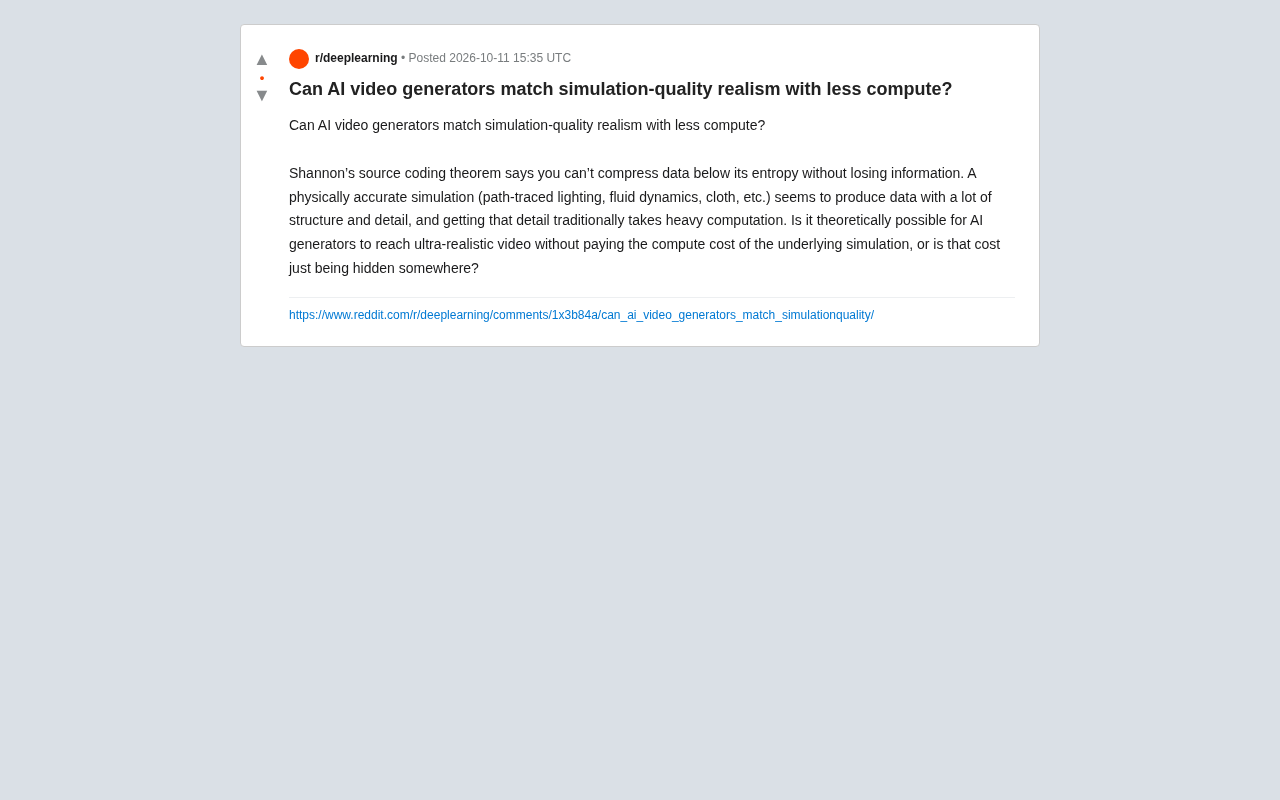
Someone on Reddit posed a technically rich question: can AI video generators achieve near-simulation-level realism without paying the steep computational cost of physical simulation? The cleverness of the question lies in invoking one of information theory's cornerstones — Shannon's source coding theorem.
The theorem states: you cannot compress data below its entropy without losing information. In other words, the intrinsic information content (entropy) of a piece of data determines the lower bound on how much it can be compressed. The poster extended this logic: a physically accurate simulation — with path-traced lighting, fluid dynamics, cloth simulation, and so on — seems to produce highly structured, detail-rich data, and traditionally extracting that detail demands heavy computation. So the question becomes: can AI generators genuinely sidestep the computational cost of underlying simulation, or is that cost merely shifted and hidden somewhere else?
Entropy and Compute Are Not the Same Thing
The key to understanding this question is separating two concepts that are often conflated: the entropy of information and the amount of computation needed to generate that information.
Shannon's theorem constrains the lower bound on lossless representation — it addresses "how many bits are needed at minimum to describe a piece of data." The computational cost of physical simulation, on the other hand, addresses "how many operations are needed to derive that data from initial conditions." These two quantities have no necessary equivalence.
A classic example: the Mandelbrot set image contains extraordinarily rich visual detail — it appears to have very high entropy — yet the rule that generates it (the iterative formula) is remarkably simple. The information needed to describe the rule is far less than the information needed to describe the resulting pixels. This demonstrates that high visual complexity does not equal high algorithmic complexity (Kolmogorov complexity), nor does it equal high generation cost.
Looked at from another angle — real-world video actually lives on a relatively low-dimensional "manifold." Not all combinations of pixels constitute valid natural imagery; the vast majority of pixel arrangements are pure noise. The effective degrees of freedom in real video are far fewer than its raw pixel count, and this is precisely the fundamental reason neural networks can learn from and compress it so efficiently.
Kolmogorov complexity is another powerful tool for understanding this distinction. It is defined as the length of the shortest program capable of generating a given piece of data — measuring the information content of the generative rule, not the result itself. The Mandelbrot set example illustrates just how different the two can be: the resulting image has very high Shannon entropy, but extremely low Kolmogorov complexity, because the generative rule requires only a few lines of code. The essence of an AI video generator is precisely that it learns a set of "low Kolmogorov complexity" generative rules to produce "high Shannon entropy" visual output — this is entirely self-consistent in theory and violates no principle of information theory.
What AI Actually Saves — and Where the Cost Goes
The poster's intuition that "costs must be hidden somewhere else" is quite sharp. The answer is: some costs are indeed shifted, but not in a simple one-to-one transfer.
Physical simulation follows a "forward propagation" path: given the laws of physics and initial conditions, it precisely computes every ray bounce and every fluid diffusion step, frame by frame and particle by particle. Its expense comes from the fact that it has no idea what the result looks like — it must compute the answer honestly from scratch.
Generative AI takes an entirely different route. During training, it consumes massive compute to learn statistical patterns from hundreds of millions of real videos — learning roughly how lighting attenuates, how water surfaces ripple, how fabric folds. During inference, it no longer performs physical propagation; instead, it directly samples from the learned distribution to produce a result that "looks right."
The critical distinction here is:
- Simulation pursues physical correctness
- Generative models pursue perceptual plausibility
Training Cost Is a One-Time Amortization
The inference compute that AI saves comes largely from the massive upfront investment of training being amortized. You train a model once; afterward, you can generate unlimited videos. In this sense, costs are indeed shifted into the training phase — but they don't recur with every frame generated. This stands in sharp contrast to simulation, where every frame must be computed from scratch.
This "high upfront investment, low marginal cost" economic structure is highly analogous to traditional software distribution, but at a far more extreme scale. Training a top-tier video generation model currently costs an estimated tens of millions to hundreds of millions of dollars in compute. But once trained, generating a few seconds of video costs only a few dollars or less in inference compute. By comparison, rendering an equivalent duration of high-quality footage with cinematic-grade path tracing — even on a professional render farm — can require hundreds of GPU-hours. So from the perspective of marginal cost per piece of content, AI generation's efficiency advantage is structural — not because it "solves the same problem more cleverly," but because it fundamentally redefines both the problem and the solution path.
The Trade-Off: Surrendering Physical Accuracy
What generative models save is, in essence, the obligation to guarantee physical accuracy. They don't enforce energy conservation. They don't guarantee that fluids satisfy the Navier-Stokes equations. They only guarantee that outputs are statistically close to training data in visual terms. For use cases like film, games, and advertising — where "looking real" is the goal — this is a worthwhile bargain. But for scientific simulation and engineering computation, where physically verifiable results are required, generative models cannot replace true numerical solvers.
The Navier-Stokes equations are a system of partial differential equations describing viscous fluid motion and serve as the mathematical foundation of fluid dynamics simulation. Path tracing is a Monte Carlo-based global illumination algorithm that generates physically correct renders by simulating large numbers of light rays bouncing through a scene — with computational cost rising sharply with scene complexity and precision requirements. What both types of solvers share is that they must solve their equations from scratch at every frame and every time step; they cannot "remember" previously computed results to skip intermediate steps. What generative models relinquish is precisely the obligation to explicitly solve these equations — they substitute statistical fitting for equation propagation, and therefore cannot fundamentally guarantee energy conservation, fluid continuity, or other physical constraints.
Where the Theoretical Boundary Lies
Returning to the original theoretical question: can AI "freely" obtain realism in an information-theoretic sense?
Strictly speaking, the entropy lower bound cannot be violated — if you truly need to losslessly express a high-entropy video, you will ultimately need to pay the corresponding bit cost. But in practice, we never need to "physically accurately reconstruct every photon." We only need results that human eyes and statistical tests cannot distinguish from reality. And the entropy of the goal "perceptually plausible" is far lower than the entropy of the goal "physically accurate."
A more precise framing, therefore, is: AI is not breaking Shannon's limit while compressing the same information — it is substituting a much lower-entropy target for the extremely high-entropy one. What it approximates is not the simulation result itself, but the projection of that result onto the space of human perception.
This also explains why modern video generation models look increasingly realistic in texture and quality, yet still produce physically implausible artifacts — clipping fingers, objects that violate rigid-body constraints, non-conserving fluids. These errors reveal exactly that the model learned the "surface distribution" rather than the "underlying laws."
Implications for Practitioners
This discussion has several practical takeaways:
- For content production focused on visual impact, generative AI delivers near-simulation aesthetics at far lower marginal compute cost — the economic advantage is clear.
- For domains requiring physically credible, verifiable results (scientific research, engineering, safety-critical systems), generative models currently cannot replace true numerical simulation.
- Hybrid approaches deserve attention: using simulation to provide physical constraints and labeled data while using AI to accelerate rendering or frame interpolation — leveraging the strengths of each — may offer the best cost-performance ratio.
Ultimately, AI hasn't magically bypassed the laws of physics. It has redefined "what we actually need to compute." What gets saved is the precision that human eyes would never detect anyway — and that, more often than not, is precisely the most expensive part.
Related articles

Chain of Thought Isn't Just for AI: How Humans Can Use CoT to Improve Thinking Quality
Chain of Thought isn't just a prompt trick for large models. Starting from a Hacker News discussion, this article analyzes why CoT works for human thinking too, breaks down actionable ways to transfer it, and highlights the key differences between human CoT and machine CoT.
Cloudflare Teams Up with OpenAI: Closi…
Cloudflare Teams Up with OpenAI: Closing the Loop from Vulnerability Discovery to Defense with AI
Cloudflare uses OpenAI Daybreak to investigate security vulnerabilities and generate reviewable remediation plans, while developers use Codex to boost coding efficiency and quality.

Orca Multi-Agent Orchestration in Practice: A Guide to Parallel Collaboration with Claude and Codex
Orca is Stable AI's free open-source agent workbench supporting 34 agents like Claude Code and Codex in parallel. Learn its Git worktree isolation, multi-model orchestration, and mobile management.