Can aina Replace Your Phone? The Discussion on Stopping the Reach for Small Stuff

aina's pitch for faster conversational interaction sparks discussion on phone dependency and scenario-based alternatives.
The article centers on a Reddit discussion exploring why people frequently reach for their phones for small tasks. The poster asks: is the problem the app ecosystem, or that every small task requires a phone? Community alternatives include smartwatches, dumb phones, and physical timers—all aimed at separating specific tasks from the phone. The article notes alternatives must be more frictionless than reaching for your phone, or they may make things worse. aina's "faster way to talk to computers" could shift some interactions to voice or dedicated devices, but its potential depends on covering enough small tasks without adding cognitive load. The conclusion: no universal solution—users need fewer distractions, not more features.
Introduction: Reflections Sparked by aina
A recent Reddit thread asks: "What would actually make you stop reaching for your phone for small stuff?" The poster mentions that aina is launching a product no one can quite describe yet, pitched as "a faster way to talk to computers." This raises a fundamental question: do we reach for our phones so often because of the apps themselves, or because every small task is tied to the phone?
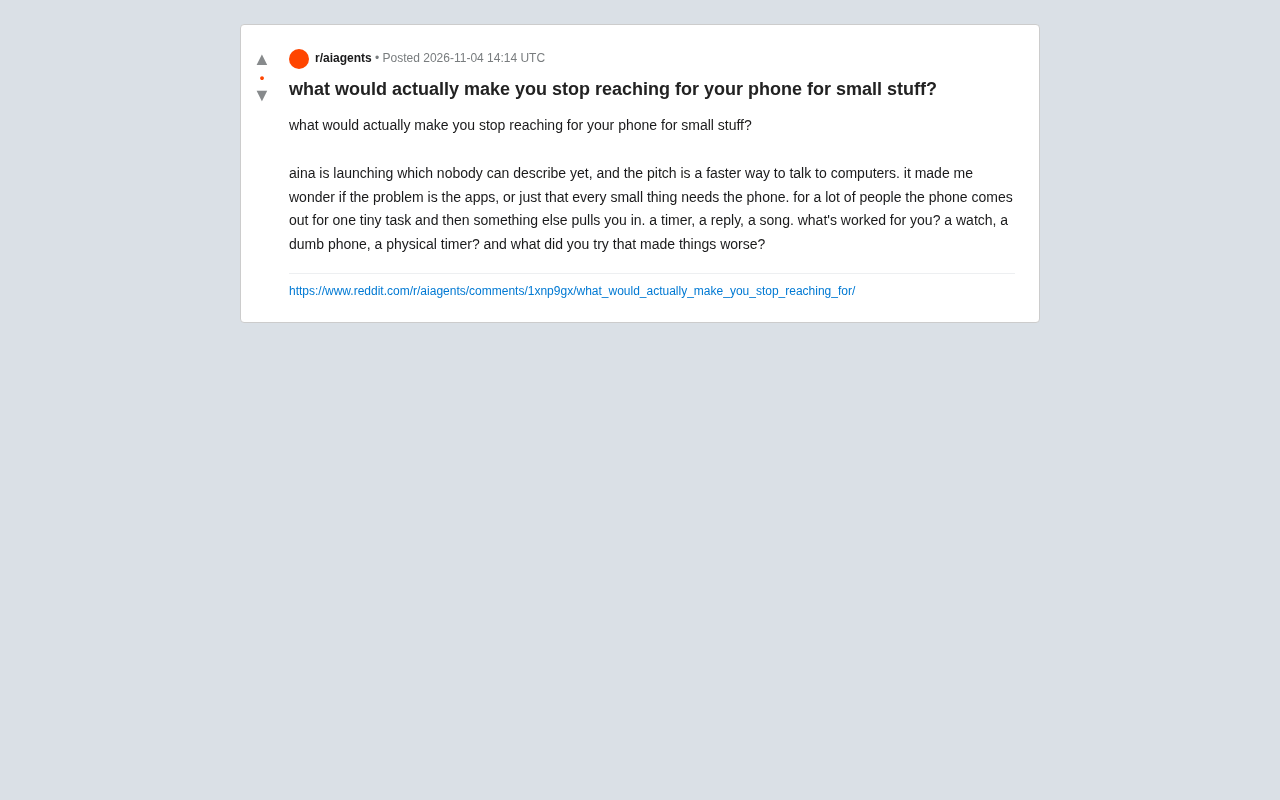
For many people, the phone comes out to complete a small task, but then something else always pulls them in—a timer, a reply, a song. This "task drift" phenomenon is a byproduct of mobile device design.
The Root of the Problem: App Ecosystem or Device Dependency?
The poster raises a key dichotomy: is the problem the apps, or the fact that every small task requires a phone?
From a user experience perspective, the phone has become a universal tool, but its openness also means attention is easily hijacked. A simple timer need might make you open your phone, then see a notification, tap into a social app, browse the feed, and half an hour later forget your original purpose.
aina's angle is exactly here: if talking to a computer can be faster, would you no longer need to open your phone? But the poster doesn't offer an answer—instead, they ask the community for input.
Attention Residue is a cognitive psychology concept introduced by Sophie Leroy in 2009, referring to how when people switch from one task to another, the thought traces of the previous task continue to occupy cognitive resources, degrading performance on the subsequent task. In phone usage scenarios, even a quick check of notifications leaves the brain still holding onto unread messages or the feed, and this residue effect undermines focus. The "task drift" mentioned in the article is precisely the external manifestation of attention residue: after a small task ends, the residual cognitive activation makes people unconsciously continue browsing other content. Understanding this concept helps explain why reducing the number of phone unlocks matters more than optimizing individual apps—each unlock can trigger a new cycle of attention residue.
Community Practices: What Works?
Several alternatives came up in the discussion:
- Smartwatches: Quickly check notifications, set timers, reducing how often you reach for your phone.
- Dumb phones: Physically limit the app ecosystem, keeping only basic communication functions.
- Physical timers: For specific scenarios (like cooking or work pomodoros), completely detach from the phone.
The common thread among these methods is separating specific tasks from the phone, lowering the probability of triggering other behaviors. But the poster also asks: what attempts made things worse? This suggests not all alternatives work—some devices may add steps, actually causing people to return to their phones more often.
Dumb phone refers to a mobile phone that retains only basic communication functions like calls and texts, without app stores, touchscreen browsing, or social media capabilities. In recent years, with the rise of digital minimalism, dumb phones have regained attention as a "digital detox" tool. The core logic is eliminating triggers through physical limitation: no app icons means no possibility of unconscious tapping. However, dumb phones also have obvious limitations—they cannot cover modern life necessities like navigation, payments, and identity verification, and users often need to carry a second device, adding burden instead. The article mentions that dumb phones can "physically limit the app ecosystem," but does not discuss the feasibility of this dual-device strategy; adding this context helps readers weigh the real costs of alternatives.
Multi-Source Perspectives and Industry Implications
Although this discussion stems from a single Reddit source, the viewpoints echo the digital minimalism trend of recent years. Users' definition of "small tasks" is often vague: replying to messages, checking the weather, setting an alarm—these take only seconds on a phone, but the cost is attention residue. If the "faster conversation" aina promises can truly be achieved, it might shift some interactions to voice or dedicated devices, thereby reducing the number of phone unlocks.
But the core challenge is: alternatives must be more frictionless than reaching for your phone. Smartwatches and physical timers work in specific scenarios but cannot cover all small tasks. If aina requires additional learning costs or device investment, it may just be another attempt that "makes things worse."
Conclusion: No Universal Solution, Only Scenario-Based Design
There is no standard answer to the poster's question. Effective methods depend on task type and personal habits. For high-frequency small tasks like timers and replies, physical separation (watches, timers) has proven helpful; but for tasks requiring information input, the phone remains the default choice.
aina's potential lies in redefining the interaction of "talking to computers," but whether it can truly get people to put down their phones depends on whether it can cover enough small tasks without adding cognitive load. The value of the community discussion is reminding product designers: users don't need more features—they need fewer distractions.
One-line Summary
aina's pitch for faster conversational interaction sparks discussion on the roots of phone dependency and scenario-based alternatives.
Paragraph Summary
The article centers on a Reddit discussion exploring why people frequently reach for their phones to complete small tasks. The poster raises a key dichotomy: is the problem the app ecosystem, or the fact that every small task requires a phone? Alternatives the community has tried include smartwatches, dumb phones, and physical timers, all sharing the common thread of separating specific tasks from the phone to reduce the probability of triggering other behaviors. The article notes that alternatives must be more frictionless than reaching for your phone to be effective; otherwise they may add steps and actually cause people to return to their phones more often. If the "faster way to talk to computers" that aina promises can truly be achieved, it might shift some interactions to voice or dedicated devices, reducing unlock frequency—but its potential depends on whether it can cover enough small tasks without adding cognitive load. The conclusion: there is no universal solution, only scenario-based design; users need fewer distractions, not more features.
Related articles
 Tech Frontiers
Gemini Omni 1.2 Flash: AI Video Moves Toward Draft-Style Editing
Google's Gemini Omni 1.2 Flash update enables conversational, draft-style editing of the same video—swap scenes while keeping products, adjust lighting while keeping characters. Clips up to 15s, 720p costs 30% less than the previous Flash—ideal for e-commerce ads, previs, and short-asset production.

Codex Tutorial: One-Command Install and Run Your First Task
Codex tutorial: one-command install and run your first task. Covers the four Codex forms, sandbox and approval guardrails, AGENTS.md and MCP configs, cloud network policy, and the iron rule of human review—everything you need to get started with this autonomous coding agent.
 Tech Frontiers
Localix: An Open-Source Agentic Development Environment with Multi-Model and Local AI Integration
Localix is an MIT open-source Agentic Development Environment (ADE) supporting seamless Claude Code plugin loading, multi-model cloud and local execution, Mini Apps extensions, and agent context management—an open AI collaboration workbench for developers.