Can Brain-LLM Alignment Be Semantically Decomposed? The SCRIBE Framework Offers a New Answer

Study uses SCRIBE semantic framework to decompose LLaMA2-7B alignment with brain activity, finding shared semantic variance dominates.
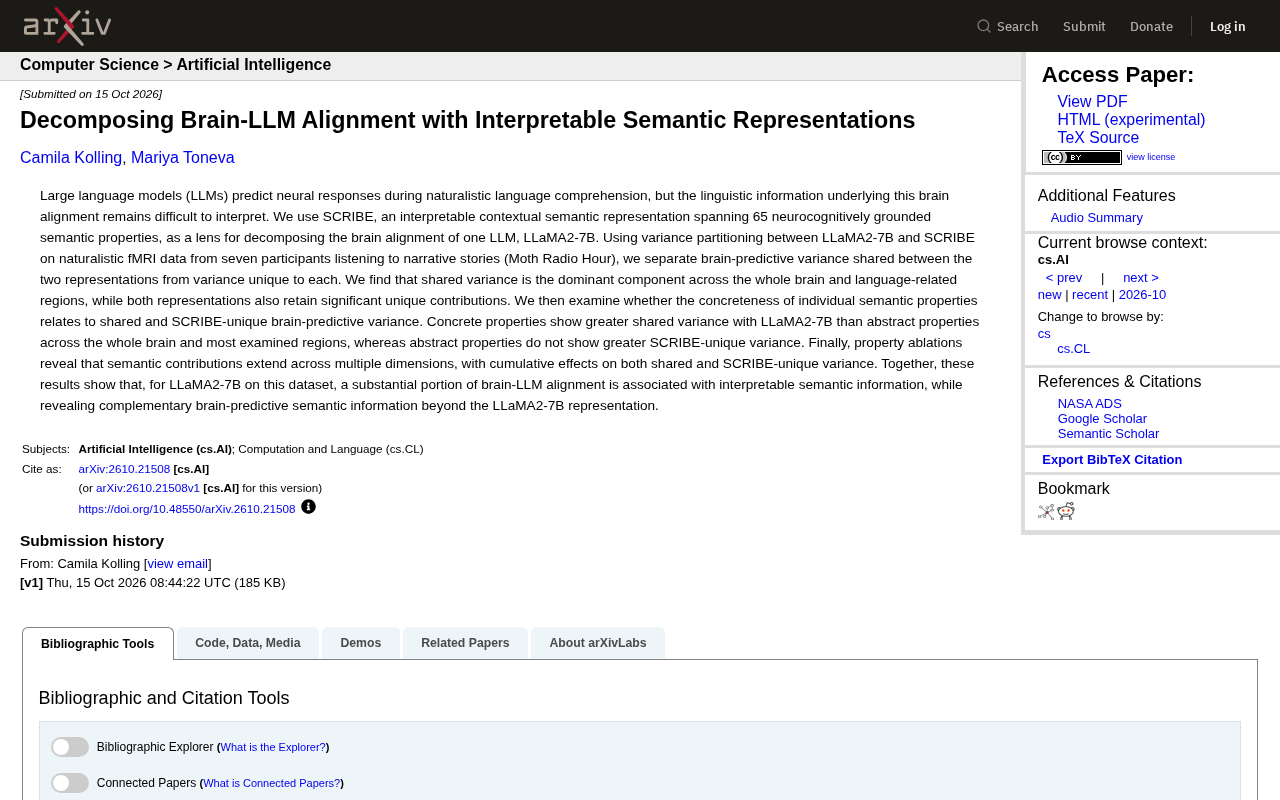
A recent study uses SCRIBE (an interpretable representation covering 65 neurocognitive semantic attributes) as a lens to decompose LLaMA2-7B's predicted variance of natural fMRI brain activity into shared and unique components via variance partitioning. Results show shared variance dominates across the whole brain and language regions, indicating the LLM's predictive power largely stems from semantic information encoded by SCRIBE. Concrete semantic attributes show significantly higher shared variance than abstract ones, while abstract attributes show no greater SCRIBE-unique contribution. Ablation experiments reveal semantic contributions span multiple dimensions with cumulative effects. The study provides a quantitative framework for AI interpretability and neuroscience.
When LLMs "Read" the Brain: The Semantic Truth Behind Alignment
That large language models can predict neural responses in the human brain during natural language comprehension is no longer news. But a key question has remained unresolved: what information is this brain-LLM alignment actually built on? Is it deep semantic understanding, or some kind of statistical coincidence?
A recent study employed an ingenious approach to answer this question. Using SCRIBE as a "lens" — an interpretable contextual semantic representation encompassing 65 neurocognitively grounded semantic attributes — the researchers decomposed the alignment between LLaMA2-7B and brain activity.
Brain-LLM alignment is a research paradigm at the intersection of neuroscience and artificial intelligence in recent years: given the same natural language stimulus, one records the human brain's fMRI or EEG responses during comprehension, while extracting the LLM's internal representations of the same text (e.g., hidden states across layers), then trains an encoding model to map the LLM representations onto neural responses and tests its predictive power. If prediction accuracy is significantly above baseline, it suggests some correspondence exists between the LLM's representations and the brain's language encoding. This alignment could stem from shared deep semantic structure, or it could merely reflect surface-level statistical similarity — such as word frequency or syntactic complexity. Therefore, simply demonstrating that "LLMs can predict brain activity" is insufficient to infer that "LLMs understand language like the brain does." One must further decompose the sources of information underlying the alignment — which is precisely the motivation behind the variance decomposition method employed in this paper.
Variance Decomposition: Shared and Unique Contributions
The research team used variance decomposition techniques on natural fMRI data collected from 7 subjects listening to narrative stories (Moth Radio Hour), splitting the variance each of LLaMA2-7B and SCRIBE predicted in brain activity into two components: the variance shared by both and the variance unique to each.
The results were quite clear. Shared variance dominated across the whole brain and in language-related regions. This means that the LLM's ability to predict brain responses largely stems from its capture of the semantic information encoded by SCRIBE. However, both representations also retained significant unique contributions — LLaMA2-7B captured additional information of its own, and SCRIBE possessed semantic dimensions that the LLM did not cover.
The significance of this finding lies in the fact that it is the first to use an interpretable semantic framework to quantify the core question of "how much of brain-LLM alignment comes from understandable semantics."
Variance partitioning is a multivariate statistical method first proposed by Borcard et al. in ecology, later widely adopted in neuroimaging. Its core idea is: when two or more sets of predictor variables (here, LLaMA2-7B representations and SCRIBE semantic representations) can each predict the same dependent variable (brain activity), one can compute their respective R² values and the joint R², decomposing the total explained variance into a shared component (variance jointly explained by both predictor sets) and unique components (variance explained by only one predictor set). In practice, unique contributions are typically calculated as "full model R² minus R² after removing that predictor set," while shared variance is the joint R² minus the sum of the two unique contributions. The advantage of this method is that it requires no assumption of causality between the two predictor sets — it quantifies their degree of information overlap purely from a predictive standpoint. In this paper, the dominance of shared variance means that most of the LLM's predictive power over brain activity can be explained by SCRIBE's semantic attributes.
The Concreteness Effect: Abstract vs. Concrete Semantics
The study further examined an interesting dimension: whether the concreteness of individual semantic attributes correlates with shared variance and SCRIBE-unique variance.
The answer leaned affirmative. Concrete semantic attributes showed significantly higher shared variance with LLaMA2-7B than abstract attributes across the whole brain and most regions examined. In other words, the more concrete the semantic content (e.g., perceivable concepts like "apple" or "running"), the greater the consistency between the LLM's representations and brain activity.
Interestingly, however, abstract attributes did not exhibit greater SCRIBE-unique variance. This suggests that SCRIBE's unique contribution is not concentrated in abstract semantics, but distributed across a broader range of semantic dimensions.
Ablation Experiments: The Multidimensionality of Semantic Contributions
Ablation experiments on semantic attributes revealed that semantic contributions span multiple dimensions, producing cumulative effects on predicted brain variance across subjects. Both shared variance and SCRIBE-unique variance were jointly influenced by multiple semantic attributes, rather than being dominated by any single dimension.
This finding challenges the simplified assumption that "a particular semantic dimension dominates brain-LLM alignment." The brain's encoding of language is inherently multidimensional, and any attempt to explain all alignment with a single feature may distort the picture.
Implications for AI and Neuroscience
The value of this study lies not only in the method itself but also in the framework it provides.
For AI interpretability research, SCRIBE offers a way to "translate" LLM internal representations into understandable semantic dimensions. If most of the LLM's predictive power over the brain can be explained by known semantic attributes, it suggests that LLMs have indeed learned some core features of human language comprehension — rather than merely fitting surface-level statistical patterns.
For neuroscience, the study suggests that there exists semantic information in brain language processing beyond LLM representations. SCRIBE's unique contribution indicates that current LLM architectures may be missing certain semantic encoding schemes used by the human brain. This points toward directions for improving model architectures or training objectives.
Of course, the study also leaves some open questions: Does this alignment pattern generalize to other LLM architectures? Are 65 semantic attributes sufficient to cover the full scope of human brain language processing? These questions await future work.
A core challenge in LLM interpretability research is that LLM hidden-layer representations are high-dimensional dense vectors, and individual dimensions often do not correspond to any human-understandable concept. SCRIBE provides an "external anchoring" path to interpretability — rather than directly corresponding to internal neurons, it projects the predictive power of LLM representations onto a set of predefined, neurocognitively grounded semantic attributes. The limitation of this approach is that interpretability is constrained by the 65 attributes SCRIBE includes: if the LLM encodes semantic information not covered by SCRIBE, that contribution would be relegated to "LLaMA2-7B unique variance" and could not be further explained. A complementary class of methods involves internal interpretability techniques based on sparse autoencoders or probe classifiers, which directly extract interpretable features from within the model. Each approach has its strengths and weaknesses, and future work may combine them for a more complete picture.
fMRI (functional magnetic resonance imaging) indirectly measures neural activity by detecting blood-oxygen-level-dependent (BOLD) signals. It has high spatial resolution (millimeter-scale) but low temporal resolution (second-scale), making it particularly suited for localizing brain regions involved in language processing (such as the left inferior frontal gyrus and superior temporal gyrus), but poor at capturing rapid neural dynamics. The natural fMRI paradigm used in this paper — having subjects listen to narrative stories (Moth Radio Hour) rather than presenting isolated words — is an important trend in recent neurolinguistics, because natural narratives simultaneously engage semantic, syntactic, and pragmatic processing, more closely approximating real-world language comprehension. A sample size of 7 subjects is typical for this field, but individual differences are large, so the researchers examined inter-subject consistency alongside whole-brain results.
Related articles

Chain of Thought Isn't Just for AI: How Humans Can Use CoT to Improve Thinking Quality
Chain of Thought isn't just a prompt trick for large models. Starting from a Hacker News discussion, this article analyzes why CoT works for human thinking too, breaks down actionable ways to transfer it, and highlights the key differences between human CoT and machine CoT.
Cloudflare Teams Up with OpenAI: Closi…
Cloudflare Teams Up with OpenAI: Closing the Loop from Vulnerability Discovery to Defense with AI
Cloudflare uses OpenAI Daybreak to investigate security vulnerabilities and generate reviewable remediation plans, while developers use Codex to boost coding efficiency and quality.

Orca Multi-Agent Orchestration in Practice: A Guide to Parallel Collaboration with Claude and Codex
Orca is Stable AI's free open-source agent workbench supporting 34 agents like Claude Code and Codex in parallel. Learn its Git worktree isolation, multi-model orchestration, and mobile management.