Can Cheap Models Handle Code Review? GPT-5.6 Luna vs. GPT-6 Astra
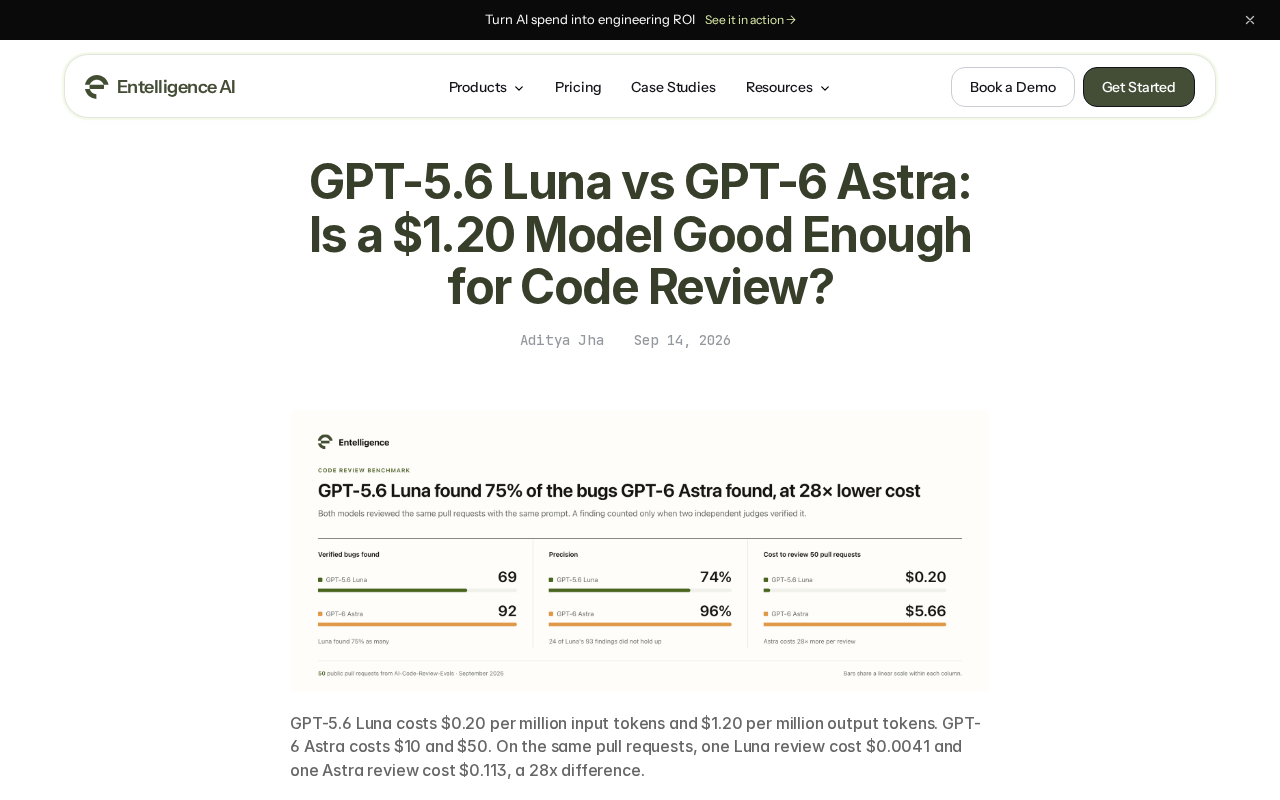
Whether a cheap AI model is good enough for code review depends entirely on how you route the work.
A Hacker News thread debating whether a $1.20 AI model can handle code review surfaces a challenge every engineering team faces. Code review is a discriminative, high-stakes task that amplifies the weaknesses of cheaper models — particularly around false positives and long-context reasoning. The practical answer isn't a binary choice but tiered routing: cheap models for style and formatting, flagship models for security and architecture. Teams should evaluate using real historical PRs and measure cost-normalized yield rather than raw accuracy.
An Old Question in a New Form: Is a Cheaper Model Good Enough?
A Hacker News thread titled GPT-5.6 Luna vs. GPT-6 Astra: Is a $1.20 Model Good Enough for Code Review? has been generating notable attention (55 points, 64 comments). The core question isn't new, but it remains a persistent challenge for every team integrating LLMs into their development workflow: when you're dealing with code review — a high-frequency, high-volume task with real accuracy requirements — should you go with a cheaper model, or bite the bullet and pay for the flagship?
The "$1.20" figure in the title is telling — it translates the abstract concept of "model capability" into a concrete unit cost. For engineering teams running hundreds or thousands of review requests per day, a difference of a few cents per call multiplies into a meaningful budget gap at scale. That's exactly why "good enough" is often a more important engineering conversation than "best in class."
Note: This article is based on analysis of the Hacker News thread's title and discussion activity. Specific benchmark data and comment details from the original post are limited, and the methodology discussed here represents a broader, generalized exploration of the topic for reference purposes.
Why Code Review Is a Uniquely Demanding Use Case
Code review is fundamentally different from code generation. Generation tasks tolerate a degree of "creativity" — even if the model's solution isn't optimal, a human can iterate on top of it. Code review, by contrast, is inherently discriminative: the model must judge whether a piece of code contains bugs, security vulnerabilities, performance issues, or style violations, and deliver actionable feedback.
This creates two specific demands on model capability. First, low false positive rates. If a review tool constantly flags spurious issues, developers will quickly lose trust and start ignoring it entirely — at which point it's a waste of money regardless of its price. Second, depth of contextual understanding. Real-world code spans files and modules; the correctness of a function may depend on conventions defined elsewhere. Cheaper models tend to struggle most with long-context reasoning and complex inference — precisely the areas where code review is most demanding.
In other words, code review is exactly the kind of task where the weaknesses of cheaper models get amplified. That's what makes the Luna vs. Astra comparison worth taking seriously.
The Cost-Capability Tradeoff: It's Not Binary
Framing the question as "is the expensive one better, or is the cheap one good enough?" is actually a trap. A more pragmatic approach is tiered routing: use cheaper models for simple, high-frequency pre-screening, and escalate complex or high-risk changes to a more capable model.
This kind of architecture is already quite common in practice:
- Formatting and style checks: Tasks with clear rules and simple judgments are well within the capabilities of cheaper models (like Luna-tier offerings) — even traditional static analysis tools can cover this.
- Logic and edge case review: These involve reasoning chains where cheaper models may miss issues; escalation should be considered depending on context.
- Security and architecture-level review: High-risk, low-tolerance scenarios where investing in a flagship model (like Astra-tier) makes far more sense — the cost of a missed security vulnerability far exceeds any savings on API calls.
Within this framework, the answer to "is the $1.20 model good enough?" becomes: it depends on what you're asking it to review. Misapplied, even the most expensive model can produce unreliable results. Applied correctly, a cheaper model can deliver exceptional value.
How to Evaluate Objectively: Don't Just Chase Benchmarks
Discussions like this easily devolve into competing subjective impressions. To reach credible conclusions, teams should build their own evaluation sets rather than relying on public benchmarks. A few key dimensions to focus on:
- Real PR replay: Take historical Pull Requests with known issues and see whether the model identifies the same problems that were caught by human reviewers at the time.
- False positive rate: Run the model against a batch of clean code and measure how often it incorrectly flags issues.
- Actionability score: Are the model's suggestions specific and executable, or vague platitudes like "consider optimizing this"?
- Cost-normalized yield: Use "valid issues found per dollar" as your core metric, not raw accuracy alone.
Once cost is in the denominator, many conclusions flip. A model that's slightly less accurate but five times cheaper may actually come out ahead on cost-normalized yield — as long as you've already used tiered routing to handle high-risk scenarios with a stronger model.
Practical Advice for Engineering Teams
For teams currently evaluating AI-assisted code review, it's worth shifting focus from debating specific model version names to investing in process design:
- Start with a baseline: Use a cheaper model as your default reviewer and observe how it actually performs on your codebase.
- Define escalation triggers: Automatically route changes touching sensitive directories — authentication, payments, data handling — to a stronger model.
- Keep humans in the loop: AI review is an accelerator, not a replacement. Critical merges should still require human sign-off.
- Monitor your cost curve: As call volume grows, periodically reassess whether your tiered routing strategy is still cost-effective.
The answer to "is $1.20 good enough?" will keep changing as models continue to improve. But the underlying engineering wisdom doesn't expire: spending the right amount of money in the right places will always matter more than chasing the most powerful model available.
Related articles
Claude Code v2.1.271 Update Deep Dive: Fast Mode, Sandbox Security, and Enterprise Improvements
Claude Code v2.1.271 adds fast mode for remote sessions, per-command sandbox network controls, enterprise policy fixes, MCP protocol improvements, and terminal/IDE enhancements.

AI Giants Collectively Hit the Brakes: Safety Protocol or Industry Cartel?
OpenAI, Anthropic, Google DeepMind, and SpaceX leaders agree to slow AI development. Is this a responsible safety pact — or an oligopolistic cartel in disguise?

Apple Home Gets AI Camera Features with iOS 27: Up to $60/Month
iOS 27 and tvOS 27 bring Apple Intelligence to Apple Home with AI video summaries for HomeKit Secure Video — but unlocking them costs up to $60/month via subscription.