Can Claude Really Prove the Riemann Hypothesis? The Truth Behind Formal Verification

Anthropic mathematician claims Claude proved the Riemann Hypothesis, but 17M lines of Lean code spark debate on verification and trust.
The article reports that an Anthropic mathematician claimed to have found a Riemann Hypothesis proof with Claude, existing as 17 million lines of Lean code rather than a paper. The community used Lean and mathlib to check the proposition, and MIT's Andrew Sutherland compiled all declarations with zero errors. Yet mathematicians remain cautious because formal translation can err, and human judgment on boundary conditions is still essential.
Background: A Claim from an Anthropic Mathematician
According to analysis by a YouTube channel, a mathematician at Anthropic published a 4-page note on their personal website claiming to have found a proof of the Riemann Hypothesis in collaboration with Claude. The claim itself is astonishing enough — the Riemann Hypothesis is one of the top unsolved problems in mathematics, and any related progress would attract enormous attention.
But the key detail in the note is this: the "proof" did not appear in the form of a traditional paper. Instead, it resides in a Lean library with a staggering 17 million lines of code. That number immediately shifts the question from "is the proof correct" to "who is going to check it."
Lean Formal Verification: How Machines Check Proofs for Humans
Faced with such a massive codebase, manual line-by-line review is clearly impractical. The approach proposed in the video is to feed the proof code into Lean and have the computer check every logical step one by one.
Lean is an interactive theorem prover whose core value lies in this: as long as the code compiles, every step of the derivation conforms to formal logical rules. Humans don't need to read every line — they just need to trust the compiler. This sounds like a perfect solution, but the video raises a deeper question: is the "proposition" the checker is verifying actually the proposition we care about?
Interactive Theorem Prover (ITP) is a class of software tools in which users write mathematical definitions and proofs in a formal language, and the tool checks step by step whether each derivation strictly follows logical rules. Unlike automated theorem provers, ITPs emphasize human-machine collaboration: humans provide proof ideas and steps, and the machine verifies correctness. Lean is one of the most active ITPs today, and its mathematical library mathlib is maintained by mathematicians worldwide, containing a large number of expert-reviewed definitions and theorems. The core advantage of ITPs is eliminating human oversight and logical gaps, but the precondition is that the formal statement must precisely correspond to the informal mathematical proposition.
Community Cross-Validation: Does the Statement Match Exactly?
This is the most easily overlooked and most critical part of the entire event. Lean can prove that "some proposition" is true, but if the statement of that proposition deviates even slightly from the Riemann Hypothesis, then even a flawless proof is meaningless.
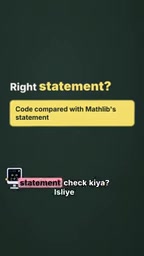
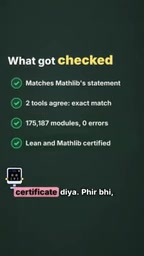
According to the video, the community's approach was to compare the proposition in the code with the expert-reviewed standard formulation in mathlib (Lean's mathematical library). Both the comparison tool and another checking tool, Conley, reported an exact match. Subsequently, MIT's Andrew Sutherland compiled all approximately 17.5 million declarations across 87 modules, with a result of zero errors. Lean and mathlib ultimately certified both the proposition and the proof.
mathlib is Lean's mathematical library, developed by the community, aimed at formalizing modern mathematics. It covers a wide range of content from basic set theory to algebraic geometry, with every definition and theorem rigorously reviewed. In formal verification, mathlib serves as a "standard reference": if a proposition has an expert-reviewed version in mathlib, the proposition in the code to be verified can be compared against the mathlib version to ensure consistency of formulation. This comparison typically checks whether definition expansions, variable bindings, and logical structures are identical. mathlib's authority comes from its rigorous contribution process and peer review, but it is itself constantly evolving, so version compatibility must be considered during comparison.
The Mathematical Community's Caution: Formalization Is Not Confirmation
Even with the above technical verification, the video emphasizes that the mathematical community remains broadly cautious: Lean formalization alone is not sufficient to confirm that the proof holds. The reason is that the formalization process itself can go wrong — the proposition may be mistranslated, definitions in the library may deviate from standard mathematics, or even the configuration of the checking environment may introduce problems.
This caution is not a denial of the tool's value but rather points to an epistemological boundary: formal verification can rule out errors in logical derivation, but it cannot fully rule out "translation errors." For developers building AI applications, the lesson from this case is that AI output verified by a formal checker is far more reliable than output accepted on trust alone — but only if you confirm that the checker is applied to the right proposition.
The epistemological boundary of formal verification lies in this: it can only guarantee that "if the proposition is true, then the proof is correct," but it cannot guarantee that the proposition itself faithfully translates the original mathematical problem. Formal translation may introduce subtle deviations, such as type errors, implicit assumptions, or definition mismatches. In addition, the configuration of the checking environment (such as compiler version and library loading order) may also affect results. Therefore, even if Lean reports zero errors, mathematicians will still demand independent human review to ensure that the formal statement is completely equivalent to the original statement of the Riemann Hypothesis. This "translation correctness" problem also exists in software engineering, for example when specifications in model checking are inconsistent with requirements.
Practical Lessons for AI Developers
Although this event occurred in the field of mathematics, its pattern has direct relevance to AI engineering. The video ends with a thought-provoking question: would you rather trust a checker or a paper?
In a context where AI-generated content is becoming increasingly common, formal verification offers a way to turn "trust" into "verifiability": let machines check machines, and humans only need to review the boundary conditions of the check. But the boundary conditions themselves — namely, "is the checker aimed at the right problem" — still require human judgment. This may be the most pragmatic positioning of human-machine collaboration at the current stage.
(This article is based on the YouTube channel's overview of the event; all claims are subject to the original sources.)
Applications of formal verification in AI engineering extend far beyond mathematical proofs. For example, in safety-critical systems (such as autonomous driving and medical diagnosis), formal methods can be used to verify whether a neural network's control policy satisfies safety properties; in the smart contract domain, formal verification has been used to audit code vulnerabilities. For AI-generated code or proofs, formal checkers can serve as a "trusted filter," but developers must clarify whether the specification being checked accurately reflects actual requirements. This requires human experts to define formal properties and verify the trustworthiness of the checker itself. Research combining formal verification with AI generation is currently emerging, with the goal of improving output reliability through machine checking while preserving AI's creativity.
One-line Summary
An Anthropic mathematician claims to have used Claude to prove the Riemann Hypothesis, but 17 million lines of Lean code spark debate over verification and trust.
Paragraph Summary
The article reports that an Anthropic mathematician claimed to have found a proof of the Riemann Hypothesis in collaboration with Claude, but the proof exists as 17 million lines of Lean code rather than a traditional paper. The community checked the code through the Lean compiler and compared the proposition's statement against mathlib; MIT's Andrew Sutherland compiled all declarations with zero errors, and both Lean and mathlib issued certification. However, mathematicians remain cautious because formal translation can go wrong, and the checker cannot guarantee that the proposition is completely identical to the original conjecture. The article notes that this event offers lessons for AI developers: formal verification can improve the reliability of AI output, but it must be ensured that the checker is aimed at the right problem, and human judgment at boundary conditions remains indispensable.
Related articles

Prospero: A Lightweight Native AI Coding Tool Built with ImGui
Prospero is a bloat-free native AI coding tool built with ImGui, emphasizing lightweight design, high performance, and low dependencies. This article analyzes its design philosophy, technical choices, and the divergence between platformization and toolization in AI coding tools.

WebRTC Abused: New Variant of Credit Card Skimming Scripts on Shopping Sites
Security researchers found skimming scripts on popular shopping sites using WebRTC data channels to exfiltrate credit card data. This article analyzes the technical原理, differences from traditional Magecart attacks, and defense strategies for e-commerce platforms in third-party script governance and CSP policies.

Single GB10 Card Hits 101 tok/s: Inkling 2 Mini Performance Tested on vLLM
A developer shared on Hacker News running Inkling 2 Mini with vLLM on a single GB10 at 101 tok/s. This article analyzes the technical context, the significance of vLLM with small models on single cards, and caveats for interpreting tok/s metrics.