Can GPT Generate a AAA Game with One Click? A Deep Dive into the Real Boundaries of AI Game Development

Why AI can't one-click generate AAA games, and how it's actually transforming game development.
A viral Reddit post joked about GPT-7 one-shotting a game better than Star Citizen, sparking debate on AI's true capabilities in game development. This article examines why generating a complete AAA game from a single prompt remains fantasy due to consistency bottlenecks, real-time system requirements, and subjective quality judgment, while exploring how AI is genuinely transforming the industry as a productivity multiplier across art, code, narrative, and level design.
The AI Anxiety Behind a Joke
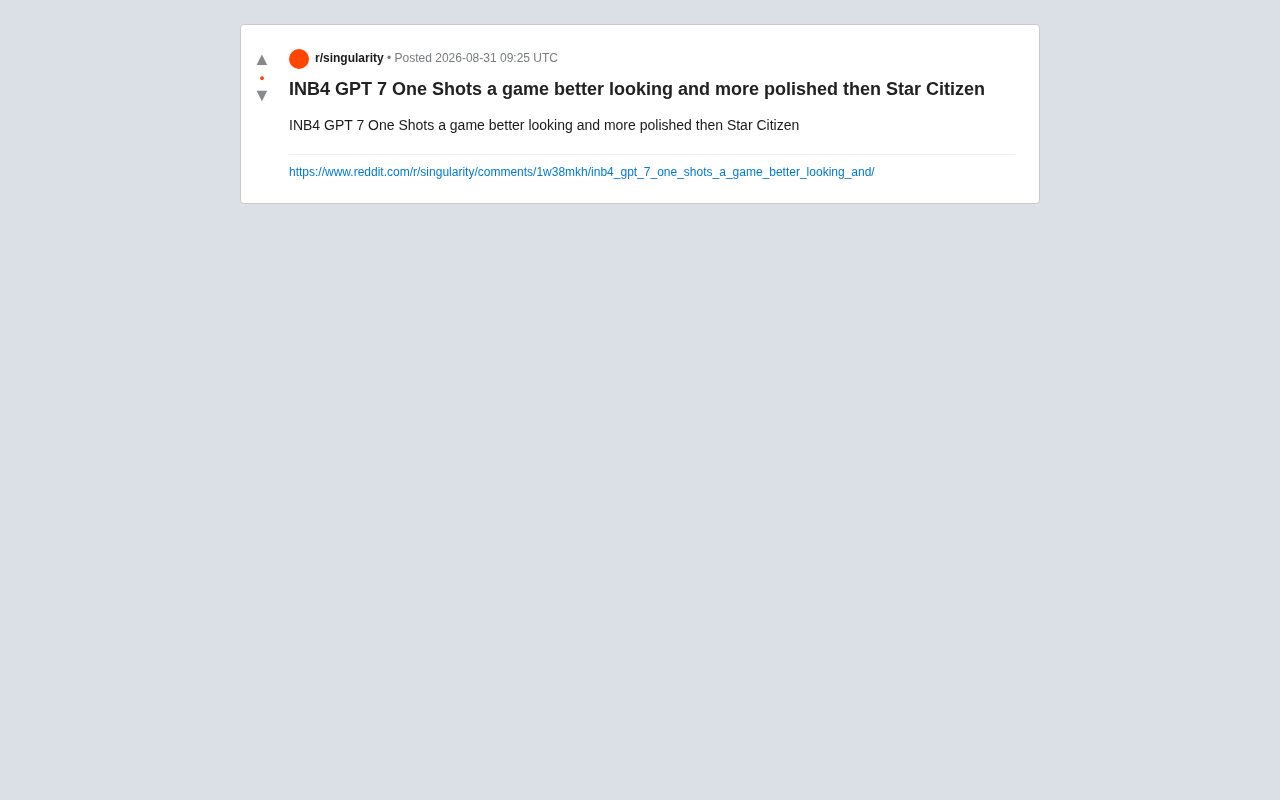
Recently, a tongue-in-cheek post on Reddit sparked heated discussion: "INB4 GPT 7 One Shots a game better looking and more polished than Star Citizen."
On the surface it's a meme, but it precisely hits on a collective fantasy and anxiety within the current AI wave. "INB4" is internet shorthand for "In Before," typically used to preemptively call out a take before someone else does. And the choice of Star Citizen as a comparison point is itself dripping with dark humor — the game is arguably the most famous "vaporware" in gaming history, having crowdfunded over $700 million with more than a decade of development and still no official release.
The Star Citizen saga dates back to 2012. Its founder, Chris Roberts, was the creator of the Wing Commander series and a legendary figure in 1990s PC gaming. After founding Cloud Imperium Games, he launched this ambitious space simulation project via crowdfunding, promising a persistent universe spanning hundreds of star systems with support for tens of thousands of concurrent players. The original funding goal was just $2 million, but player enthusiasm far exceeded expectations, ultimately surpassing $700 million — making it the largest crowdfunded project in human history. Yet over a decade later, the game remains in Alpha testing, and the planned single-player campaign Squadron 42 has been delayed multiple times. The project has become a textbook case of feature creep and runaway development management, turning "When will Star Citizen actually release?" into a perennial meme in the gaming community.
The subtext of the post is clear: given how rapidly generative AI is evolving, could there come a day when a single prompt (one shot) produces a title that surpasses what a top-tier studio spent a decade and hundreds of millions building?
The Technical Reality Behind the "One Shot" Myth
What Generative AI Is Actually Good At
To understand both the absurdity and the kernel of reason in this joke, we first need to clarify the real capability boundaries of today's generative AI.
Large language models like the GPT series are fundamentally powerful content generation and pattern completion tools. These models are built on the Transformer architecture — a deep learning framework introduced in the 2017 paper Attention Is All You Need by a Google team. Its core mechanism, Self-Attention, captures dependencies between any positions in an input sequence, enabling the understanding and generation of complex structured content. The GPT series uses an autoregressive generation approach, predicting the next most likely token one at a time. This makes it excel at sequential tasks like text and code generation. But it's worth noting that this step-by-step generation mechanism inherently suffers from error accumulation — the longer the generated content, the harder it becomes to maintain global consistency.
In certain areas of game development, these models have already shown remarkable potential:
- Code generation: Assisting with game logic, scripting, and shader code. Modern AI programming assistants like GitHub Copilot and Cursor can already understand game engine API structures, generate functional code snippets, and even help with debugging and refactoring. For highly specialized GPU programs like shaders, AI can quickly produce HLSL or GLSL code for specific visual effects, significantly lowering the barrier to entry for Technical Art.
- Art assets: Producing textures, concept art, and models in conjunction with image and 3D generation models. From 2D image generation tools like Midjourney and DALL-E to 3D model generation platforms like Meshy and Tripo, AI is reshaping the art pipeline. In PBR (Physically Based Rendering) texture generation especially, AI tools can already produce complete material sets — normal maps, roughness maps, metallic maps — ready for direct import into Unity or Unreal Engine.
- Narrative content: Generating quest text, dialogue, and worldbuilding lore.
- Level design: Procedurally generating maps and scene layouts.
However, a game of Star Citizen's scale involves far more than just "content generation." It requires system-level engineering integration: physics engines, network synchronization, performance optimization, cross-platform compatibility, consistency management across massive asset libraries, and the hardest thing to quantify — playability and polish.
It's important to understand the core complexity of game engineering here. A AAA-level game typically relies on a complete game engine — such as Unreal Engine, Unity, or a proprietary engine — which itself is an enormous software engineering project encompassing rendering pipelines, physics simulation, audio systems, asset management, scripting systems, and dozens of other subsystems. Take the rendering pipeline as an example: modern games need to implement Ray Tracing, Global Illumination, Screen Space Reflections (SSR), and more, each involving complex GPU programming and performance tradeoffs. Star Citizen's heavily customized version of CryEngine also has to solve extremely challenging technical problems like 64-bit floating-point precision coordinates (for representing ultra-large-scale space scenes) and Server Meshing (distributing a single game world across multiple servers to support massive multiplayer online play). These system-level engineering challenges are far beyond what current AI can address by "generating a piece of code."
"Better Looking" and "More Polished" Are Two Very Different Things
The wording of the post is worth examining closely: "better looking" versus "more polished." The former is a goal that AI is relatively close to achieving — visual generation technology is advancing rapidly. The latter, however, is the deep end where AI struggles most.
"Polish" refers to the iterative refinement of countless details: control feel, numerical balance, bug fixing, and the smoothness of the player experience. Take "control feel" as an example — optimizing a character's jump action alone might involve fine-tuning dozens of parameters: the takeoff force curve, mid-air controllability, landing animation blending, camera follow smoothness, and sound effect trigger timing. These parameters are all interconnected, and changing one affects everything else. Veteran game designers often rely on years of accumulated intuition to judge whether "this feels right" — a form of tacit knowledge that's extremely difficult to formalize into training data for AI.
These things depend on extensive real user feedback and the intuitive judgment of human designers, far beyond what a single prompt can accomplish. Ironically, even Star Citizen — with ten years and $700 million invested — hasn't achieved "polished." That alone illustrates just how expensive and resistant to automation the polishing process truly is.
Real Progress in AI Game Development
From "One-Click Generation" to "Collaborative Enhancement"
Jokes aside, the actual path for AI in game development is much clearer: it's not about replacing the entire development process, but embedding itself as a productivity multiplier across various stages.
Existing industry practices include:
- AI-assisted art pipelines dramatically shortening concept design cycles. For example, Blizzard Entertainment has publicly stated it uses AI generation tools for rapid prototype exploration during the concept design phase. Ubisoft's Ghostwriter tool uses AI specifically to generate NPC "bark dialogue" — the short phrases NPCs say while patrolling, fighting, etc. — freeing narrative designers to focus on more important storylines.
- Procedural Content Generation (PCG) combined with AI optimization, enabling small teams to build large worlds. PCG has a long history in gaming — the 1980 classic Rogue used random algorithms to generate dungeon layouts, directly spawning the "Roguelike" genre. Later, Minecraft used noise functions to generate infinite terrain, and No Man's Sky created a universe containing 18 quintillion planets through procedural algorithms. Modern AI-driven PCG goes further: rather than being purely random or rule-driven, it uses machine learning to understand the characteristics of "good level design," generating content that's both varied and playable. For instance, researchers have successfully trained AI models to generate Super Mario levels that follow specific difficulty curves.
- NPC dialogue powered by large language models, enabling more natural interaction experiences. Companies like Inworld AI and Convai have released middleware solutions that integrate large language models into game NPCs, allowing NPCs to generate real-time dialogue responses that match their character profiles based on players' natural language input, rather than simply selecting branches from a preset dialogue tree.
All of these fall under "collaborative enhancement," not "one-click replacement." Real indie developers and major studios alike are treating AI as an efficient tool, not an all-powerful magic wand. A one- or two-person team, with AI assistance, might be able to deliver what previously required a team of ten — that's the more realistic and more valuable picture of the present.
Why "GPT-7 One-Shots a AAA Game" Is Still Fantasy
From the standpoint of technological evolution, even with continued leaps in model capability, "one-click generation of a complete AAA game" remains unrealistic for the foreseeable future, for three reasons:
-
Context and consistency bottleneck: A large-scale game is an organic whole consisting of millions of lines of code and massive assets. Maintaining global consistency far exceeds the context-processing capabilities of current models. Take Star Citizen as an example — its codebase is estimated to be in the millions of lines, and total game assets (3D models, textures, audio, animations, etc.) reach the terabyte scale. Even if future large language models extend their context windows to millions of tokens, that only covers information capacity at the text level. The geometry data, skeletal rigging, animation state machines, LOD (Level of Detail) configurations, and other information for a single 3D character model simply cannot be compressed into text tokens to be "understood" and "kept consistent." Moreover, consistency in games isn't just about data — it includes art style consistency, interaction logic consistency, worldbuilding consistency, and many other dimensions of complex constraints.
-
Interactivity and real-time requirements: Games are dynamic systems requiring real-time physics simulation, network synchronization, and precise rendering pipeline coordination — problems that static content generation cannot solve. A multiplayer online game's server needs to process player input, physics collision detection, AI behavior decisions, and state synchronization at the millisecond level, while the client simultaneously renders at 60 fps or higher. These real-time constraints demand extreme optimization of code in both time and space complexity — for instance, using spatial partitioning algorithms (like octrees) to accelerate collision detection, or using Entity Component System (ECS) architecture for cache-friendly data layouts. This kind of performance-sensitive system-level optimization requires engineers to deeply understand hardware architecture and runtime behavior, and remains one of current AI's weakest areas.
-
Subjective quality judgment: What makes a game "fun" still has no objective function that models can fully learn — the core magic of game design lies precisely in the unquantifiable nature of human aesthetics and creativity. Game design theory has a classic concept called "Flow," proposed by psychologist Mihaly Csikszentmihalyi, referring to the highly immersive state players enter when skill and challenge reach a dynamic equilibrium. How to design difficulty curves that keep players in flow, when to deliver rewards for a sense of achievement, how to convey emotion through environmental storytelling — these design decisions are fundamentally rooted in a deep understanding of human psychology and emotion, and cannot yet be reduced to an optimizable loss function.
Lessons Beyond the Joke
This Reddit post resonated so widely because it reflects two extreme public attitudes toward AI capabilities: one is boundless techno-optimism, believing AI will eventually "one-click" solve everything; the other is a resigned self-mockery of existing industry woes (like game delays and runaway development costs).
In fact, the gaming industry is facing a severe cost crisis. According to industry analysis, the average development cost of a AAA game has skyrocketed from tens of millions of dollars during the PS3/Xbox 360 era to $200–300 million or more in the PS5/Xbox Series X era, with development cycles commonly spanning 5 to 7 years. Player expectations for visual fidelity and content volume keep rising, yet game prices have long remained in the $60–70 range. This "cost inflation vs. price stagnation" scissors effect is squeezing profit margins across the entire industry. It's against this backdrop that AI is being counted on for cost reduction and efficiency gains — not "one-click replacement," but significant labor cost reduction in labor-intensive areas like art production, QA testing, and localization.
A more rational perspective might be this: AI won't "one-click" produce the next AAA masterpiece, but it will profoundly change the way games are created. Lower development barriers, faster iteration cycles, quicker validation of creative ideas — these incremental transformations are far more worth anticipating than the fantasy of "GPT-7 ascending to godhood with one click," and far closer to what's actually happening.
After all, rather than waiting for a super AI that can conjure a perfect game from thin air, making the tools in every creator's hands more powerful — that's what technology is truly about.
Key Takeaways
Related articles

Workbuddy for Absolute Beginners: How a Desktop AI Agent Fits Into Real Workflows
A beginner's guide to the Workbuddy desktop AI agent: installation, claiming credits, file management, and building automated workflows—compared with CodeX for fit and cost, helping professionals shift from AI question-askers to AI managers.

OpenAI's New Agent Stack: Computer Use, Decisions API, and Ultra-Fast Workflows
OpenAI Dev Day unveiled a new agent stack: Computer Use outperforms humans, Decisions API delivers ultra-low-latency classification via Luna, Agents API opens the same Computer Use capabilities, and GPT-6.1 Sol costs only one-seventh of Astra. Core updates, benchmark data, and developer insights.

Liang Wenfeng Open-Sources DeepInfo Inference Framework, Takes On U.S. Ban
DeepSeek open-sources its DeepInfo inference framework after its models, featuring GPU/CPU cross-pipelining, small-model prediction with large-model verification, and full Huawei Ascend and NVIDIA chip support—facing the U.S. federal ban head-on. This article analyzes its significance for AI deployment and open-source strategy.