Can Machines Reason Non-Verbally? The GenVerOpt Framework Breaks Through Visual Reasoning Bottlenecks

GenVerOpt extends machine reasoning beyond language into visual non-verbal domains via a generate–verify–optimise loop.
Existing large models excel at verbal reasoning but fall short on visual non-verbal tasks like abstract pattern completion and medical image segmentation, largely because the intermediate steps in visual reasoning are implicit and hard to verify. GenVerOpt unifies generation, verification, and optimisation into a single pipeline that iteratively refines answers for each specific sample, mimicking the human cognitive process of imagining, evaluating, and correcting. Results across abstract IQ tests and clinical medical tasks — including prostate cancer segmentation and liver vessel reconstruction — match or exceed expert performance, suggesting that general intelligence must be grounded in modalities beyond language.
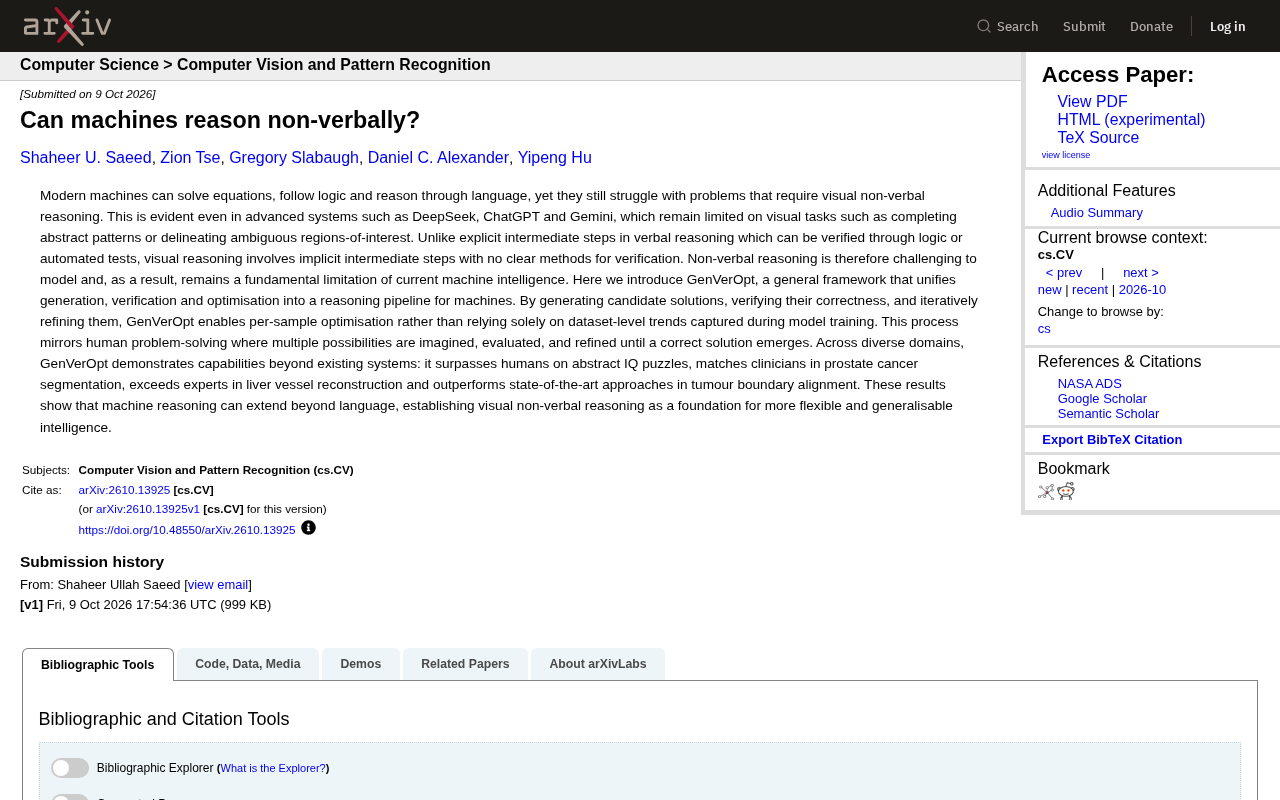
Modern AI systems can solve equations, follow logical chains, and handle complex reasoning through language — but they still struggle with problems that require visual, non-verbal reasoning. Even advanced systems like DeepSeek, ChatGPT, and Gemini fall short when faced with visual tasks such as completing abstract patterns or delineating ambiguous regions of interest. A new study called GenVerOpt aims to break through this bottleneck, establishing visual non-verbal reasoning as the foundation for more flexible and generalizable intelligence.
Why Visual Reasoning Is a Fundamental Weakness in Machine Intelligence
Verbal reasoning is relatively easy to model because its intermediate steps are explicit — every logical step can be verified and checked for correctness using logical rules or automated tests. This verifiability gives model training and error correction a clear foothold.
Visual reasoning is a different story entirely. It involves implicit intermediate steps with no clear verification method. When a human looks at a series of abstract patterns and infers what comes next, the reasoning process the brain undergoes is difficult to decompose into a verifiable logical chain. This is precisely why non-verbal reasoning has long resisted modeling, making it a fundamental limitation of current machine intelligence.
Researchers point out that this gap has far-reaching real-world consequences — from medical image analysis to abstract pattern recognition, a large number of real-world problems are inherently non-verbal, and existing language-centric reasoning paradigms struggle to address them.
Abstract pattern completion tasks (such as Raven's Progressive Matrices) have long been used in cognitive science as a core tool for measuring "fluid intelligence" — the ability to solve novel problems through inductive reasoning, without relying on prior knowledge. For AI systems, the difficulty of these tasks lies not in perception (recognizing shapes themselves), but in simultaneously inferring hidden rules across multiple dimensions (such as combined logic of shape transformations, numerical increments, and color rotations) and projecting them onto unseen blank cells. Even large language models that perform reasonably on text-based versions of similar problems see their accuracy drop sharply once the task is presented in pure image form, stripped of all text descriptions. This confirms that "language ability" and "visual structural reasoning ability" are two relatively independent cognitive mechanisms — the former cannot simply substitute for the latter.
GenVerOpt: A Unified Framework of Generation, Verification, and Optimisation
The core idea behind GenVerOpt is to unify Generation, Verification, and Optimisation into a single reasoning pipeline. Its workflow can be summarized as a three-step loop:
- Generate candidate solutions: Propose multiple possible answers to a given problem;
- Verify correctness: Evaluate each candidate to determine whether it holds up;
- Iteratively refine: Continuously adjust based on verification feedback until the correct result is reached.
The most critical breakthrough in this mechanism is the realization of per-sample optimisation, rather than relying solely on the overall trends the model captures from a dataset during training. In other words, traditional models tend to get things right "in most cases," while GenVerOpt can deliberate on a single specific problem repeatedly until it finds the optimal solution.
A Problem-Solving Process Closer to Human Cognition
This loop of "imagine multiple possibilities — evaluate — refine" maps closely onto the way humans actually solve problems. When faced with a difficult challenge, people rarely arrive at the answer in one step; instead, they envision several approaches, evaluate each one, and keep refining until they converge on the right answer. GenVerOpt engineers this cognitive process, giving machines a similar capacity for trial-and-error and convergence.
From a technical implementation perspective, the "Verification" stage is the key distinguishing feature of GenVerOpt compared to traditional generative models. Conventional image generation or prediction models (such as diffusion models or discriminative classifiers) typically perform a single forward inference pass — input goes in, output comes out, with no built-in self-correction mechanism. GenVerOpt's verification module essentially acts as a "critic," needing to produce quantifiable evaluation signals about the quality or correctness of visual outputs without explicit text labels. This is technically quite challenging: for language tasks, a verifier can check grammar, logical consistency, or unit tests; but for visual tasks, there is no ready-made formal standard for whether "this pattern completion is correct" or "this segmentation boundary is reasonable." The researchers designed verification signals that capture visual structural consistency, allowing the optimization loop to close — which is also one of the underlying reasons the framework can transfer across domains.
Cross-Domain Validation: From IQ Tests to Cancer Segmentation
GenVerOpt's most compelling achievement is that it demonstrates performance surpassing existing systems across multiple vastly different domains:
- Abstract IQ puzzles: Surpasses human-level performance on abstract intelligence tests;
- Prostate cancer segmentation: Reaches clinician-level performance on medical image segmentation;
- Liver vessel reconstruction: Outperforms expert performance;
- Tumor boundary alignment: Beats current state-of-the-art methods.
These results span two very different domains — cognitive testing and clinical medicine — demonstrating that GenVerOpt is not a task-specific trick, but a generalizable reasoning framework. Achieving or exceeding expert-level performance in high-stakes, high-precision fields like medical imaging suggests that the approach could potentially be deployed in real clinical decision support.
Medical image segmentation deserves a separate explanation as a task type. In the case of prostate cancer and liver vessels, segmentation involves precisely delineating the boundaries of lesions or specific anatomical structures on CT or MRI images. This type of task demands deep domain expertise, and even experienced clinicians can produce significant subjective variation ("inter-observer variability") in regions with blurry boundaries or low tissue contrast. Existing deep learning segmentation models (such as nnU-Net and medical variants of SAM) have achieved solid results on standard test sets, but generalizability and boundary precision remain bottlenecks. When GenVerOpt is described as "reaching or exceeding clinician-level performance" on such tasks, this is typically measured using metrics like Dice coefficient and Hausdorff distance — meaning its output boundaries achieve clinically acceptable levels of overlap and shape correspondence with expert annotations, rather than merely outperforming on coarse-grained metrics.
Implications: Machine Reasoning Can Go Beyond Language
The central message of this research is that machine reasoning can extend beyond language. The success of large language models has long led the field to conflate "language ability" with "reasoning ability," but the breakthrough in visual non-verbal reasoning suggests that truly general intelligence requires building reasoning foundations across a much wider range of modalities.
Establishing visual non-verbal reasoning as a cornerstone of intelligence may offer a new direction for the design of next-generation AI systems — moving away from simply scaling language data and parameter counts, and toward building general-purpose frameworks capable of flexible reasoning and iterative problem-solving across different modalities. GenVerOpt's "generate—verify—optimise" paradigm may well be an important piece of that puzzle.
Open Questions Worth Watching
Of course, information about the original research is limited, and a number of questions remain to be clarified: What is the computational cost of GenVerOpt? Does per-sample iterative optimisation introduce inference latency? How does its verification module ensure reliability on open-ended visual tasks where there is no clear right or wrong answer? These are all critical questions that need to be answered before moving from the lab to large-scale deployment.
But regardless, this work redraws the boundaries of machine reasoning — it extends beyond language, and in the once-blind domain of vision, it charts a new path that is verifiable, optimizable, and generalizable.
Related articles

JobRunner MCP Server: AI Agents Can Now Fix Failed Java Jobs
JobRunner launches an open-source MCP server enabling AI agents to view cluster status, diagnose failures, and recover Java jobs—incident response from any cloud coding environment or existing agent.

MLAI Digital Launches 9 Security Agents: MCP Server Safeguards the Full Lifecycle of Agentic AI
MLAI Digital launches Security MCP Server with nine built-in specialized security agents covering vulnerability discovery, attack simulation, prompt injection detection, API and infrastructure assessment, and accelerated remediation—embedding security validation across the full Agentic AI lifecycle from development to production.

Running Isaac Lab on H100 GPUs: Exploring Better Approaches
Exploring optimization methods for running Isaac Lab on NVIDIA H100 GPUs, including MIG configuration, mixed precision, TensorRT acceleration, and community experience to improve robotics simulation and reinforcement learning efficiency.