Can Multi-LLM Dialogue Really Improve Task Performance? Lessons from a Rigorous Experimental Design
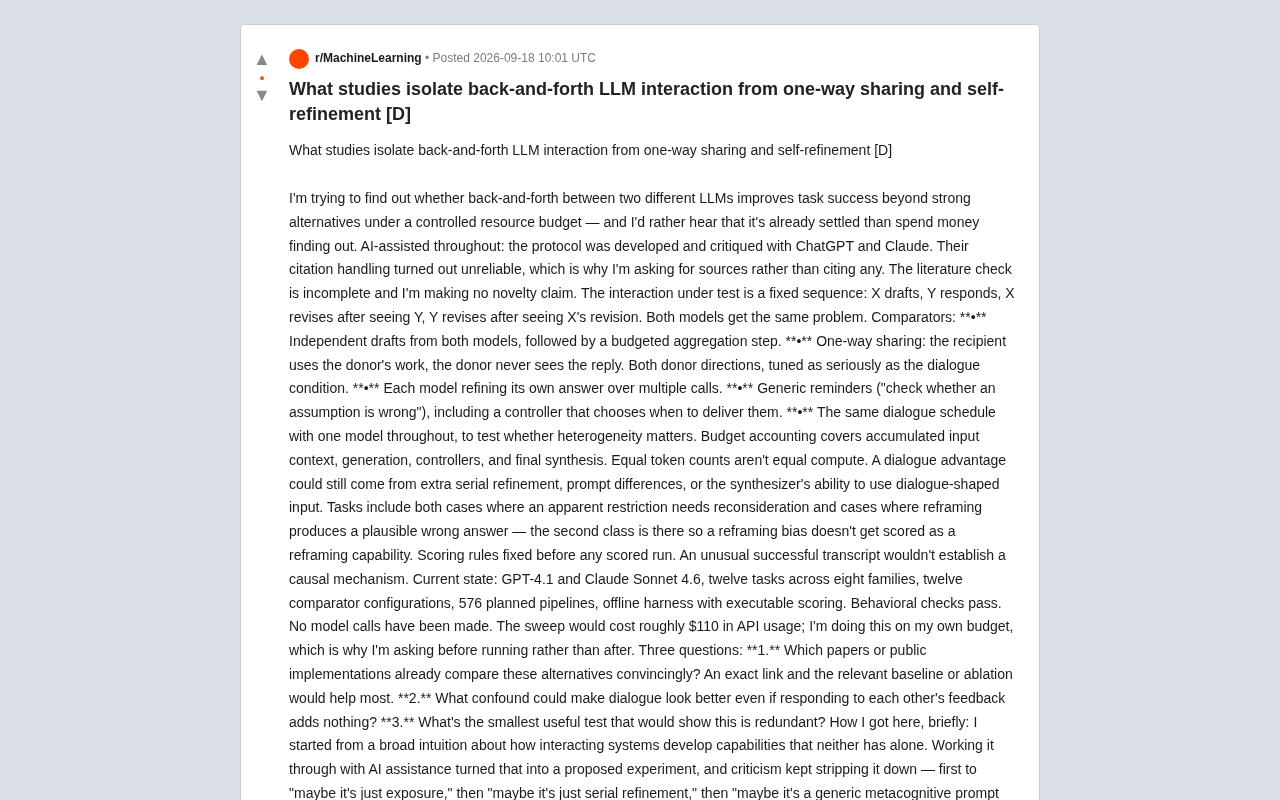
A researcher stress-tests multi-LLM dialogue with rigorous controls before spending a single API dollar.
This article covers a Reddit discussion in which a researcher asks whether back-and-forth interaction between two different LLMs can genuinely outperform simpler approaches—like independent drafting, one-way sharing, or self-refinement—under matched compute budgets. The design includes 12 control configurations to isolate "interaction" from confounds like information aggregation and serial refinement, while also highlighting that equal token counts don't mean equal compute. The 576-pipeline offline framework is ready, but the author sought community feedback before making any API calls—exemplifying a rigorous, falsifiability-first research mindset.
A Research Question Sharpened by Criticism
In AI research, a widely held intuition suggests that having two different large language models (LLMs) engage in back-and-forth dialogue — critiquing each other's outputs — can produce capabilities that neither model could achieve alone. It sounds compelling, but does it actually hold up?
A Reddit user sparked a discussion in the machine learning community, attempting to untangle a deceptively simple question: Under a controlled resource budget, can back-and-forth interaction between two different LLMs genuinely outperform stronger baseline approaches on task success rate?
Interestingly, the question itself was gradually refined through collaboration with ChatGPT and Claude. The author openly admitted that AI assistants handle citations unreliably — which is precisely why he turned to the community for verified literature sources. The entire inquiry reflects a rare kind of scientific self-awareness: criticism is more valuable than construction.
The Core Challenge: Isolating "Dialogue" from Similar Mechanisms
The most valuable aspect of this discussion is its precise definition of what's being tested — and its deliberate effort to isolate the mechanism from several easily confused alternatives.
The interaction being tested follows a fixed sequence: X drafts → Y responds → X revises after seeing Y → Y revises after seeing X's revision. Both models face the same problem.
To demonstrate that "dialogue" itself contributes independently, the author designed multiple control conditions:
- Independent drafting + within-budget aggregation: Both models answer independently, then results are aggregated.
- One-way sharing: The receiving model uses the giving model's output, but the giver never sees the reply (tested in both directions).
- Self-refinement: Each model iteratively polishes its own answer across multiple calls.
- Generic reminders: Injecting metacognitive prompts like "check whether an assumption is wrong" — including a controller that decides when to send such reminders.
- Same-model dialogue: Running the full dialogue flow with a single model, to test whether heterogeneity actually matters.
The elegance of this design is that if the dialogue advantage actually stems from "additional serial refinement," "prompt phrasing differences," or "a metacognitive hint arriving at exactly the right moment," the control conditions can isolate those confounds.
This "Multi-Agent Debate" (MAD) paradigm attracted widespread attention around 2023. Du et al.'s paper Improving Factuality and Reasoning in Language Models through Multiagent Debate demonstrated that having multiple models critique each other could improve reasoning accuracy, sparking a wave of follow-up research. However, several subsequent studies found the advantages difficult to replicate consistently. The root issue is that "letting a model see another model's output" is fundamentally injecting additional information into the input — which is distinct from whether models can generate emergent capabilities through genuine interaction. Early work by Irving et al. on AI safety debates, and later work by Liang et al., both suggested that observed gains often come from information aggregation rather than true collaborative reasoning. Isolating "back-and-forth interaction" from "single-pass information sharing" is therefore a critical step toward resolving this core controversy in the field.
Budget Accounting: Equal Tokens ≠ Equal Compute
The author places particular emphasis on an often-overlooked principle of experimental fairness: fair comparison requires accounting for all computational costs, including cumulative input context, generation, controller overhead, and final synthesis steps.
His point is direct: "Equal token counts do not equal equal computation." A dialogue-based approach may appear superior simply because it consumes more serial reasoning steps — not because the interaction itself produced any gain. This is precisely why many "multi-agent collaboration is effective" conclusions don't hold up: they typically fail to compare against simpler baselines under matched budgets.
This issue is known in the LLM evaluation community as "compute-matched" or "FLOP-matched" comparison, and has become an important topic in recent discussions about evaluation rigor. Serial reasoning chains (such as Chain-of-Thought) and multi-turn dialogue significantly increase input context length, while the attention mechanism in Transformer architectures scales quadratically with sequence length — meaning actual compute far exceeds what raw token counts suggest. Additionally, API pricing typically distinguishes between input and output tokens; in multi-turn dialogue, outputs from earlier turns become inputs in subsequent turns and are billed again, further amplifying cost disparities. In academic comparisons, ignoring these cumulative costs when comparing multi-turn collaborative approaches against single-call baselines almost inevitably makes the collaborative approach look better — a methodological flaw that is extremely common in the literature yet rarely called out.
Task Design to Prevent Reframing Bias from Being Mistaken for Capability
The task set is also carefully designed. It includes two types of problems:
- Problems where surface-level constraints need to be reexamined in order to find a solution.
- Problems where reframing leads to a plausible-sounding but incorrect answer.
The second category exists to prevent a model's reframing bias from being mistakenly scored as reframing capability. Scoring rubrics are fixed before any formal runs, avoiding post-hoc adjustment bias.
Reframing bias refers to the tendency of language models to transform problems into forms they're comfortable answering, rather than genuinely understanding the problem's constraints. This is analogous to the "Texas Sharpshooter Fallacy": the model shoots first (outputs a reframed solution) and then draws the bullseye (claims to have solved the original problem). In multi-agent dialogue settings, if all evaluation tasks require breaking surface-level constraints to answer correctly, any dialogue pattern that tends to question assumptions will receive inflated scores — even if that same pattern makes errors in scenarios where reframing is harmful. By including tasks where reframing is detrimental, the evaluation can decouple genuine reframing capability from systematic reframing bias at the score level, which is an important paradigm for robust benchmark design.
Current Progress and Three Open Questions
From a technical standpoint, the author has built a fairly complete offline testing framework:
- Models: GPT-4.1 and Claude Sonnet 4.6
- 12 tasks spanning 8 task families
- 12 control configurations, totaling 576 planned pipelines
- Offline testbed with executable scoring; behavioral checks have passed
- No model API calls have been made yet
The full sweep is estimated to cost around $110 in API fees. Since it's self-funded, the author chose to seek community input before running anything — rather than discovering problems only after spending the money. He poses three questions:
- Which papers or public implementations have already convincingly compared these alternative approaches? Precise links and relevant baselines or ablation studies are especially welcome.
- What confounds might make dialogue appear better even if "responding to each other's feedback" actually provides no gain?
- What is the "minimally useful test" that would demonstrate this work is redundant?
Implications for AI Researchers
This thread may ultimately be more valuable than the answers it seeks. It demonstrates a research paradigm worth emulating: before spending money to run experiments, push the hypothesis to its narrowest, most falsifiable boundary.
From the grand intuition that "interactive systems can develop unique capabilities," to "perhaps it's just exposing more information," to "perhaps it's just serial refinement," to "perhaps it's just a metacognitive prompt arriving at the right moment" — layer by layer, criticism compressed a vague idea into a controlled experiment.
For researchers working on multi-agent systems, LLM collaboration, and self-reflection, this control design provides a template for testing whether "collaborative gains" are real. In an era where multi-agent frameworks are proliferating rapidly, whether such systems can genuinely beat simple baselines under matched budgets remains a question that is far from adequately answered.
Related articles
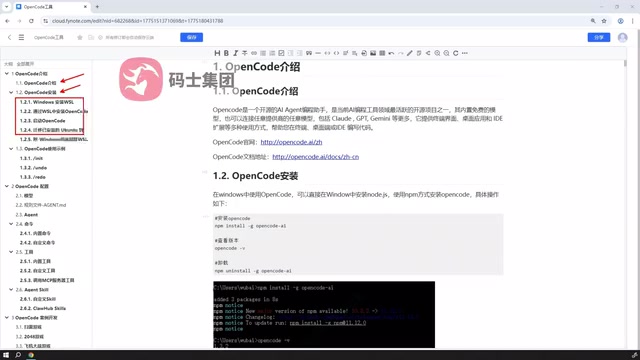
OpenCode Complete Guide: Installation, Configuration & Practical Usage
A complete guide to OpenCode, an open-source AI coding tool: desktop and WSL installation, model and rule configuration, agent types, custom commands, MCP integration, and Agent SQL reuse.

Which $10 AI Coding Plan Should You Choose? Go vs. Code Credit Breakdown
After DeepSeek's price hike, should you pick Go or Code for your $10 AI coding plan? We break down credit allocations for Mimo, Qwen, DeepSeek V4, Kimi, and more.
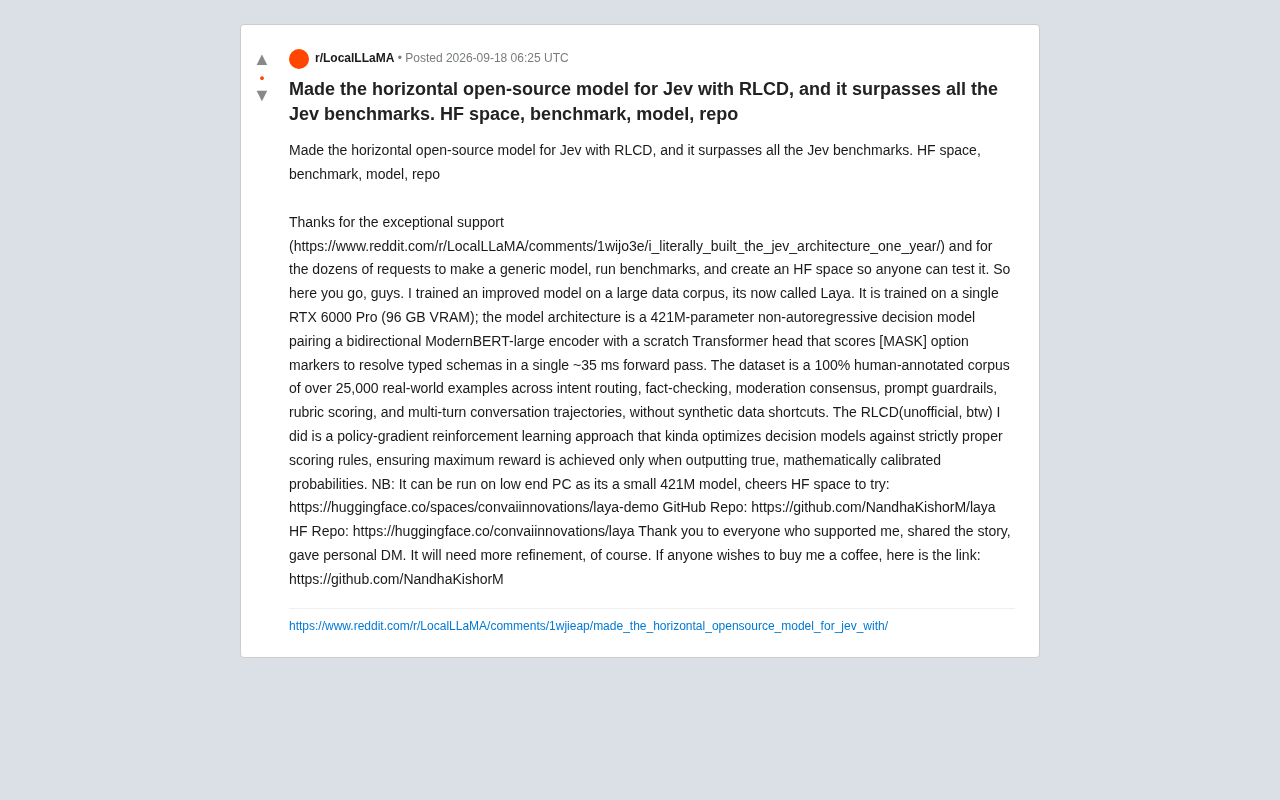
Laya Open-Source Decision Model: How 421M Parameters Beat Jev Benchmarks
Laya is an open-source 421M-parameter non-autoregressive decision model built on the Jev architecture, trained with RLCD on 25,000 human-annotated samples using a single GPU, running in ~35ms on low-end PCs.