Can Muse Resolve Meta's Trust Crisis?

Meta's AI launch grabbed the spotlight, but its historical trust deficit remains the real hurdle to clear.
Meta's latest AI announcement successfully outpaced OpenAI and Anthropic in timing and impact, reclaiming the industry spotlight. But grabbing headlines is only the starting point of a strategic shift — the real test is whether Meta can overcome its long-standing trust crisis. Past controversies around data privacy (the Cambridge Analytica scandal), content moderation, and targeted advertising mean every new product faces heightened scrutiny. Meta's open-source strategy, exemplified by the LLaMA series, is an effective lever for winning developer community support — but for everyday consumers, open weights don't automatically translate into trustworthiness. Privacy protection, product reliability, and long-term commitment are what truly matter. Rebuilding trust is a patient game of sustained follow-through, and its outcome will set the trust benchmark for how the entire industry views big companies in AI.
Meta's AI Narrative and the Trust Problem
A central topic has emerged in recent discussions on tech media outlet Equity: how Meta's latest AI announcement successfully stole the industry spotlight from OpenAI and Anthropic. Behind this battle for attention lies a deeper question — can Meta use its new AI products to repair the trust crisis that has long haunted the company?
For any tech giant, grabbing media headlines isn't difficult. The real challenge is convincing users, developers, and regulators that the intentions behind those products are genuine. Meta's history of controversy around data privacy, content moderation, and targeted advertising means every new product launch faces a much higher bar of scrutiny.
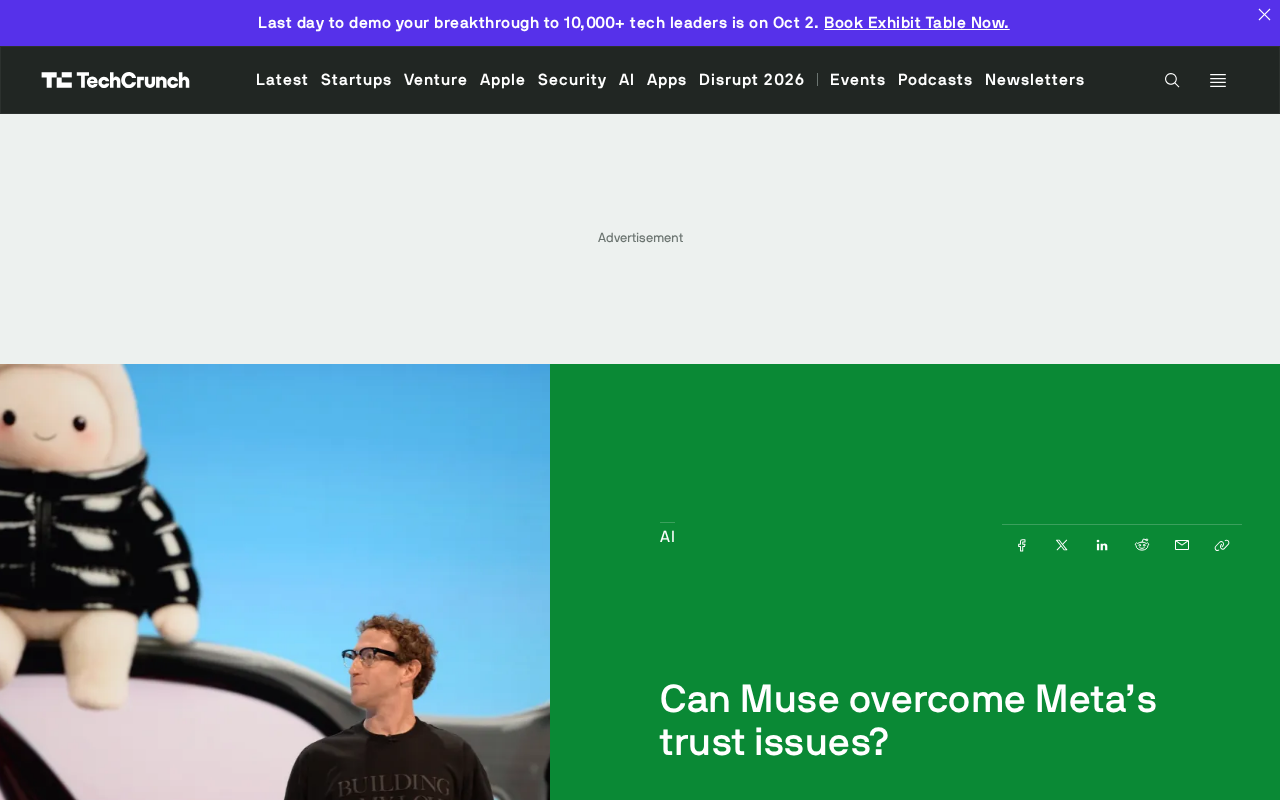
What Stealing the Spotlight Actually Means
Meta's AI announcement generated widespread discussion largely because it outpaced two companies currently considered industry benchmarks — OpenAI and Anthropic — in both timing and impact. These two companies have shaped mainstream understanding of large language models through the ChatGPT and Claude families respectively. Standing out in that competitive landscape requires more than technical benchmarks.
Seizing the spotlight is itself a strategic signal: Meta wants to redefine how the world sees its role in AI. Transitioning from social media giant to provider of AI infrastructure and products is an identity shift that requires sustained narrative support — and a successful launch is only the beginning.
OpenAI and Anthropic became industry benchmarks through different narrative logics. OpenAI ignited public awareness with ChatGPT in late 2022, building a massive consumer user base and strong brand recognition. Anthropic, meanwhile, leads with a "safety-first" research orientation, establishing differentiated credibility among enterprise clients and policy circles through methodologies like Constitutional AI. Meta's competitors, then, aren't just rivals in product features — they are "narrative incumbents" who have already claimed distinct positions in the public mind. In this context, Meta needs to find a third narrative path: one that differs from OpenAI's mass appeal and from Anthropic's safety halo.
Trust Is the Core Variable
The question raised by the Equity podcast — whether Muse can overcome Meta's trust problem — cuts right to the heart of the matter. Technological leadership can be closed through R&D investment relatively quickly, but rebuilding trust is a slow and fragile process.
User trust in AI products operates on multiple levels: how data is used, whether model outputs are reliable, and whether the company will exploit product capabilities for aggressive monetization. For Meta, these happen to be precisely the areas most questioned throughout its history. Whether a new brand or product line can sufficiently distance itself from the parent company's past image will determine how well it is received.
Meta's trust crisis has several landmark moments worth understanding. The Cambridge Analytica scandal, exposed in 2018, revealed large-scale misuse of Facebook user data by a third party, directly leading to founder Mark Zuckerberg testifying before the U.S. Congress. In subsequent years, Meta faced ongoing EU GDPR compliance investigations and massive fines. On content moderation, controversies over misinformation and algorithmic amplification have resurfaced repeatedly across multiple election cycles. This history has conditioned both regulators and segments of the public to respond with reflexive wariness — whenever Meta launches a new product involving data processing, these memories are reactivated, creating structural resistance that a single product launch cannot dissolve.
Open Source as a Trust Lever
Notably, Meta has consistently pursued a relatively open approach in AI, seeking developer community support by releasing model weights. This strategy functions as a trust lever — returning choice and transparency to the community, using openness to counterbalance concerns about closed commercial motives.
If the new product continues in this direction, it may gain faster acceptance within developer communities. But for ordinary consumers, open source does not directly translate to trustworthiness. Product experience, privacy protection, and long-term commitment are what they actually care about.
Meta's open-source AI strategy is embodied in the LLaMA model series — successively releasing LLaMA, LLaMA 2, and LLaMA 3 starting in 2023, with open model weights that allow researchers and developers to freely download, fine-tune, and deploy them. This approach generated strong enthusiasm in academic and independent developer communities, directly spawning a large ecosystem of LLaMA-derived models and applications, and earning Meta considerable goodwill in technical circles. However, a subtle gap remains between "open weights" and "fully open source": Meta's model releases typically come with usage terms — for instance, commercial applications exceeding a certain number of monthly active users require separate licensing. This means the open-source strategy ultimately serves Meta's ecosystem ambitions, a point some observers characterize as "conditional transparency" rather than unconditional openness.
Conclusion: A Game That Requires Patience
Whether Meta can resolve its trust crisis through new AI products is unlikely to be settled anytime soon. Stealing headlines demonstrates its market pull, but the real test lies in long-term performance after products ship. Trust cannot be won through a single launch event — it depends on whether Meta is willing to make and consistently honor commitments around transparency, user rights, and product reliability.
The outcome of this game matters not only for Meta's own AI strategy, but will also shape the entire industry's baseline of trust in the proposition of "big companies doing AI."
Related articles

Chain of Thought Isn't Just for AI: How Humans Can Use CoT to Improve Thinking Quality
Chain of Thought isn't just a prompt trick for large models. Starting from a Hacker News discussion, this article analyzes why CoT works for human thinking too, breaks down actionable ways to transfer it, and highlights the key differences between human CoT and machine CoT.
Cloudflare Teams Up with OpenAI: Closi…
Cloudflare Teams Up with OpenAI: Closing the Loop from Vulnerability Discovery to Defense with AI
Cloudflare uses OpenAI Daybreak to investigate security vulnerabilities and generate reviewable remediation plans, while developers use Codex to boost coding efficiency and quality.

Orca Multi-Agent Orchestration in Practice: A Guide to Parallel Collaboration with Claude and Codex
Orca is Stable AI's free open-source agent workbench supporting 34 agents like Claude Code and Codex in parallel. Learn its Git worktree isolation, multi-model orchestration, and mobile management.