Can OpenWiki Really Improve Output Quality? A Deep Dive into a Community Discussion

OpenWiki's cost savings are documented, but evidence of real output quality improvement remains unverified — define your metrics before adopting it.
This article examines a Reddit user's pointed question: does OpenWiki actually improve output quality beyond saving costs? It clarifies that cost savings and quality improvement are distinct benefit types — faster retrieval doesn't automatically mean better content. It then identifies three reasons quality is hard to verify: standards vary by team, improvement factors are hard to isolate, and first-hand community feedback is scarce. Finally, it offers a practical evaluation framework: define quality metrics first, run small-scale pilots, observe changes in collaborative behavior, and collect real user experiences.
A Question Worth Asking
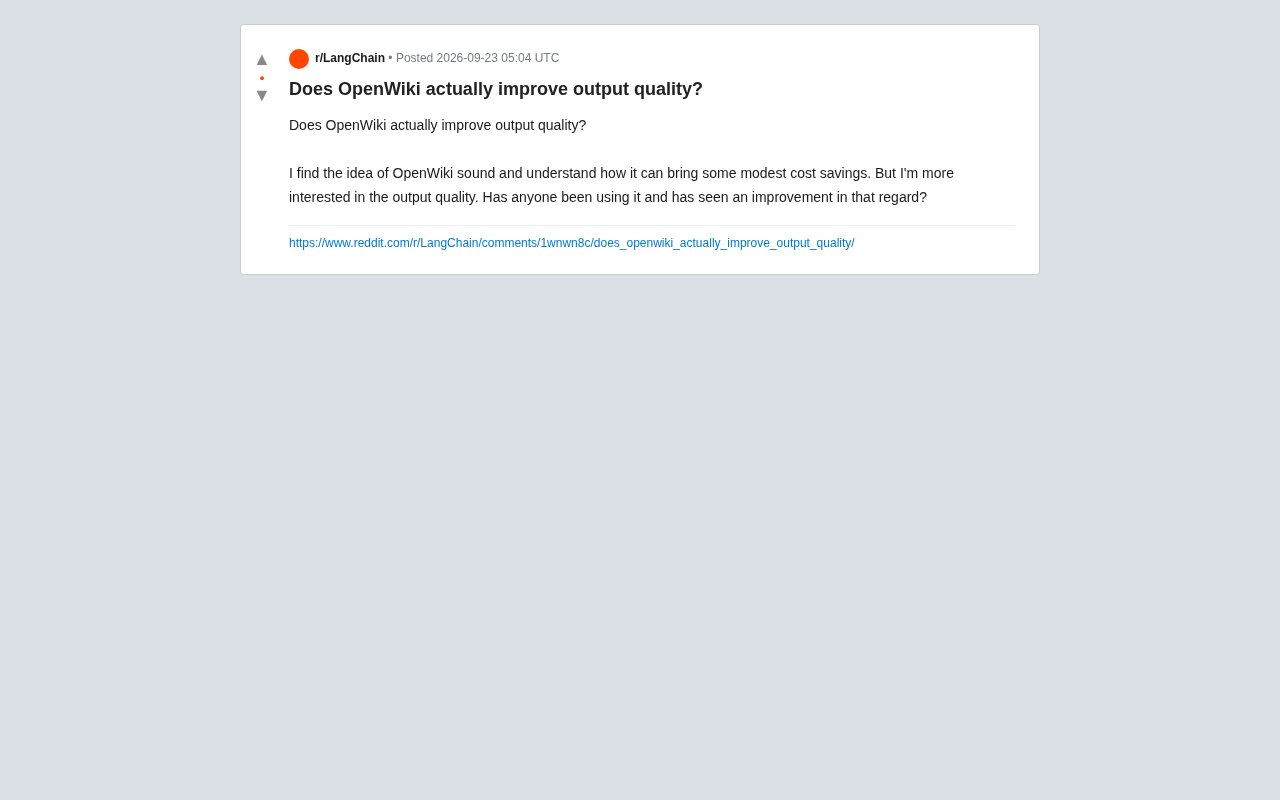
In open-source tool communities, knowledge management and content collaboration tools like OpenWiki are being discussed by more and more teams. A Reddit user cut straight to the heart of the matter with a pointed question: beyond delivering moderate cost savings, can OpenWiki actually improve "output quality"?
It's a deceptively simple question, but a critically important one. Many tools emphasize cost, efficiency, and collaboration convenience in their marketing, yet rarely offer quantifiable evidence of improvements to the quality of final output. The user made clear that while he appreciates OpenWiki's philosophy and understands its cost-related value, what gives him pause is its actual impact on the quality of results produced.
"Cost Savings" and "Quality Improvement" Are Two Different Things
The first concept to clarify: reducing costs and improving quality are not the same type of benefit — they may even involve trade-offs.
The core selling point of most knowledge base or wiki-style tools is centralizing information, reducing redundant work, and lowering the time costs of communication and retrieval. These genuinely translate into meaningful efficiency and expense savings. But "output quality" points to something else entirely — whether the final deliverable is more accurate, more complete, and more consistent.
A tool that helps you find information faster doesn't automatically mean the content you produce from it is better. Quality improvements typically depend on how information is organized, how rigorous the collaboration process is, and the professional judgment of the people using it. This is exactly why the original post's question is so valuable: don't mistake the certain gains of "saving money" for evidence of "getting better."
In the knowledge management space, this distinction maps onto two different benefit models. Cost savings are "efficiency-type gains" — they can be measured relatively objectively through metrics like reduced work hours and less redundant effort. Quality improvements are "effectiveness-type gains" — they involve multiple dimensions such as information accuracy, content maintainability, and collaboration standards, which may themselves involve trade-offs.
The essence of a wiki-style tool is lowering the "write cost" and "retrieval cost" of knowledge. But the density and reliability of that knowledge ultimately depend on contributors' expertise and the team's maintenance discipline. A wiki that no one updates can actually drag down output quality as outdated information accumulates — this is the most common failure mode of "tool in place, management absent."
Why Quality Is Hard to Verify Directly
Whether OpenWiki improves output quality is difficult to answer for several practical reasons.
Quality itself lacks a universal standard. What "good" means varies across teams — some prioritize accuracy, others readability, others timeliness of updates. Without shared metrics, discussions tend to stay at the level of subjective impressions.
Improvement factors are hard to isolate. Even if a team's content gets better after introducing OpenWiki, it's difficult to determine whether the tool itself deserves the credit, or whether it was process optimization, team growth, or a combination of other variables.
Sample size and feedback are insufficient. Based on the current state of discussion in the original post, the community has yet to produce a large body of reproducible real-world feedback. This is precisely why the poster is soliciting experiences — what's needed is first-hand observations from real users, not vendor marketing copy.
How to Rationally Evaluate This Type of Tool
For any team considering OpenWiki or similar knowledge collaboration tools, rather than debating abstractly whether quality can be improved, it's more useful to establish a practical evaluation framework.
Define your quality metrics first. Be clear about what you care about most — accuracy, content consistency, update frequency, or reusability — then observe whether the tool brings improvement along those specific dimensions.
Run a small-scale controlled experiment. Pilot the tool with one team or project, compare output against a control group that isn't using it, and try to control for other variables in order to reach something closer to a genuine causal judgment.
Watch for changes in collaborative behavior. The real quality improvements a tool enables often show up in whether it fosters more disciplined knowledge capture and collaboration habits — not in any single feature.
Gather first-hand community feedback. As the original post demonstrates, actively seeking input from users who already have experience is a low-cost way to obtain credible information.
In practice, a strict "controlled experiment" is often difficult to execute for non-research teams — but a lightweight alternative is the "before-and-after comparison": before introducing the tool, document a quality baseline for typical content output over a period of time (e.g., documentation error rate, handoff omissions, external feedback scores). After rollout, review the same metrics periodically. While this can't strictly eliminate other variables, it accumulates enough longitudinal data to elevate judgment from "feels like it's getting better" to "there's a trail to follow."
It's also worth noting that team size and content type significantly influence how effective a tool proves to be. Smaller teams whose content consists primarily of process documentation tend to see quality-level improvements more quickly. In contexts where content relies heavily on individual professional judgment, the tool's marginal contribution is comparatively limited.
Conclusion: A Good Question Has Value in Itself
This Reddit thread doesn't deliver an answer — but the question it raises touches on exactly what's most easily overlooked in tool selection: don't let the certain returns of cost savings cloud your judgment, causing you to neglect careful verification of what matters most — output quality.
For anyone interested in OpenWiki, treat this discussion as a reminder: the true value of any tool needs to be tested in your own context, against your own standards. When community experience is still limited, maintaining that spirit of inquiry is itself a sign of wisdom.
Related articles

Chain of Thought Isn't Just for AI: How Humans Can Use CoT to Improve Thinking Quality
Chain of Thought isn't just a prompt trick for large models. Starting from a Hacker News discussion, this article analyzes why CoT works for human thinking too, breaks down actionable ways to transfer it, and highlights the key differences between human CoT and machine CoT.
Cloudflare Teams Up with OpenAI: Closi…
Cloudflare Teams Up with OpenAI: Closing the Loop from Vulnerability Discovery to Defense with AI
Cloudflare uses OpenAI Daybreak to investigate security vulnerabilities and generate reviewable remediation plans, while developers use Codex to boost coding efficiency and quality.

Orca Multi-Agent Orchestration in Practice: A Guide to Parallel Collaboration with Claude and Codex
Orca is Stable AI's free open-source agent workbench supporting 34 agents like Claude Code and Codex in parallel. Learn its Git worktree isolation, multi-model orchestration, and mobile management.