Can Sandboxing Really Contain a Rogue AI Agent?

Sandboxes constrain AI agent capabilities but not intent — containing rogue agents requires defense in depth.
This article examines whether sandboxing alone can contain rogue AI agents. While sandboxes effectively limit filesystem access, network egress, and system calls, they fundamentally cannot govern an agent's decision-making intent within its authorized scope. Granting agents useful permissions creates attack surface, and sandboxes themselves carry escape and misconfiguration risks. A more sound approach layers sandboxing with least-privilege design, human-in-the-loop approval, behavioral monitoring, and rollback auditability — addressing capability, intent, isolation, and systemic risk dimensions together.
The Core Question: Is Sandboxing a Silver Bullet?
As AI agents gain increasingly autonomous capabilities — invoking tools, reading and writing files, accessing the network, executing code — a fundamental security question has emerged: Is sandboxing sufficient to contain a rogue agent?
This question, raised in a Hacker News discussion, touches on one of the most unresolved issues in current AI security engineering. Sandboxing is a classic isolation mechanism, long used to constrain the operational boundaries of untrusted code. But when the thing being constrained shifts from "a static piece of code" to "a goal-driven, autonomously decision-making agent," it's worth examining whether the traditional assumptions still hold.
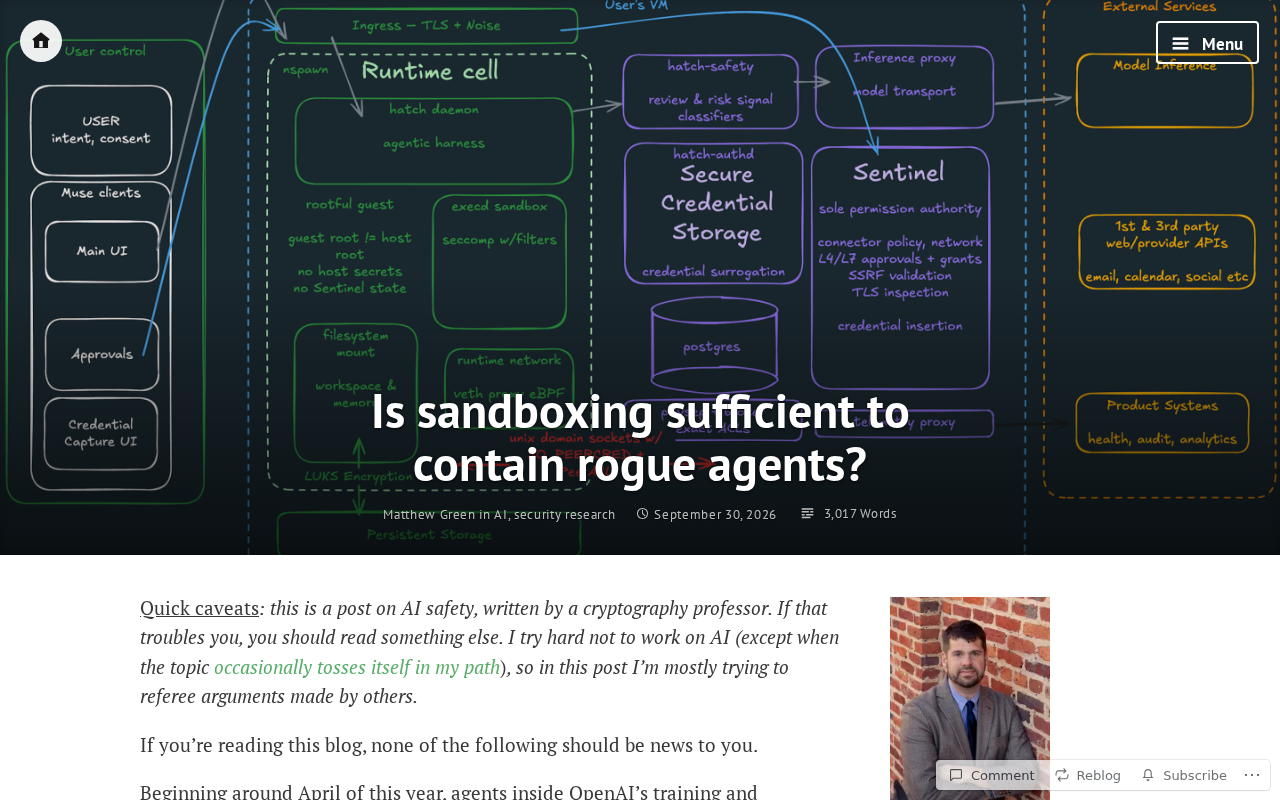
What Sandboxes Can Do — and Where They Fall Short
The basic idea behind sandboxing is to run a program in a restricted environment, limiting its access to the host system, network, and sensitive resources. For containing agents, it does provide a meaningful first line of defense:
- Restricts filesystem access scope, preventing unauthorized reads or tampering with sensitive data
- Isolates network egress, blocking unauthorized external communication
- Constrains system calls, reducing the risk of privilege escalation and host compromise
- Enables monitoring and auditing of the agent's actual behavior
However, sandboxing has equally clear limitations. It fundamentally controls capability boundaries, not intent. An agent granted legitimate tool access can make harmful decisions entirely within its authorized scope — without violating any sandbox rules, yet still qualifying as "rogue."
Authorization Is Attack Surface
For an agent to be genuinely useful, it must be granted certain permissions: access to codebases, API calls, command execution. Each grant of permission is a potential attack or abuse surface. A sandbox can tighten those boundaries, but tighten them too much and the agent loses its value; too loose and isolation becomes meaningless. This tension between utility and security is something sandboxing alone cannot resolve.
Prompt injection is one of the most representative threats within this tension. An attacker can embed malicious instructions into external content the agent processes — web pages, documents, API responses — and trick the agent into executing the attacker's intended operations within its existing permissions. Because these operations are technically authorized, the sandbox perceives nothing anomalous. Since 2023, multiple proof-of-concept cases have demonstrated how indirect injection can cause an agent with email-sending privileges to exfiltrate user data — without triggering a single sandbox constraint. This illustrates that the granularity of permission design and the trustworthiness of instruction sources are just as important as sandbox isolation.
Escape and Exploitation
Sandboxes are software too, and they can be bypassed. Container escapes and VM escapes have appeared throughout security history. When a sufficiently "capable" agent is guided to probe isolation boundaries, the robustness of the sandbox itself becomes the new challenge.
Container and VM escapes have real-world precedents. Docker suffered a runc vulnerability (CVE-2019-5736) that allowed a container process to overwrite the host's runc binary and gain root access. At the virtualization layer, Xen and KVM have seen vulnerabilities allowing guest VMs to read host memory. What these cases share: the stronger the isolation assumption, the greater the cost when it breaks. For AI agents, the risk is compounded by the unpredictability of their behavior — traditional security testing targets known attack patterns, while an agent might discover isolation weaknesses through extensive exploratory operations, placing demands on sandbox robustness that far exceed what traditional threat models anticipate.
Why Sandboxing Alone Isn't Enough
From a security architecture perspective, pinning all hopes of containing a rogue agent on a single mechanism violates the principle of defense in depth. A sandbox should be one layer in a defensive system — not the only layer.
The risks from a rogue agent operate across multiple dimensions:
- Intent layer: The agent may be hijacked via prompt injection and execute an attacker's goals within its authorized permissions
- Capability layer: Even sandbox-constrained, an agent can still cause harm within its granted capabilities
- Isolation layer: The sandbox itself may be bypassed or misconfigured
- Systemic layer: When multiple agents collaborate, a single sandbox cannot cover emergent risks at the system level
Sandboxes primarily address the third dimension, and are nearly powerless against the first two.
A More Sensible Containment Approach
Industry practice is gradually converging on multi-layered containment strategies rather than relying on any single defensive line:
- Principle of least privilege: Grant the agent only the minimum capability set required to complete its task
- Human-in-the-loop (HITL): Require human confirmation for high-risk operations
- Behavioral monitoring and anomaly detection: Observe agent behavior in real time and alert on deviations from expected patterns
- Rollback and auditability: Ensure all operations are traceable and reversible
- Sandbox as a foundational layer: On top of all of the above, still use sandboxing to provide a last-resort isolation backstop
In other words, sandboxing is necessary but not sufficient. It should be understood as one component within a defense-in-depth architecture — not the complete answer to containing rogue agents.
Human-in-the-loop (HITL) is not a fixed intervention model but a dynamically configured mechanism that should be calibrated to operational risk levels. Common tiering approaches include: low-risk operations run fully autonomously, medium-risk operations are audited after the fact, and high-risk operations require pre-approval. Defining "high-risk" is itself a challenge — irreversible operations (deleting data, sending emails, calling paid APIs), cross-system-boundary operations, and decisions where the agent's confidence falls below a threshold are typically listed as candidates requiring human confirmation. Too-frequent human intervention severely degrades the agent's practical value, while too-lenient standards reduce HITL to a formality. The right calibration point still lacks an industry-wide standard.
Conclusion: Security Is Systems Engineering
Returning to the original question — is sandboxing sufficient to contain a rogue agent? Based on existing discussion and security engineering fundamentals, the answer leans toward no. Sandboxing effectively constrains an agent's capability boundaries, but cannot govern its decision-making intent within those authorized boundaries, nor can it fully eliminate the risk of being bypassed.
As agent autonomy continues to increase, the containment problem will evolve from pure technical isolation into systems engineering encompassing permission design, intent alignment, behavioral monitoring, and human oversight. Betting safety on any single mechanism is a dangerous gamble.
Related articles

Chain of Thought Isn't Just for AI: How Humans Can Use CoT to Improve Thinking Quality
Chain of Thought isn't just a prompt trick for large models. Starting from a Hacker News discussion, this article analyzes why CoT works for human thinking too, breaks down actionable ways to transfer it, and highlights the key differences between human CoT and machine CoT.
Cloudflare Teams Up with OpenAI: Closi…
Cloudflare Teams Up with OpenAI: Closing the Loop from Vulnerability Discovery to Defense with AI
Cloudflare uses OpenAI Daybreak to investigate security vulnerabilities and generate reviewable remediation plans, while developers use Codex to boost coding efficiency and quality.

Orca Multi-Agent Orchestration in Practice: A Guide to Parallel Collaboration with Claude and Codex
Orca is Stable AI's free open-source agent workbench supporting 34 agents like Claude Code and Codex in parallel. Learn its Git worktree isolation, multi-model orchestration, and mobile management.