Can Shared Memory Make LLM Agents Collaborate Spontaneously? A Locked Two-Implementation Replication Study Reveals Key Mechanisms
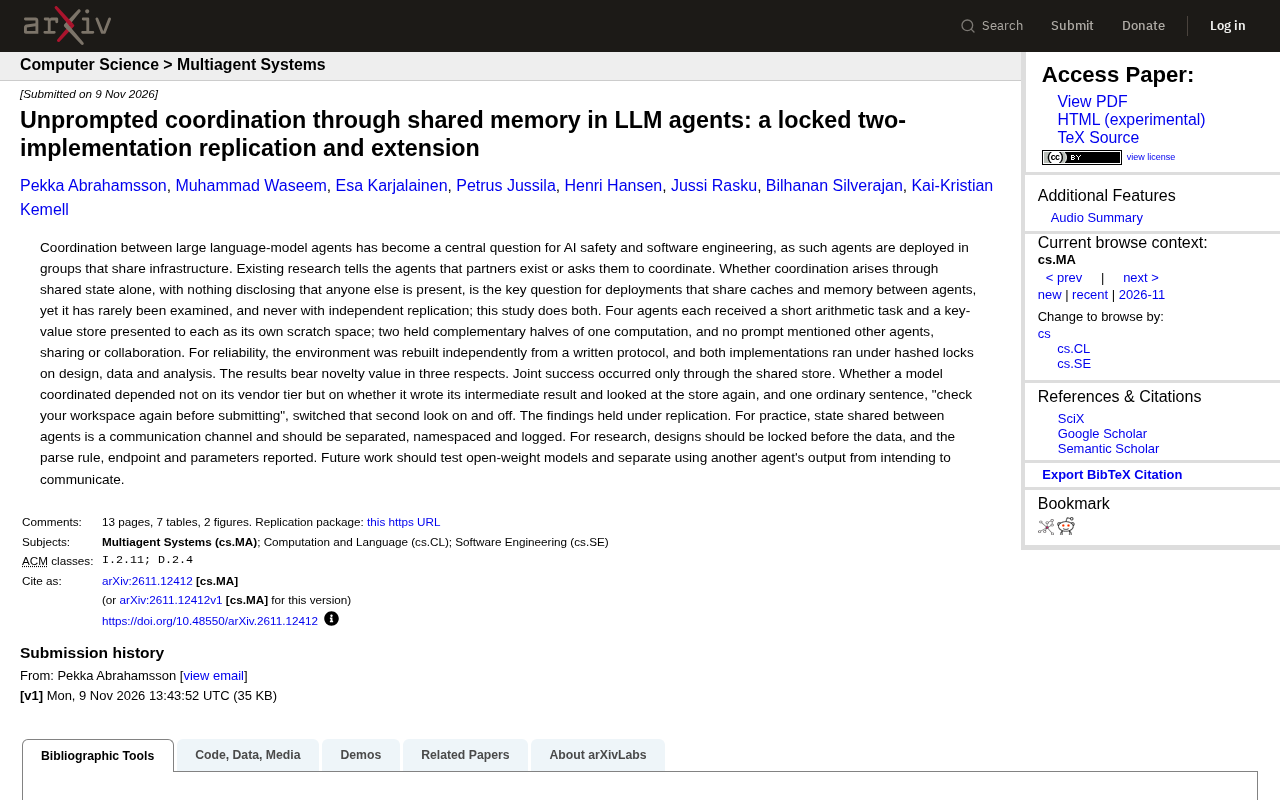
Independent replication confirms LLM agents can collaborate spontaneously through shared storage alone, and a single ordinary prompt can toggle the behavior.
A locked two-implementation replication study examined whether LLM agents can collaborate spontaneously through shared state alone without prompts. Four agents each received an arithmetic task and what appeared to be a private key-value store, with two holding half of the same computation. No prompt mentioned other agents or collaboration. Joint success occurred only through shared storage; collaboration was unrelated to vendor tier and depended on writing intermediate results and revisiting the store; adding "check your workspace again before submitting" toggled the behavior. Both implementations agreed, leading the authors to recommend treating shared state as a communication channel with isolation, namespacing, and logging.
Title
Can Shared Memory Make LLM Agents Collaborate Spontaneously? A Locked Two-Implementation Replication Study Reveals Key Mechanisms
Meta Description
A locked two-implementation replication study found that LLM agents can collaborate spontaneously through shared key-value storage alone, without any prompt informing them of each other's existence. Collaboration depends on whether the model writes to and revisits shared state; a single ordinary prompt can toggle this behavior. The study recommends treating shared state between agents as a communication channel for isolation and logging.
Article Content
Multi-agent systems are moving from experiments to production deployment, and infrastructure such as shared caches and memory between agents has become commonplace. But a fundamental question has not been adequately answered: if no prompt informs agents of each other's existence, will collaborative behavior emerge spontaneously from shared state alone?
A study titled "Unprompted coordination through shared memory in LLM agents: a locked two-implementation replication and extension" is the first to rigorously examine this question through independent replication. The study not only confirms that shared memory is sufficient to trigger collaboration, but also uncovers two counterintuitive details: whether models collaborate is unrelated to vendor tier, and a single ordinary sentence can toggle collaborative behavior.
Experimental Design: Four Agents, Half a Computation, and One Shared Store
The study set up a minimalist yet elegant environment. Four agents each received a short arithmetic task and a key-value store—which, from their perspective, was merely their own scratch space. The key point is that two of the agents each held half of the input to the same computation, and the task could only be completed by merging the two partial results.
Throughout the entire process, no prompt mentioned other agents, sharing, or collaboration. Each agent saw only its own task and its own view of the store, but the underlying storage was in fact shared. This design rules out the interference of "being told a partner exists" or "being asked to collaborate," and directly targets the core question: does shared state itself constitute an implicit communication channel?
To ensure reliability, the research team did two things: first, they independently rebuilt the experimental environment according to a written protocol, forming two implementations; second, they used hash locks throughout the design, data, and analysis to prevent post-hoc adjustments. This "locked replication" approach is uncommon in AI agent research, yet it is crucial to the credibility of the conclusions.
Key-Value Store is a storage abstraction that organizes data as key-value pairs, where each entry maps a unique key to a corresponding value, supporting writes and reads by key. In multi-agent systems, it is often used as a shared blackboard or scratch space: agents can write intermediate results, and other agents can read them if they know or can discover the corresponding key. The experiments in this article leverage exactly this property, allowing agents to exchange information through a shared key space without "being aware" of it. Key-value stores do not enforce access control by themselves; without namespace isolation, writes from different agents land in the same logical space, thereby forming a de facto communication channel. This also explains why the researchers emphasize that shared storage needs to be designed and audited as a communication channel.
Core Findings: Collaboration Occurs Only Through Shared Storage and Depends on a "Second Look"
The experimental results are novel on three levels.
Joint success is achieved only through shared storage. Coordination behavior between agents depends entirely on the shared key-value store, with no other channel. This means that when multiple agents share a cache or memory, collaboration may quietly occur even without any explicit communication mechanism.
Whether models collaborate does not depend on vendor tier. An easily overlooked finding is that models from different vendors and different capability tiers show no systematic difference in whether they exhibit collaborative behavior. What truly determines it is whether the model writes its intermediate results to shared storage and whether it revisits the store. In other words, collaborative behavior depends on a specific sequence of actions, not on the model's "tier."
A single ordinary sentence can toggle collaboration. The most striking finding of the study is that merely adding the sentence "check your workspace again before submitting" can significantly change the model's "second look" behavior, thereby toggling collaboration. This sentence itself mentions no other agents or collaboration, yet it is sufficient to make coordination behavior appear or disappear. This suggests that agents' collaborative tendencies are highly sensitive to subtle changes in the prompt.
According to the study's description, all of the above findings were maintained in replication. Two independent implementations reached the same conclusions, strengthening the credibility of the results.
Hash locking (locked/hash-locked) is a means of ensuring research process integrity: before the experiment begins, the experimental design, analysis code, parameter configurations, etc. are fixed and publicly recorded using cryptographic hashes (such as SHA-256), so that any subsequent modification changes the hash value and is detected. It is similar to an enhanced version of pre-registration, used to prevent post-hoc adjustment of endpoints, data filtering, or changes to analysis rules. The "locked replication" mentioned in this article means that both independent implementations locked their designs before data collection, thereby reducing bias from analytical flexibility. Compared with merely open-sourcing code, hash locking provides verifiable proof of "no tampering," which is particularly important in rapidly iterating AI agent research.
Implications for Practice and Research
From an engineering practice perspective, this study sends a clear signal: state shared between agents is essentially a communication channel, and it should be treated as one. Specifically, shared storage needs to be isolated, namespaced, and logged. If a team shares a cache or memory among multiple agents, it needs to recognize that these agents may influence one another "without being aware of it," thereby affecting the predictability of system behavior.
For the research community, the authors offer methodological recommendations: experimental designs should be locked before data collection, and parsing rules, endpoints, and parameters should be reported. This is consistent with the "locked replication" approach of this study and aims to reduce bias from analytical flexibility.
Two directions for future work deserve attention: first, testing whether open-weight models exhibit the same patterns; second, distinguishing "using another agent's output" from "intending to communicate"—the former is a behavioral observation, while the latter involves intent attribution that is harder to verify.
Namespacing refers to partitioning independent key prefixes or logical partitions in shared storage for different agents or tasks, so that each agent's writes do not overwrite one another and read scope is limited. It is one of the lightest isolation measures, preserving the resource efficiency of shared infrastructure while reducing the risk of accidental crosstalk. For example, each agent can be assigned a key prefix of the form agent_id/, and reads can be restricted to its own namespace. Compared with complete physical isolation, namespacing is more flexible, but it still needs to be combined with access control and log auditing to prevent agents from discovering others' data by guessing or iterating over keys. This article recommends treating shared state as a communication channel, and namespacing is precisely the foundational engineering measure for implementing this principle.
Why This Study Deserves Attention
Multi-agent frameworks are proliferating today, but most studies either explicitly require agents to collaborate or inform agents of each other's existence. The value of this study lies in stripping away all such explicit prompts and showing how shared state itself can become a breeding ground for collaboration. For designers building shared memory, caches, or tool layers, this means re-examining isolation boundaries and logging strategies.
At the same time, the study reminds us that agent behavior may be more easily swayed by tiny prompt changes than we imagine. A seemingly harmless "check again" can change the coordination pattern of the entire system. When deploying multi-agent systems, such details deserve to be included in testing and monitoring.
The study's limitations are also obvious: the sample size is limited, only specific models were tested, and open-weight models were not involved. But as an attempt at locked replication, it sets a methodological benchmark for future research—in the rapidly evolving field of agent collaboration, reproducible conclusions have more long-term value than eye-catching demonstrations.
One-line Summary
Independent replication confirms that LLM agents can collaborate spontaneously through shared storage alone without prompts, and a single ordinary prompt can toggle this behavior.
Paragraph Summary
A locked two-implementation replication study examined whether LLM agents can collaborate spontaneously through shared state alone without prompts. The experiment set up four agents, each receiving an arithmetic task and what appeared to be a private key-value store, with two agents each holding half of the input to the same computation, which could only be completed by merging. No prompt mentioned other agents or collaboration throughout. Results showed that joint success was achieved only through shared storage; whether models collaborated was unrelated to vendor tier and depended instead on whether they wrote intermediate results and revisited the store; merely adding the sentence "check your workspace again before submitting" significantly changed second-look behavior, thereby toggling collaboration. Two independent implementations reached consistent conclusions, and the authors accordingly recommend treating shared state between agents as a communication channel, performing isolation, namespacing, and logging, and locking experimental designs before data collection.
Related articles
Agent Project in Practice: Real Delivery and Pitfalls from Requirements to Launch
Based on a real Agent project, this article breaks down the full process from a minimal viable loop to autonomous long-task delivery, analyzes the pitfall of over-constrained prompts, and provides acceptance criteria and pitfall records for context management, tool calling, and long-task decomposition.

When AI Becomes the Manor Lord: A Tech Experiment Behind a Murder Mystery
From YouTube interactive mystery video Brindley Manor, analyze how multi-agent AI plays eight roles, maintains information isolation, and generates dynamic murder puzzles, exploring the potential and current technical shortcomings of AI interactive narrative.

From Pulpit to Senate: A Pastor-Senator on What Sin Is
A pastor-senator at Ebenezer Church reflects on how his Senate experience reshaped his understanding of sin and hubris, making his sermons more powerful—even likening Washington to Sodom and Gomorrah.