Can't Keep Up with AI Model Releases? Practical Strategies for Practitioners to Handle Information Overload

Practical strategies for AI practitioners to handle overwhelming model releases and information overload
The rapid pace of AI model releases creates anxiety for practitioners trying to keep up. This article analyzes the nature of the model release frenzy and provides actionable strategies: establish personal evaluation criteria based on actual needs, curate high-quality information sources, accept that following everything is unnecessary, and focus on mastering tools that deliver real value rather than chasing every new release.
The AI Model "Arms Race" is Accelerating
A recent Reddit post that resonated widely—"Me trying to keep up with all the new AI models being released"—captured the sentiment of countless AI practitioners and enthusiasts. What seems like self-deprecating humor precisely reflects a prominent phenomenon in today's AI industry: the pace of new model releases has become overwhelmingly fast.
In just over a year, we've witnessed the iteration of OpenAI's GPT series, updates to Anthropic's Claude family, expansion of Google's Gemini lineup, Meta's Llama open-source camp, and the intensive emergence of new forces like Mistral, DeepSeek, and Qwen.
Technical Background of AI Large Language Models
Large Language Models (LLMs) are deep learning models based on the Transformer architecture that learn statistical patterns and knowledge representations of language through pre-training on massive text datasets. After Google introduced the Transformer architecture in 2017, this technical approach quickly became mainstream in the AI field. Model scale has evolved from hundreds of millions of parameters initially to hundreds of billions or even trillions today. Training these models requires substantial GPU computing power and data, with costs often reaching millions to tens of millions of dollars. Key technical metrics include parameter count, context window length, inference speed, and cost. Differences in model architecture, training data, and alignment methods across vendors have created distinct model families with unique characteristics.
AI Industry Competitive Landscape
The current AI large model landscape shows multi-polar competition. OpenAI holds first-mover advantage with its GPT series, while Anthropic, founded by former OpenAI members, focuses on safety-aligned Claude models. Google leverages its search and cloud computing strengths with Gemini, and Meta adopts a fully open-source strategy with Llama to build an ecosystem. The Chinese market features domestic players like Alibaba's Qwen, ByteDance's Doubao, and DeepSeek. Open-source and closed-source camps each have advantages: closed-source models typically offer stronger performance but at higher cost, while open-source models, though slightly less capable, allow local deployment, cost control, and active community innovation. This competition drives rapid technical iteration but also creates a fragmented ecosystem.
Almost every few weeks, or even every few days, a new model appears claiming to "top the leaderboard" or "surpass its predecessor." For individual developers and regular users, this pace no longer brings just excitement—it brings genuine anxiety.
Why AI Practitioners Feel They "Can't Keep Up"
Model Release Frequency Far Exceeds Learning Speed
Human cognitive bandwidth is limited. Truly understanding a new model's capability boundaries, applicable scenarios, and potential risks often requires investing hours or even days in testing and reading. But when model release intervals shrink to weeks, an irreconcilable contradiction forms between deep understanding and release pace. Many practitioners haven't had time to fully grasp the characteristics of one generation before the next is already online.
Marketing Rhetoric Creates Information Noise
Almost every new model comes with promotional language like "SOTA (state-of-the-art)," "beats GPT-4," or "significantly improved reasoning." However, there's often a considerable gap between benchmark results and actual user experience.
Limitations of Benchmarks
AI model evaluation heavily relies on standardized benchmarks, commonly including MMLU (Massive Multitask Language Understanding), HumanEval (code generation), and GSM8K (mathematical reasoning). These tests measure model performance on specific tasks through quantitative metrics. However, benchmarks have significant limitations: test sets may be contaminated (training data includes test questions), benchmark tasks differ from real application scenarios, and single scores cannot reflect comprehensive capability and stability. Recent years have seen "benchmark gaming"—vendors optimizing models for specific benchmarks, leading to inflated scores. Consequently, the industry increasingly values "vibe checks" (actual experience evaluation) and domain-specific real-world task testing rather than relying solely on leaderboard rankings.
This means practitioners must not only keep up with release pace but also possess the ability to discern marketing hype, further increasing the information processing burden.
FOMO Psychology Continuously Amplifies Anxiety
FOMO (Fear of Missing Out) is particularly evident in the AI community. Worrying about falling behind peers by not using the "latest and strongest" model drives people to constantly switch tools and chase new releases, ironically making it difficult to establish stable workflows with any single tool.
Rationally Understanding the Nature of AI Model Releases
Most Model Updates Are Incremental Improvements
Despite each release being packaged as a revolutionary breakthrough, objectively speaking, the vast majority of model iterations are incremental improvements—slightly longer context windows, a few percentage points higher on certain benchmarks, somewhat reduced inference costs.
Evolution of Model Context Window Technology
Context Window refers to the maximum text length a model can process at once, measured in tokens. Early GPT-3 supported only 2048 tokens, approximately 1500 English words. With advances in positional encoding techniques—from absolute positional encoding to relative positional encoding, then to Rotary Position Embedding (RoPE) and ALiBi—model context length has expanded dramatically. Current mainstream models support 32K to 128K tokens, with some reaching over 1 million tokens. Longer context enables models to handle complete books, large codebases, or extended conversation history, but brings quadratic growth in computational cost. In practice, the "lost in the middle" problem (model attention decay on middle portions) with ultra-long context remains a research focus.
While these improvements matter, for most practical application scenarios, they don't constitute a "must migrate immediately" reason.
Capability Convergence Among Leading Models Is Happening
Here's a detail: the capability gap between leading large language models is narrowing. For common daily tasks like writing, coding assistance, and information summarization, mainstream models on the market perform quite similarly. This means the marginal benefit of blindly chasing new releases is decreasing, and stably using a mature AI tool may actually bring higher overall efficiency.
Practical Strategies for Practitioners to Handle AI Information Overload
Establish Your Own Model Evaluation Criteria
Rather than passively accepting every leaderboard, build an evaluation method based on your actual needs. For instance, if you primarily use AI for code generation, test new models with a fixed set of real programming tasks rather than fixating on general benchmark scores. Replacing "is it the strongest" with "is it useful to me" can dramatically reduce decision costs.
Filter for a Few High-Quality Information Sources
Instead of subscribing to dozens of channels leading to information overload, curate a few quality-consistent, reliable sources. Let professional reviewers do the initial filtering for you, investing your energy only when truly valuable updates appear.
Accept the Mindset of "Don't Need to Follow Everything"
Perhaps the most important mindset shift is: acknowledge that you cannot and need not keep up with every AI model release. Tools serve goals, not vice versa. Choosing one or two models that meet core needs and mastering them deeply often provides more practical value than superficially trying a dozen models.
Value of the Open-Source AI Ecosystem
The open-source large model ecosystem, represented by Meta's Llama series and including Mistral, Qwen, and others, allows researchers and developers to access model weights, deploy locally, and fine-tune for specific tasks without worrying about API costs and data privacy. The community has developed a rich toolchain around open-source models: quantization techniques (like GGUF, GPTQ) lower deployment barriers, parameter-efficient fine-tuning methods like LoRA reduce training costs, and frameworks like LangChain and LlamaIndex simplify application development. The open-source ecosystem has spawned numerous vertical domain models and innovative applications, providing a counterbalance to closed commercial models. Open source also promotes academic research transparency and reproducibility, driving knowledge sharing and rapid progress across the field.
For practitioners seeking deep mastery of AI tools, diving into an active open-source model ecosystem often provides more long-term value than chasing closed-source model version updates.
Conclusion: Maintaining Composure in the AI Wave
This Reddit post resonated widely precisely because it captured a universal state of existence in the AI era—we live in a period where technological iteration outpaces human adaptation capacity. Anxiety is a normal response, but anxiety itself doesn't improve productivity.
AI Model Alignment and Safety
Model Alignment refers to techniques for making AI system behavior conform to human values and intentions. Primary methods include RLHF (Reinforcement Learning from Human Feedback) and Constitutional AI. RLHF has human annotators rank model outputs by preference, training a reward model, then using reinforcement learning to optimize the language model. Anthropic's Constitutional AI uses predefined principle sets for self-critique and correction. These techniques aim to reduce the probability of models producing harmful, biased, or inaccurate content. However, alignment is an ongoing process; different cultural backgrounds have varying definitions of "harmful," and over-alignment may reduce model capability and creativity. The industry continues exploring the degree and methods of alignment.
True professional wisdom lies not in keeping up with every model release, but in building the ability to filter noise and focus on value. When waves of AI model releases keep coming, rather than exhausting yourself chasing every crest, stand firm and discern which waves are worth pursuing and which are merely transient bubbles. After all, tools will constantly update, but clear judgment is the core of long-term competitive advantage.
Related articles
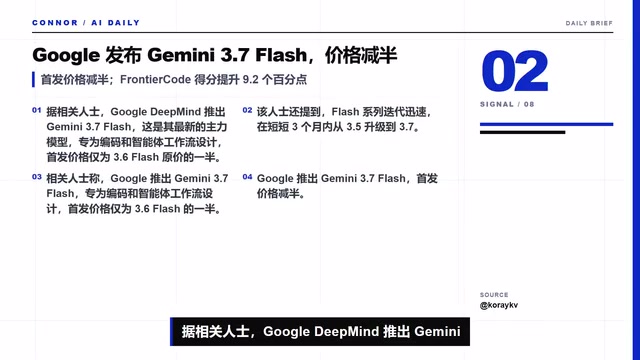
AI Daily: The Speed War and Cost War Are in Full Swing
OpenAI GPT 5.6 UltraFast mode delivers 14x faster inference, Gemini 3.7 Flash slashes prices while boosting performance, MOE architecture gains traction, HBF storage breakthrough—AI industry competition shifts from model capability to speed and cost efficiency dual-front battle.
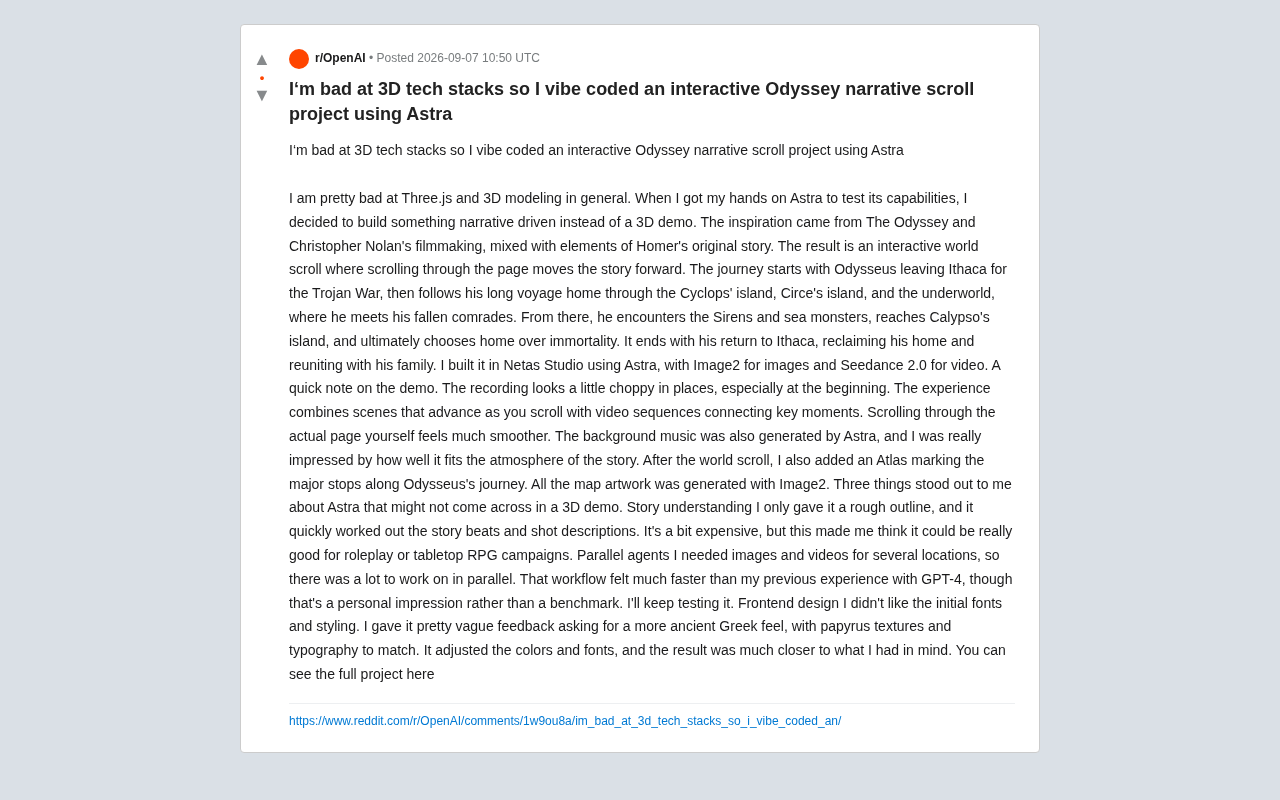
AI-Assisted Creative Production: Building an Interactive Odyssey Narrative Scroll with Astra
A developer with weak 3D skills used Astra AI to create an interactive Odyssey narrative scroll. Learn how AI tools lower technical barriers through story comprehension, parallel workflows, and design iteration.

Internet Archive Fundraising Crisis: Server Operations Challenge Behind 800 Billion Archived Web Pages
The Internet Archive faces server operations funding pressure with 800 billion archived pages. Analysis of Wayback Machine cost challenges, nonprofit digital preservation survival crisis, and sustainable development paths.