Can the File System Become the New Foundation Layer for AI Agents? Three Key Engineering Challenges

File systems offer a natural AI Agent interface, but multi-agent use introduces concurrency, retrieval cost, and auditability challenges.
A developer on Reddit proposed that since LLMs already understand paths and Shell commands, file systems could serve as a zero-learning-cost interface for AI Agents. However, turning this intuition into production infrastructure requires solving three deep problems: concurrent writes cause classic "lost updates" requiring conflict detection and merging; blind file traversal burns tokens and pollutes context, demanding indexed or RAG-style retrieval; and error recovery requires full change history, yet human review can't keep pace with high-frequency Agent edits. These challenges map to core unsolved problems in distributed systems, information retrieval, and software engineering. The author is building AgentWS — a persistent workspace with an Agent-specific control plane — though it remains in early stages.
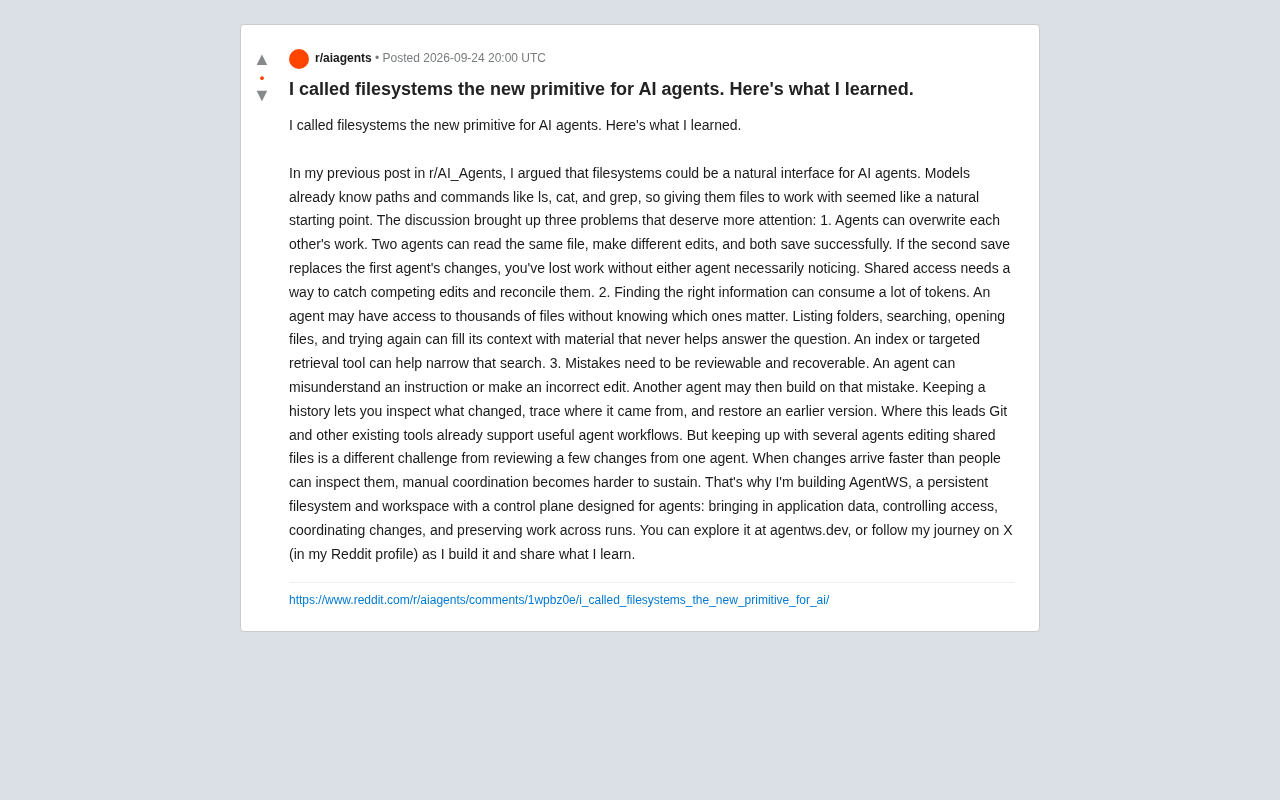
When we talk about how AI Agents interact with the external world, tool calls and API integrations are usually the go-to solutions. But a developer on Reddit's r/AI_Agents community raised a more fundamental perspective: the file system itself can serve as a natural interface for AI Agents. Models are already familiar with paths, ls, cat, grep, and similar commands — handing files directly to them seems like the most natural starting point imaginable.
This idea sounds simple, yet the community discussion exposed three engineering problems worth examining closely. They concern not just the usability of individual Agents, but the foundational challenges that must be addressed in the era of multi-Agent collaboration.
Why the File System Works as an Agent Interface
The author's core argument is "zero learning cost." Large language models have absorbed enormous amounts of Shell commands, directory structures, and file operation knowledge during training. Rather than designing a brand-new API for models to understand and call, directly exposing the file system means Agents can leverage their existing knowledge base.
For an Agent, reading a config file, searching for keywords in a directory, or writing intermediate results to a temporary file — these are all operations equally common in a human developer's daily workflow. The file system provides a "persistent, inspectable, structured" workspace, which is precisely what many purely in-memory Agents lack.
But actually deploying the file system as Agent infrastructure brings its own set of problems. The author summarizes three critical challenges.
Challenge 1: Write Conflicts Among Multiple Agents
The first problem is work loss caused by concurrent edits. Imagine two Agents reading the same file simultaneously, each making different modifications, then saving their changes one after the other. If the second save simply overwrites the first Agent's changes, the earlier work disappears without anyone noticing.
This is essentially the classic "lost update" problem in distributed systems. In human collaboration, we have code reviews, locking mechanisms, and merge requests to mitigate this; but when the participants are Agents operating at high speed with no communication protocol between them, conflicts become far more frequent. The author notes that shared access requires a mechanism to "capture competing edits and reconcile them" — meaning optimistic locking, version conflict detection, and even automatic merge strategies all become necessities.
Optimistic Locking is a common strategy for handling such conflicts: each file carries a version number or timestamp, and before writing, the system checks whether the version matches what was read. If not, the write is rejected and the caller must re-read before making a new decision. Pessimistic Locking, by contrast, locks the resource at read time to block other writers — at the cost of potentially reducing concurrent throughput significantly. In Agent scenarios, where operations tend to be short-lived and high-frequency, optimistic locking is generally more suitable, though if conflict rates are high, frequent retries can also degrade performance. Automatic merge strategies (such as three-way merges) go a step further, attempting to intelligently combine two divergent edits without human intervention — but this requires changes to be in a format amenable to merging, which works poorly for unstructured text.
Challenge 2: Token Cost of Information Retrieval
The second problem is economic. An Agent might have access to thousands of files but have no idea which ones are actually relevant to the current task. So it starts listing directories, searching, opening files, failing, and trying again — this process of "blind exploration" continuously stuffs useless material into the context window.
The cost here is twofold: the direct economic cost of tokens, and the degraded reasoning quality that comes from a context window polluted by irrelevant content. When useful information is buried in noise, the model's judgment suffers noticeably. The author's proposed solution is to build indexes or provide targeted retrieval tools, enabling Agents to quickly narrow their search scope rather than relying on brute-force traversal. This aligns closely with the RAG (Retrieval-Augmented Generation) approach — only the battlefield shifts from a vector database to a file system.
The core idea behind RAG (Retrieval-Augmented Generation) is: rather than stuffing all documents into the context, a retrieval module (typically based on vector similarity) first finds the most relevant passages for the current query, then injects those passages into the model's prompt. In a file system context, you can build an Embedding Index over file contents, allowing Agents to locate target files through semantic queries rather than path traversal. Additionally, metadata indexes (such as file modification timestamps, tags, or summary fields) can serve as a lightweight filtering layer, letting Agents dramatically narrow the candidate set before performing a full-text search. Combining these two mechanisms can significantly reduce the tokens an Agent burns on blind exploration, while also reducing the interference that irrelevant content causes to reasoning quality.
Challenge 3: Auditability and Recoverability of Errors
The third problem concerns trust and safety. An Agent might misinterpret instructions or make incorrect edits; worse, another Agent might build on top of those errors, allowing mistakes to compound layer by layer.
Maintaining a complete change history lets you trace "exactly what was changed and where the change came from," and roll back to an earlier version when necessary. This logic is identical to that of version control systems like Git. The author acknowledges that Git and existing tools already support many useful Agent workflows — but he immediately points out a critical distinction: reviewing a handful of commits from a single Agent is an entirely different order of magnitude from keeping up with multiple Agents simultaneously editing shared files at high frequency.
From Git to an "Agent-Native" Workspace
When changes arrive faster than humans can review them, manual coordination becomes untenable. This is precisely the core tension the author identifies — traditional collaboration tools are designed for human-paced work, while Agents may operate orders of magnitude faster.
Based on this insight, the author is building a project called AgentWS: a persistent file system and workspace equipped with a control plane designed specifically for Agents. Its target capabilities include: ingesting application data, controlling access permissions, coordinating changes, and preserving work across multiple runs. The project can be explored at agentws.dev.
It's worth noting that AgentWS is still in early development, and the author is more sharing an exploratory journey than a mature product. As such, many claims in the post represent a single-source personal perspective and await broader validation in practice.
The concept of a "control plane" is borrowed from network architecture: in Software Defined Networking (SDN), the control plane handles decision-making and coordination, while the data plane handles actual data forwarding. Translated to an Agent workspace context, the control plane refers to a layer of management logic that sits above file read/write operations, responsible for access control, concurrency scheduling, change auditing, and conflict arbitration. The advantage of this layered design is that the file system itself stays simple — complex coordination logic is centralized in the control plane, and Agents only need to interact with the interfaces the control plane defines, without each individually implementing locking or version detection logic. This is conceptually similar to a database's transaction manager or an OS's file lock manager, but with the added requirement of handling the non-deterministic behavior unique to AI Agents.
Some Extended Thoughts
The value of this post lies not in providing a definitive answer, but in clearly laying out the engineering complexity behind the intuition of "file system as Agent primitive." Write conflicts, retrieval costs, auditability — these three problems map almost perfectly onto the hardest unsolved challenges across distributed systems, information retrieval, and software engineering.
For developers designing Agent architectures, this provides a useful checklist: when you plan to have multiple Agents share a persistent storage layer, make sure you've thought through concurrency control, retrieval strategy, and change traceability upfront — otherwise, what seems like a "simple and direct" file interface will quickly become an unmaintainable mess.
Related articles

AgentCore in Practice: Connecting Custom Tools and MCP Servers to Agents
DebuggerCafe tutorial shows how to connect custom tools and MCP servers to Amazon Bedrock AgentCore agents, covering tool contract design, MCP reuse, and production concerns.

816B Parameters Scores Only 39? The Real Cost-Effectiveness of the Open-Source LLM Parameter Race
Meta's 816B Muse Spark Open scores just 39 on Artificial Analysis, while 180B Qwen3.8-Flash-Next scores 40. This article analyzes 11 open-weight models' parameters vs. scores, exploring the real impact of activated parameters, quantized size, and deployment cost.

Aerial Manipulators: The Next Step for Drones from 'Seeing' to 'Changing'
Starting from a Reddit discussion, this article analyzes the technical challenges, potential applications, and deployment bottlenecks of aerial manipulators, exploring the key challenges for drones moving from environmental perception to physical manipulation.