Can Visual Generation Expand the Knowledge Boundaries of Multimodal Models?

The paper proposes the KTP protocol, revealing that image generation training can transfer knowledge to text QA, but an accessibility gap remains between modalities.
This study proposes the Knowledge Transfer Probing (KTP) protocol to systematically examine whether new knowledge acquired by Unified Multimodal Models (UMMs) through image generation training can transfer to pure-text question answering. Experiments cover seven knowledge categories and three UMMs. Results show that visual supervision does transfer to language capabilities, but transfer effectiveness is highly uneven across different knowledge types. The study further introduces two strategies: textual alignment and interleaved image-text alignment. The latter establishes tighter cross-modal connections through interleaved image-text sequences, allowing guidance effects to generalize across entities even without QA supervision. The core finding is that knowledge correctly reproduced in images is more easily accessible in text, yet a substantial gap remains between the two, indicating that the model lacks an effective cross-modal retrieval channel. The study concludes that visual generation can serve as a source of knowledge beyond text, but requires joint optimization of training data design and model architecture.
Introduction: Can Generating Images Also Teach a Model New Knowledge?
Unified Multimodal Models (UMMs) are becoming a major direction in AI—they can both understand images and generate them. But this raises an interesting question: when a model is exposed through image generation tasks to information that has never been recorded in text, can these "visual experiences" in turn expand the model's knowledge reserves?
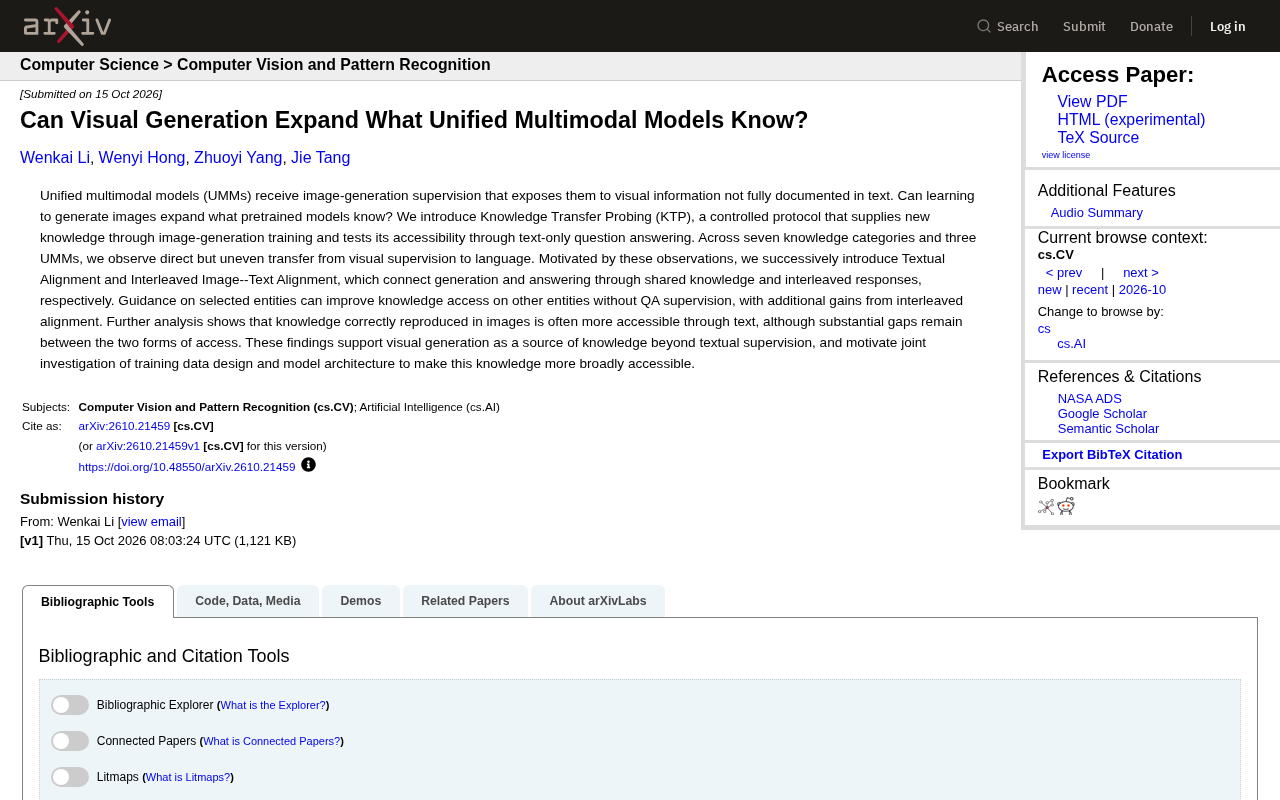
A recent research paper conducts a systematic exploration of this question. The research team proposes the Knowledge Transfer Probing (KTP) protocol, injecting new knowledge into the model through image generation training, then using pure-text question answering to test whether this knowledge has truly been "learned" by the model. This study covers seven knowledge categories and three unified multimodal models, revealing a direct but uneven path of transfer from visual supervision to language capabilities.
Unified Multimodal Models (UMMs) are an important architectural direction in recent multimodal research. Their core characteristic is that a single model simultaneously possesses visual understanding, text understanding, and image generation capabilities, with representative works including Chameleon, Transfusion, and Janus.
Unlike traditional "stitched-together" multimodal systems (such as a CLIP encoder + frozen LLM + independent diffusion model), UMMs allow tasks across different modalities to influence each other through shared parameters or a shared latent space. This gives rise to a key question: does information encountered during image generation tasks "spill over" into language understanding capabilities? Theoretically, this question relates to the knowledge unification of multimodal models—that is, whether the model constructs a cross-modally shared knowledge space, or merely a loose mapping between multiple subspaces. The KTP protocol is designed precisely to answer this question, and its conclusions have direct guiding significance for UMM architecture design.
The KTP Protocol: How to Detect Knowledge Transfer in Visual Generation?
The design of the KTP protocol is quite clever. The researchers' core logic is: if the model is exposed during image generation training to certain factual knowledge (such as the appearance features of an object, or details of a scene), then when asked related text questions, can the model answer correctly?
The key to this experimental design lies in controlling variables—ensuring that the knowledge being tested is indeed introduced through image generation training, rather than already mastered during the model's pretraining phase. In this way, researchers can clearly trace the transfer path of knowledge from visual supervision to linguistic expression.
Experimental results show that visual supervision can indeed transfer to language capabilities, but this transfer is not uniform. Across different knowledge categories, transfer effectiveness varies significantly, suggesting that the model's ability to absorb and transform visual information is influenced by multiple factors.
Knowledge Transfer Probing (KTP) methodologically falls within the category of "causal probing." The key is to construct a controlled experiment: researchers first screen for long-tail knowledge that is highly unlikely to appear in the model's pretraining corpus (for example, appearance descriptions of specific fictional entities), then provide information about that entity to the model solely in the form of an image generation task, and finally use pure-text question answering to test whether the model can recall the entity's factual attributes.
Unlike traditional "probing classifiers," KTP does not rely on linear classifiers over intermediate hidden layers, but instead directly uses generation/question-answering behavior as the criterion for whether knowledge exists. Therefore, its conclusions reflect accessibility rather than mere decodability. This distinction is important: knowledge may already be encoded in the parameters, but the model may lack an available retrieval path to bring it forth. KTP separates "how much is stored" from "whether it can be retrieved" through cross-modal task design, which is the core reason it is regarded as a benchmark protocol in this field.
Two Alignment Strategies: From Textual Alignment to Interleaved Image-Text Alignment
Faced with the problem of uneven knowledge transfer, the research team introduced two improvement strategies in sequence.
Textual Alignment was the first attempt. It seeks to connect generation tasks and question-answering tasks through a shared knowledge space, allowing knowledge learned during image generation to more smoothly serve text question answering.
Interleaved Image-Text Alignment goes further. It uses interleaved image-text responses to establish tighter cross-modal connections. Experiments show that providing guidance on selected entities can improve the model's knowledge acquisition for other entities—and this improvement does not require the direct involvement of question-answering supervision signals. The interleaved alignment strategy brings additional performance gains on top of this.
This finding is quite illuminating: it means that knowledge from visual generation training can propagate and be reused more broadly within the model through carefully designed alignment mechanisms.
Interleaved image-text alignment draws on the idea of interleaved image-text pretraining, such as the cross-modal attention structures adopted in works like Flamingo and OpenFlamingo. Its core mechanism is to let images and text alternate at the sequence level, enabling the model to simultaneously model dependencies between visual tokens and language tokens within the same context, thereby bringing the semantic distance between the two modalities closer in latent space.
In the KTP setting, the significance of interleaved alignment is: when the model "sees" the visual form of an entity during an image generation task, if the same sequence also contains textual descriptions or question-answering correspondences for that entity, then the visual signal and the language signal will be bound to nearby representation regions, making it easier to "retrieve" that knowledge during subsequent pure-text question answering. The observed phenomenon in the study—that "guidance on selected entities can generalize to other entities"—indicates that interleaved alignment is not simply a memorized mapping, but rather improves the overall organization of entity-attribute relationships in latent space. This is precisely the key to its superiority over pure textual alignment.
The Gap Between "Correct" in Images and "Accessible" in Text
A core finding of the study deserves deeper reflection: knowledge that is correctly reproduced in images is often also more easily accessible in text question answering. This sounds self-evident—if the model can draw it correctly, surely it should be able to answer correctly.
But the actual situation is far more complex. Analysis shows that although there is a positive correlation between correct image reproduction and text accessibility, a substantial gap still exists between the two. In other words, the fact that a model can correctly represent certain knowledge in image generation does not mean it can stably extract and express that knowledge in text question answering.
This gap reveals a deep-seated problem in current unified multimodal models: the knowledge-sharing mechanism between visual generation and language understanding remains inadequate. Knowledge may be "stored" in certain parameters of the model, but the model lacks an effective "retrieval channel" to flexibly invoke it across different modalities.
The modality accessibility gap is a repeatedly observed phenomenon in multimodal research, and its root cause can be traced to the quality of representation alignment. In UMMs, image generation typically relies on diffusion or autoregressive visual decoding paths, while text question answering relies on language decoding paths. Even if the two share backbone parameters, their downstream computation paths may still project knowledge into different subspaces.
Therefore, when knowledge is activated only along the visual path, the language path may not "hit" the same set of parameters. This has some analogy to the "tip-of-the-tongue phenomenon" in human cognition: the knowledge does exist in memory, but the retrieval cues are insufficient to bring it forth. The research results suggest that to narrow this gap, stronger cross-modal bridging modules (such as shared key-value memory or cross-modal routers) need to be introduced at the architectural level, rather than simply scaling up image data. This perspective has important methodological significance for evaluating the "true knowledge content" of UMMs, and also shows that measuring multimodal model capability solely by generation quality is insufficient.
Implications for the Development of Multimodal AI
This study provides strong evidence for the value of visual generation as a source of knowledge. It shows that image generation training is not just about teaching a model to "draw," but may also become a new path for expanding a model's knowledge boundaries—especially for information that is difficult to describe fully in text.
Researchers point out that to make this knowledge more broadly accessible, progress must be made simultaneously in two directions: the joint optimization of training data design and model architecture. Simply increasing image generation training data may not be enough; better alignment mechanisms and knowledge-sharing structures also need to be designed.
From a broader perspective, this work touches on the core proposition of multimodal learning: how is knowledge represented, stored, and transferred across different modalities? When we have a model process both images and text, is it truly constructing a unified knowledge space, or merely establishing fragile mappings between multiple independent spaces? The answers to these questions will determine the capability ceiling of the next generation of multimodal models.
One-line Summary
The paper proposes the KTP protocol, revealing that image generation training can transfer knowledge to text question answering, but an accessibility gap still exists between the two modalities.
Paragraph Summary
This study proposes the Knowledge Transfer Probing (KTP) protocol to systematically examine whether new knowledge acquired by Unified Multimodal Models (UMMs) through image generation training can transfer to pure-text question answering. Experiments cover seven knowledge categories and three UMMs. Results show that visual supervision does transfer to language capabilities, but transfer effectiveness is highly uneven across different knowledge types. The study further introduces two strategies: textual alignment and interleaved image-text alignment. The latter establishes tighter cross-modal connections through interleaved image-text sequences, allowing guidance effects to generalize across entities even without question-answering supervision. The core finding is that knowledge correctly reproduced in images is more easily accessible in text, yet a substantial gap remains between the two, indicating that the model lacks an effective cross-modal retrieval channel. The study concludes that visual generation can serve as a source of knowledge beyond text, but requires joint optimization of training data design and model architecture.
Related articles

Chain of Thought Isn't Just for AI: How Humans Can Use CoT to Improve Thinking Quality
Chain of Thought isn't just a prompt trick for large models. Starting from a Hacker News discussion, this article analyzes why CoT works for human thinking too, breaks down actionable ways to transfer it, and highlights the key differences between human CoT and machine CoT.
Cloudflare Teams Up with OpenAI: Closi…
Cloudflare Teams Up with OpenAI: Closing the Loop from Vulnerability Discovery to Defense with AI
Cloudflare uses OpenAI Daybreak to investigate security vulnerabilities and generate reviewable remediation plans, while developers use Codex to boost coding efficiency and quality.

Orca Multi-Agent Orchestration in Practice: A Guide to Parallel Collaboration with Claude and Codex
Orca is Stable AI's free open-source agent workbench supporting 34 agents like Claude Code and Codex in parallel. Learn its Git worktree isolation, multi-model orchestration, and mobile management.