Can You Add Co-authors After Submission but Before the Deadline in ACL ARR? A Policy Conflict Explained

ACL ARR has conflicting policies on post-submission author changes — always get official written confirmation before acting.
This article analyzes a real policy ambiguity in the ACL Rolling Review (ARR) submission process: the ARR Call for Papers states the author list is locked upon submission, while ACL's dedicated Authorship Changes Policy explicitly permits all changes — including adding new authors — before the submission deadline. The conflict stems from ARR's rolling review mechanism, where submission and review start are separate events. The article recommends emailing ARR Support for timestamped written confirmation, retaining contribution and communication records, and — most importantly — finalizing the author list before submitting to avoid policy uncertainty.
A Policy Contradiction That Confuses Submitters
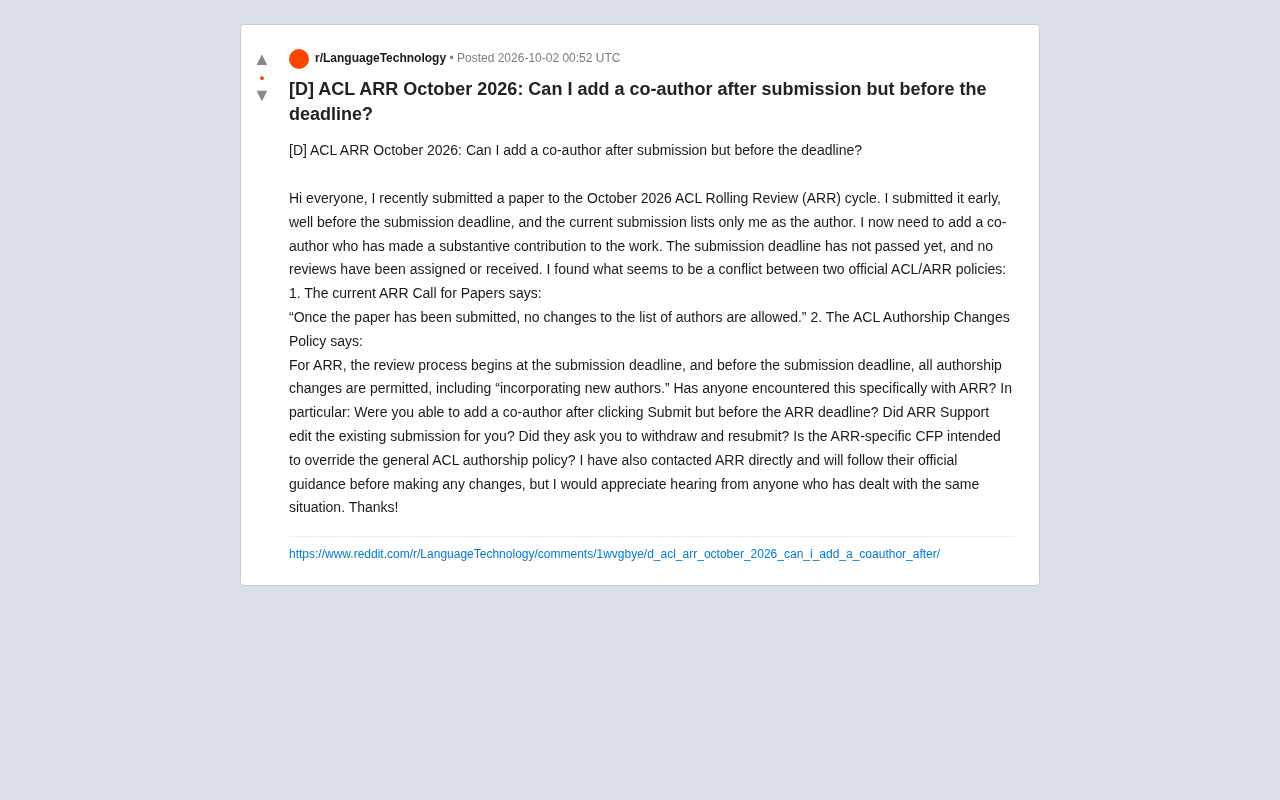
Within the ACL Rolling Review (ARR) submission process, a researcher posted a highly representative question on Reddit: they had submitted a paper early in the October cycle with only themselves listed as an author, and now needed to add a co-author who had made substantial contributions. The submission deadline had not yet passed, and no reviewers had been assigned to the paper.
The crux of the issue lies in an apparent conflict between two official policies. For any researcher preparing to submit to a top NLP venue, this is a practical detail worth clarifying — because authorship concerns not only academic ethics, but also attribution once a paper is accepted.
What the Two Policies Actually Say
The first policy cited by the poster comes from the current ARR Call for Papers:
"Once the paper has been submitted, no changes to the list of authors are allowed."
This statement is quite absolute — taken literally, the author list is locked the moment you click "Submit."
The second comes from ACL's Authorship Changes Policy. Addressing ARR's unique mechanism specifically, it states that the ARR review process begins at the submission deadline, and that all author changes — including incorporating new authors — are permitted before that deadline.
The point of divergence is clear: the ARR Call for Papers uses the act of submission as the cutoff, while the ACL general policy uses the deadline. For researchers who submit early, these two points in time can be separated by days or even weeks.
ACL conferences follow widely accepted academic standards for authorship eligibility, typically referencing ICMJE guidelines or society-specific criteria: co-authors must have made substantive contributions (e.g., conceptual design, experiment execution, results analysis, or manuscript writing), while those who only provided funding or equipment should not be listed. ACL maintains a dedicated Authorship Changes Policy that classifies changes at different stages as "permitted," "requires approval," or "prohibited," in order to prevent honorary authorship or ghost authorship from being concealed through post-submission edits. The policy uses the start of the review process (i.e., the ARR cycle deadline) as the key dividing line, reflecting a legislative intent to protect the integrity of the review process rather than to restrict the act of submission itself.
Why This Conflict Exists
Understanding this contradiction requires first understanding ARR's unique rolling review mechanism.
Traditional conferences use hard deadlines — once the clock runs out, all papers enter review simultaneously. ARR, by contrast, is a continuously operating review pool where papers can be submitted at any time and are organized into monthly cycles. As a result, "submission" and "entering review" are two separate events in ARR — you can submit very early, but the system doesn't formally begin assigning that batch of papers until the cycle deadline arrives.
This explains why the ACL general policy uses the deadline as its cutoff: before review has started, modifying the author list does not affect any reviewer's prior judgment, and should therefore theoretically be allowed. The Call for Papers' "locked upon submission" language is more likely a conservative formulation to simplify rules and prevent abuse, or a case of borrowing traditional conference wording without fully accounting for ARR's distinct structure.
In other words, this is most likely a surface-level conflict caused by differing levels of specificity, not two genuinely opposing rules. A more granular, more recently updated specific policy (the Authorship Changes Policy) should generally take precedence over a broad call for papers.
ARR (ACL Rolling Review) was launched in 2021 jointly by ACL, EMNLP, NAACL, EACL, and other major NLP venues to address the problem of fragmented reviewing resources and duplicated reviewer effort in the traditional conference model. Under the traditional model, if a paper was rejected and resubmitted to another venue, reviewers would need to start from scratch. ARR decouples reviewing from acceptance decisions — once a paper completes review in ARR and receives scores, authors can "commit" those review results to any participating venue, where the program committee makes acceptance decisions based on the existing reviews, with no need to repeat the review process. The key advantage of this mechanism is that review results are reusable. However, it also introduces multiple distinct time points — submission time, deadline, review start time, commitment time — splitting what was once a unified process in traditional conferences into several stages. This makes policy boundaries considerably more complex and prone to ambiguity at the wording level.
What to Do in Practice
The poster raised several key questions: can you add a co-author after clicking submit but before the deadline? Will ARR technical support directly edit the existing submission, or require a withdrawal and resubmission? Does the ARR-specific Call for Papers intend to override the general policy?
Based on policy logic and common practice, here are a few practical recommendations:
Prioritize the Official Email Response
The poster had already contacted ARR Support directly and indicated they would follow official guidance — this is the safest approach. When two written policies conflict, obtaining a timestamped official email confirmation both resolves the immediate issue and serves as evidence if disputes arise later. Do not act based solely on others' experiences shared on forums.
Two Possible Handling Paths
Based on similar past cases, ARR typically handles such requests in one of two ways: either support staff directly modify the author list on the backend, or submitters are advised to withdraw the current version and resubmit with the updated author information. As long as the action occurs before the deadline and before review has begun, neither approach generally affects submission eligibility.
Keep Complete Records of Communications and Contributions
Since this involves adding an author based on "substantial contribution," it's advisable to retain materials demonstrating the new co-author's involvement, as well as all correspondence with ARR. Authorship disputes are rare, but when they do occur, these records become critical evidence.
A Broader Lesson for Submitters
This case has value beyond the specific question asked. It reminds all NLP researchers: don't submit a paper before the author list is finalized. While the rules generally permit changes before the deadline, every change carries operational risk and uncertainty in policy interpretation.
The safer approach is to click submit only after confirming all co-authors, their contributions, and author order have been settled. If there's a genuine need to submit early to hold a spot, be sure to review the latest Authorship Changes Policy first, and obtain written official permission before making any changes.
The terms of academic submission platforms often contain minor inconsistencies across versions. When faced with similar conflicts, the process of "ask first, act second, document everything" applies to nearly every scenario.
Related articles

@ai-sdk/vue 3.0.306 Patch Release Syncs with [email protected] Update
@ai-sdk/vue 3.0.306 released, synced with [email protected]. A routine patch release for the Vercel AI SDK ecosystem with no public API changes; the Vue adapter layer stays version-aligned with the core package.

Gemini 4 Argon API Launches: The Era of Million-Token Output Begins
Google launches Gemini 4 Argon with sparse MoE architecture, up to 1M output tokens, and a 68.90% Vals Index score, available across API, AI Studio, and the Gemini app.

DukaanAI: Turning Product Photos into Inventory Lists with Open-Source AI
DukaanAI is an AI inventory tool for small retailers that turns product photos into inventory entries using the open-source Gemma 3 model, with local inference, editable fields, and CSV export.