Can You Claim the Gemini Student Free Plan on Multiple Accounts? Rules and Risks Explained
Multi-account Gemini student plan claims are technically tempting but practically risky and likely to fail.
This article examines whether students can claim Google's Gemini free plan on multiple accounts using different .edu emails. It explains how SheerID's identity-level verification and Google's sophisticated risk control systems make duplicate claims difficult, and outlines the serious risks including offer revocation and account bans. The practical advice: use one account and explore other legitimate student programs instead.
The Multi-Account Frenzy Sparked by Gemini's Student Offer
Google's Gemini free plan for students provides eligible students with access to premium AI services for up to a year or longer, covering Gemini Advanced, generous cloud storage, and access to advanced models. Specifically, this plan is essentially the education version of the Google One AI Premium plan, which normally costs $19.99 per month. It includes access to Gemini Advanced powered by the Gemini Ultra series of models, 2TB of Google One cloud storage, and AI-assisted features integrated into Workspace apps like Gmail, Google Docs, and Google Sheets. The key differences between Gemini Advanced and the free version of Gemini include: support for longer context windows (handling longer documents and conversations), stronger reasoning and coding capabilities, file upload and analysis, and more complex multi-turn conversations. For students who need to process large volumes of academic papers, write code, or perform data analysis, these premium features offer genuine academic value.
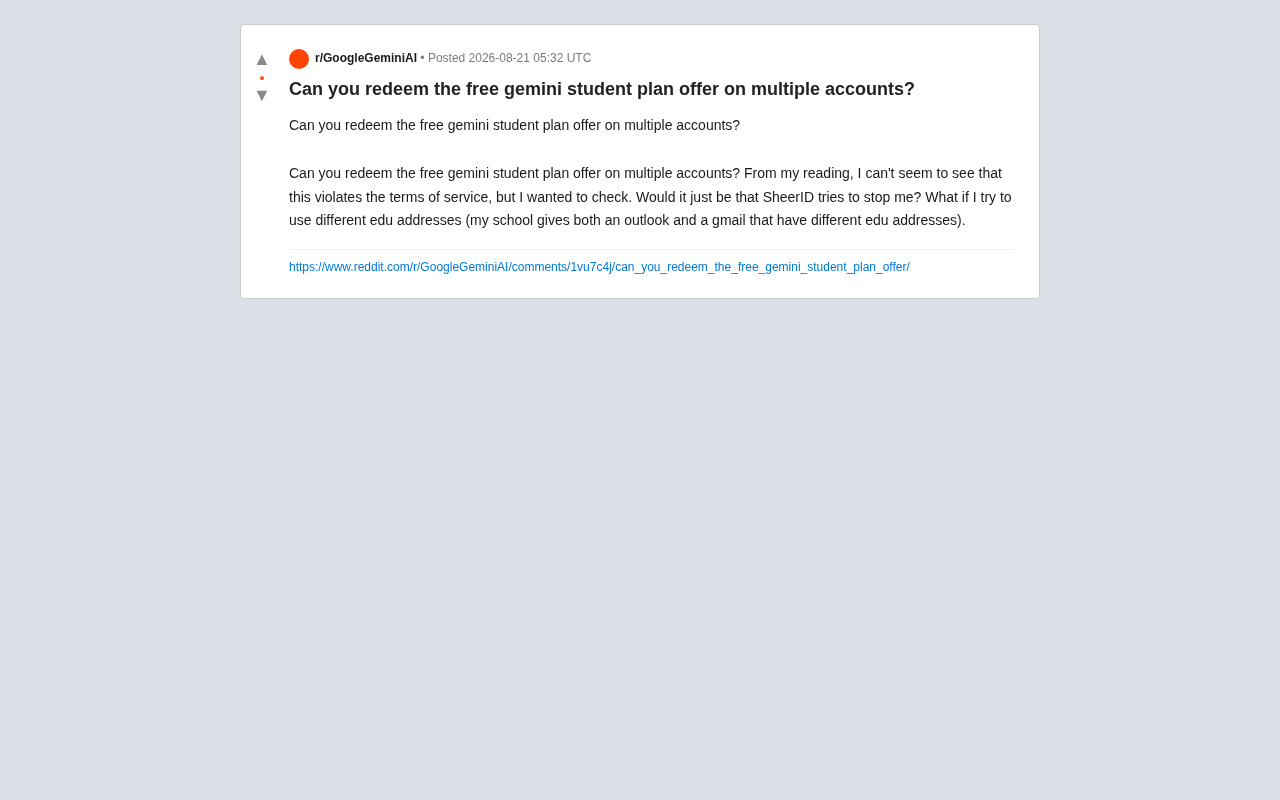
This generous offer naturally attracted a lot of attention, and it also sparked a controversial question on communities like Reddit: Can you use multiple accounts to claim this free benefit more than once?
One Reddit user raised a typical scenario: their school provides both Outlook and Gmail systems, each corresponding to different educational email addresses (.edu). This dual-system setup is not uncommon in higher education — many universities have signed educational licensing agreements with both Microsoft and Google at different times, or maintain both systems simultaneously during a platform migration transition. For example, a school's administrative system might use Outlook for official communications, while the teaching system uses Google Workspace for course collaboration. These two systems typically assign different email address formats to the same student (e.g., firstname.lastname@university.edu and flastname@mail.university.edu), but they point to the same enrollment record in the school's unified identity authentication platform (usually based on LDAP or Active Directory).
Since the user has multiple legitimate educational emails, can they activate the student offer on multiple Google accounts? The user noted that from their reading of the terms of service, there didn't seem to be any explicit clause prohibiting this, but they still wanted to verify with the community.
The SheerID Verification Mechanism: The Core Barrier to Multi-Account Claims
To understand this issue, you first need to understand the verification mechanism behind Google's student offer. Google doesn't verify student identity on its own — instead, it delegates the eligibility review to a third-party identity verification provider called SheerID. Founded in 2011 and headquartered in Portland, Oregon, SheerID is a leading global digital identity verification platform and one of the most widely used verification platforms for education, military, healthcare, and other identity-based discounts. Hundreds of well-known brands including Spotify, Adobe, YouTube Premium, Amazon Prime, and Apple Music rely on it for student identity verification, and the platform processes over 200 million verification requests per year.
SheerID's core technology relies on direct database connections with over 9,000 educational institutions worldwide, using APIs to compare student-submitted information against school enrollment records in real time. Unlike simple email suffix verification, SheerID employs an "authoritative data source verification" model — it directly accesses data from authoritative institutions such as the National Student Clearinghouse to confirm whether someone is a currently enrolled student. This means that even if you have a valid .edu email, SheerID may still reject your verification request if you've already graduated or taken a leave of absence.
SheerID's verification logic goes well beyond simply checking "whether the email suffix is .edu." It typically cross-verifies the following information:
- The student's real name
- The name of the school they attend
- Date of birth or year of enrollment
- Validity of the educational email
This means that even if you have two different .edu email addresses, as long as they point to the same real identity (same name, same school), SheerID will very likely identify them as the same person at the database level, thereby blocking duplicate claims. In other words, the Outlook and Gmail emails issued by the school may have different addresses, but they share the same enrollment record — the chances of bypassing verification are not high.
The "Gray Area" in Terms of Service and Hidden Risks
The original poster's observation has some merit — Google's terms of service may not explicitly state "one claim per person" in extremely precise language. But that doesn't mean the practice is risk-free.
Most subscription services include broad clauses in their general terms covering account abuse, fraudulent use, and one-per-person offer limits. Google can easily invoke such clauses to take action against duplicate claims under the same identity. Common consequences include:
Potential Risks of Multi-Account Claims
- Offer revocation: The student benefit on the duplicate account gets canceled, reverting to standard paid or free tier.
- Account association and bans: Google's risk control system can associate multiple accounts through device fingerprints, IP addresses, payment information, recovery emails, and other dimensions. Google's account security and anti-fraud system is one of the most sophisticated risk control systems in the industry. Its core technologies include Device Fingerprinting, browser characteristic analysis, IP address and geolocation tracking, and login behavior pattern analysis. Device fingerprinting technology collects dozens of parameters including the device's operating system version, screen resolution, installed fonts, browser plugin list, and hardware identifiers to generate a nearly unique device identifier. Even if users log in with different Google accounts, these accounts can be linked together as long as they're operated on the same device. Additionally, Google uses machine learning models to analyze user behavior patterns, including typing rhythm, mouse movement trajectories, and app usage habits, further improving the accuracy of multi-account detection. Once flagged as abuse, it could implicate your primary account and even affect core services like Gmail and cloud storage.
- Verification failure records: Multiple verification attempts through SheerID may themselves trigger risk control flags.
For users who rely on their Google account for academics, work, and daily tasks, risking a primary account ban for an extra AI subscription is clearly not worth it.
Technically Possible Doesn't Mean Practically Feasible
From a technical standpoint, the user's envisioned path of "different emails + different accounts" does have some room for experimentation at the operational level. But in reality, the success rate is constrained by multiple factors:
- Same-name verification conflicts: As mentioned above, SheerID will most likely intercept duplicate applications from the same identity. Since SheerID directly accesses authoritative educational data sources for identity-level (not email-level) verification, two different email addresses will be resolved to the same enrollment record in its system, triggering the duplicate application interception mechanism.
- Device and network association: Even if you switch emails, multiple applications from the same device and network environment are easily flagged by risk control systems. Google's device fingerprinting technology can collect dozens of hardware and software parameters to uniquely identify a device — simply switching browsers or using incognito mode is not enough to evade this detection.
- Offer binding mechanism: Google typically binds student offers deeply to accounts and identities, not just to email addresses. This binding relationship is persistently stored in Google's backend systems and may retain relevant records even after the offer expires.
Therefore, even if someone manages to succeed under specific conditions (for example, if the school's two email systems are treated as independent records in SheerID's database), such success is often unstable and subject to retroactive revocation.
Practical Advice for Student Users
For genuine enrolled students, activating the student offer once on your primary, most frequently used Google account is the safest choice. This way, you can fully enjoy the complete one-year benefit, avoid risk control issues, and seamlessly integrate the AI service with your everyday email, documents, and cloud storage.
If your needs genuinely exceed the single-account free quota, a more reasonable approach is to evaluate a paid upgrade rather than circumventing limits through multiple accounts. After all, the student offer is designed to lower the barrier to learning, not to provide unlimited free resources. Google and SheerID continuously invest technical resources into anti-abuse measures, and the marginal returns of trying to exploit loopholes are steadily declining.
It's also worth noting that beyond the Gemini student offer, students can look into other legitimate educational discount programs such as GitHub Student Developer Pack (which includes free access to AI development tools like GitHub Copilot), JetBrains educational licenses, and Microsoft Azure student subscriptions. These programs can complement Gemini and together build a powerful learning toolkit — without needing to use multiple accounts to extend a single service's quota.
Conclusion
Returning to the original question: Can the Gemini student free plan be claimed on multiple accounts? The answer is: technically there might be cracks, but in practice it's extremely difficult, and the risks significantly outweigh the benefits. SheerID's identity-level verification and Google's multi-dimensional account association risk controls together form a barrier that's nearly impossible to overcome. Rather than spending energy figuring out how to bypass verification, it's better to make the most of one legitimate entitlement — that's the right way for students to enjoy the benefits of AI.
Related articles

Chain of Thought Isn't Just for AI: How Humans Can Use CoT to Improve Thinking Quality
Chain of Thought isn't just a prompt trick for large models. Starting from a Hacker News discussion, this article analyzes why CoT works for human thinking too, breaks down actionable ways to transfer it, and highlights the key differences between human CoT and machine CoT.
Cloudflare Teams Up with OpenAI: Closi…
Cloudflare Teams Up with OpenAI: Closing the Loop from Vulnerability Discovery to Defense with AI
Cloudflare uses OpenAI Daybreak to investigate security vulnerabilities and generate reviewable remediation plans, while developers use Codex to boost coding efficiency and quality.

Orca Multi-Agent Orchestration in Practice: A Guide to Parallel Collaboration with Claude and Codex
Orca is Stable AI's free open-source agent workbench supporting 34 agents like Claude Code and Codex in parallel. Learn its Git worktree isolation, multi-model orchestration, and mobile management.