Can You Really Build an AI Twin from LinkedIn Posts?

Building a knowledge-base AI twin from LinkedIn posts is feasible, but outdated content and trust issues must be addressed.
Starting from a Reddit discussion, the article explores whether years of LinkedIn posts can become a genuinely useful AI twin. It focuses on a "knowledge-base" assistant that cites original posts, valuable for consultants and coaches. Two core challenges emerge: posts are time slices and opinions go stale, requiring manual review or time-stamped citations; and trust — whether AI should fully answer on your behalf depends on risk, with tiered authorization as a compromise. Data quality, citation mechanisms, update planning, and boundary setting all matter.
From "Imitating Writing Style" to "Citing Original Content"
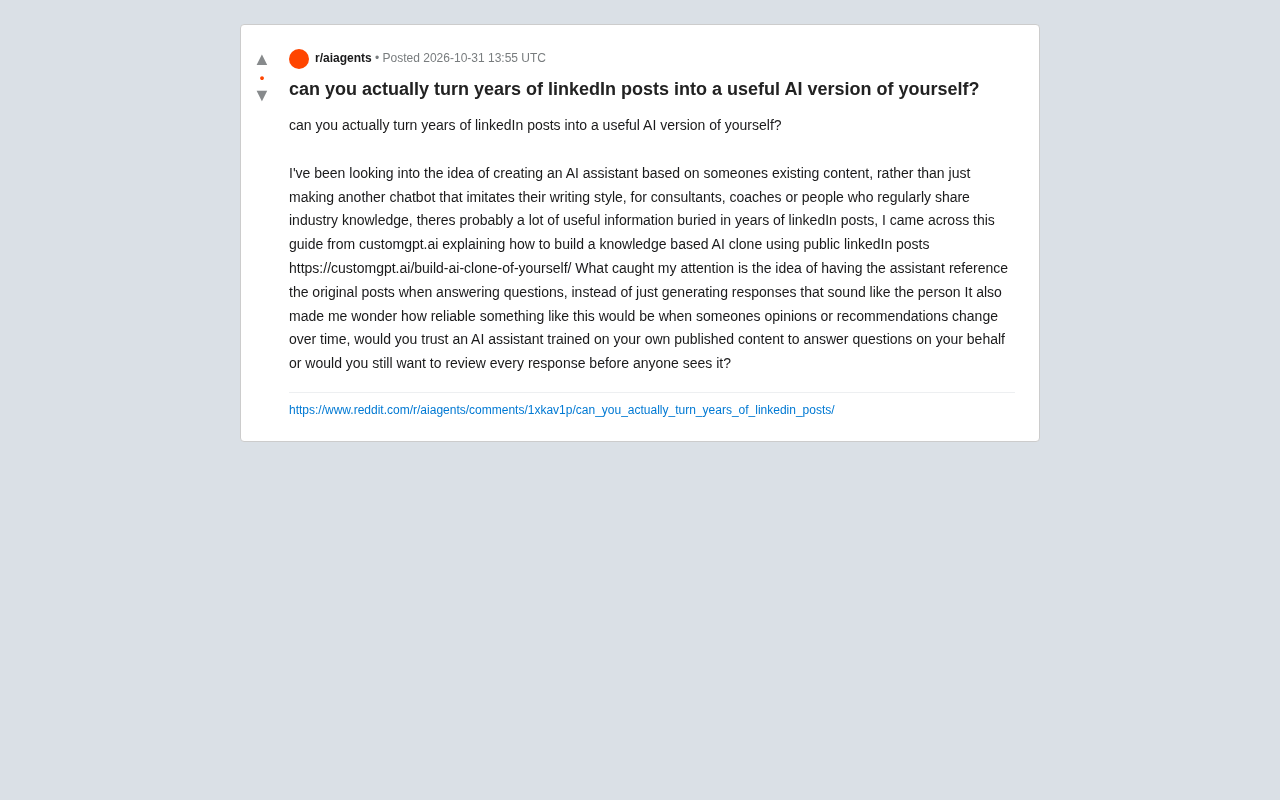
I recently came across an interesting discussion on Reddit: can you turn years of accumulated LinkedIn posts into a genuinely useful AI version of yourself? The poster wasn't looking to build a chatbot that merely imitates their writing style — they wanted an AI that, based on their publicly published content, could serve as a "knowledge base" assistant for consultants, coaches, or industry knowledge sharers.
They referenced a guide from customgpt.ai that teaches people how to build an AI clone from public LinkedIn posts. What really caught their attention was this: the assistant cites the original posts as evidence when answering questions, rather than generating responses that merely sound like the person.
This shift in thinking is crucial. Most "AI twins" stay at the level of style imitation — the generated content looks the part but lacks the substance, and it isn't credible. A knowledge-base-driven clone, by contrast, tries to treat each post as a traceable information source, pointing to specific origins when answering. That's far more valuable in scenarios that require professional credibility.
CustomGPT.ai is a no-code RAG (Retrieval-Augmented Generation) platform for enterprises. After users upload documents, web pages, or posts, the platform automatically chunks the content, generates vector indexes, and retrieves relevant snippets during Q&A to have the LLM organize an answer. Its key design is "retrieval-based answering" — the model is constrained to prioritize answering based on the original text in the index and returns source links. This differs from pure fine-tuning-style cloning: fine-tuning "compresses" content into model weights, making sources hard to trace, whereas RAG keeps knowledge in an external library that can be added to, deleted, or modified at any time, naturally supporting citation of original content. The guide the poster referenced uses exactly this mechanism to turn LinkedIn posts into a searchable knowledge source, so answers can point to specific posts.
Where the Value of a Knowledge-Base AI Twin Lies
For people like consultants and coaches who make a living on professional judgment, years of LinkedIn posts are effectively an unorganized personal knowledge asset. They contain industry observations, methodologies, case commentary, and even early judgments about certain trends. Structuring this content and handing it to an AI could, in theory, enable quick responses to common questions and free up time from repetitive consulting work.
More practically, the value lies in consistency. Human replies inevitably fluctuate with mood and state, while an AI can consistently output based on an established knowledge base. For a personal brand, this means a guaranteed baseline quality for external communication.
But there's a precondition: the posts themselves need to be solid and systematic. If years of posting are just fragmented musings, the value an AI can extract will be limited.
Opinions Go Out of Date — How Does an AI Twin Keep Up?
The poster raised a sharp question: when a person's views or advice change over time, is such an AI assistant still reliable?
This is indeed the Achilles' heel of knowledge-base cloning. LinkedIn posts are time slices — advice from five years ago may no longer apply today, but the AI won't automatically know which ones should be deprecated. If a user's question happens to touch on this outdated content, the AI may confidently give an old answer.
There are roughly two approaches to solving this: one is regular manual review and updating of the knowledge base, marking or removing outdated content; the other is having the AI attach time information when citing, so questioners can judge timeliness for themselves. Either way, it means "build it and forget it" is unrealistic.
RAG systems have no built-in judgment about "knowledge timeliness". The retrieval step typically recalls snippets by semantic similarity and doesn't automatically downweight a post just because it was published long ago; the generation step also tends to treat retrieved content as factual statements. Therefore, time awareness needs to be injected at the engineering level. Common practices include: attaching metadata such as publication time and source to each knowledge snippet, requiring the model in the prompt to annotate dates when citing, and filtering or weighting by time during retrieval. Some systems also introduce an "expiry flag" field, downgrading or isolating old content after manual review. Understanding this makes clear why the original article emphasizes that "update mechanisms must be planned in advance" — it's not an operational nicety but a necessary design to compensate for RAG's technical shortcomings.
The Trust Problem: Can It Work Without Anyone Watching?
At the end of the discussion, the poster asked: would you trust an AI assistant trained on your public content to answer questions on your behalf? Or would you still want every reply to go through human review?
There's no standard answer to this — it depends on the risk of the scenario. For low-risk common Q&A, such as "What's your consulting process like?", AI auto-replies are fine. But when it comes to specific advice, quotes, or sensitive judgments, human review is almost mandatory.
A compromise is tiered authorization: AI handles factual and procedural questions, while complex or high-value questions are escalated to the person. This leverages AI's efficiency while retaining control over critical steps.
From the tone of the community discussion, most people are cautious about "fully letting go." After all, the core of a personal brand is trust — one inaccurate auto-reply could erase years of accumulated credibility.
"Tiered authorization" corresponds in engineering terms to confidence thresholds and human-handoff workflows. The system can compute a confidence score for each answer (e.g., the relevance of retrieved snippets to the question, the model's self-assessed certainty). Above the threshold, it replies automatically; below the threshold or when sensitive intents are hit (quotes, contracts, specific advice), it hands off to the person. Another approach is intent classification: pre-categorizing questions into factual, procedural, and judgmental types, with only the first two going through the automated channel. Either way, the trigger conditions and messaging for "handoff to human" need to be clearly defined before deployment, to avoid users mistakenly thinking they're talking to the person themselves. This is the technical meaning of the original article's statement that "rules should be defined clearly before deployment" — it's not a management slogan but a concrete configuration that needs to be written into the system logic.
Things to Think Through Before Going Live
If you're seriously considering building an AI twin from LinkedIn posts, there are several practical issues worth thinking through first.
Data quality matters more than quantity. A few hundred high-quality, systematic posts may be more useful than thousands of scattered musings. The workload of the curation phase is often underestimated.
The citation mechanism is the foundation of trust. Answers that can point to original sources are more credible than fluent but unsourced generated content. This is also the most noteworthy design in the customgpt.ai guide.
Update mechanisms need to be planned in advance. Opinions change, industries change, and the knowledge base needs a regular maintenance process — otherwise the AI twin will slowly become "the you of the past."
Finally, boundary setting. Which questions the AI can answer on your behalf and which must be handled by you personally — this rule is best defined clearly before deployment rather than patched up after problems arise.
Overall, building an AI twin from LinkedIn posts is technically feasible and backed by real demand, but it's more like a knowledge product requiring ongoing operations than a one-off tech toy. Whether it's worth doing depends on your trade-off between efficiency gains and brand risk.
One-line Summary
Building a knowledge-base AI twin from LinkedIn posts is feasible, but outdated content and trust issues must be addressed.
Paragraph Summary
Starting from a Reddit discussion, the article explores whether years of LinkedIn posts can be turned into a genuinely useful AI twin. The poster isn't after a style-imitating chatbot but a "knowledge-base" assistant that cites original posts as evidence — more valuable for consultants and coaches who rely on professional judgment, improving reply consistency and efficiency. But the article points out two core challenges: first, LinkedIn posts are time slices and opinions go out of date, and the AI won't automatically identify deprecated content, so regular manual review or time-stamped citations are needed; second, the trust problem — whether to let AI fully answer on your behalf depends on scenario risk, with tiered authorization as a compromise. Finally, it emphasizes that data quality matters more than quantity, the citation mechanism is the foundation of trust, update mechanisms need advance planning, and boundaries should be set beforehand.
Related articles
 Tech Frontiers
Sherlock: An Open-Source Tool for Tracking Usernames Across Social Networks
Sherlock is an open-source Python tool that tracks social accounts across networks by username. This article covers its core features, why developers love it, typical use cases, and privacy compliance considerations.
 Tech Frontiers
GitHub Daily·Nov 07: Agent-Ready and Context Compression
GitHub Trending Nov 07: meta's agent-ready design system astryx, billion-context's 5x context compression, sherlock nearing 100k stars, plus local-first localthings and bare-metal GPU orchestration nvke.
 Tech Frontiers
Buoyant Open-Sources Kinference: An Inference Control Plane for vLLM on K8s
Buoyant open-sources Kinference, an inference control plane for vLLM on Kubernetes, with declarative routing, KV-cache-aware load balancing, and per-tenant metrics—claiming 95% lower median TTFT in official benchmarks.