Can You Still Use Google AI Pro Student Discount After Graduation? Terms Breakdown & Strategies

Google AI Pro student discount likely ends after graduation due to annual identity verification requirements.
This article analyzes Google's AI Pro student discount offering 5TB storage and AI Pro at ₹489/month for "up to 4 years." It explains why "up to" is a ceiling not a guarantee, details how periodic identity verification works through SheerID and edu emails, outlines three post-graduation scenarios, and provides practical advice for students to plan ahead before losing eligibility.
Google AI Pro Student Discount Sparks Discussion
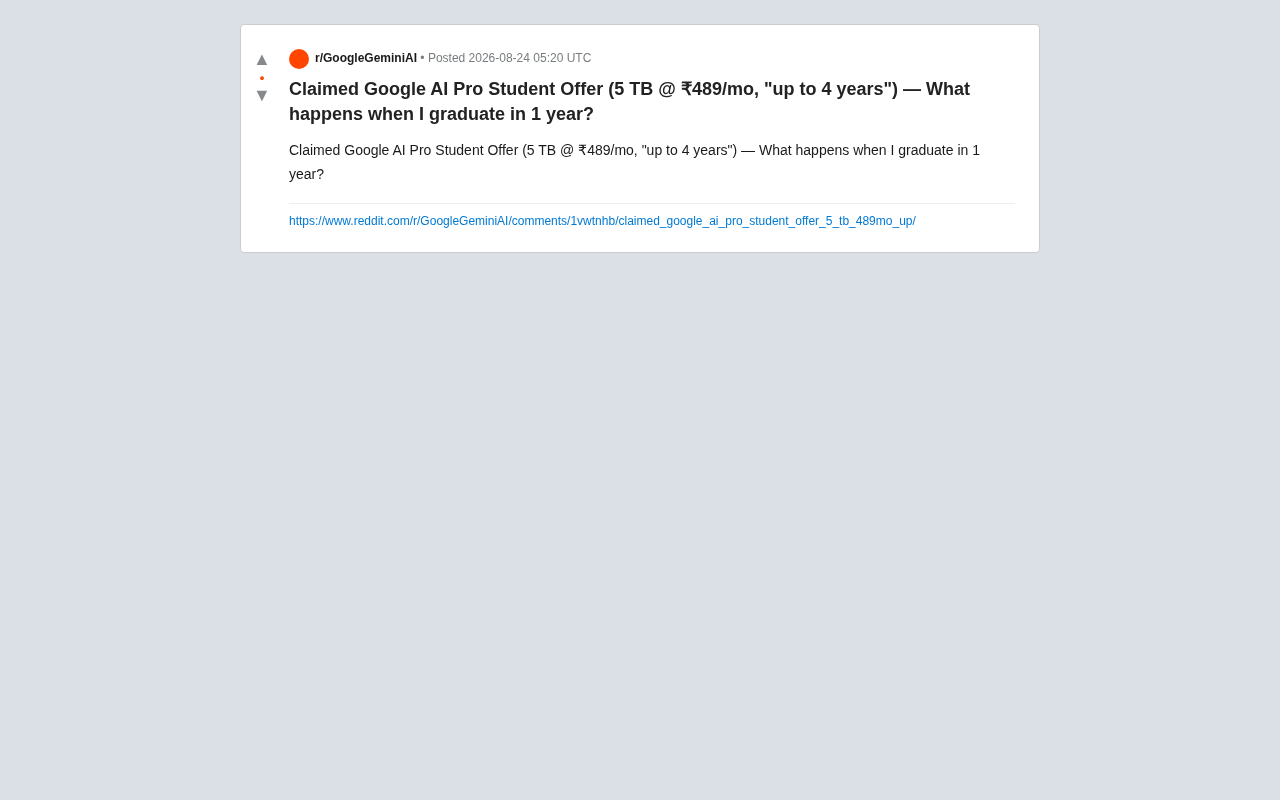
Recently, a discussion about Google's AI Pro student discount has drawn attention on the Reddit community. According to users, Google has launched an attractive subscription plan for students: 5TB of cloud storage and AI Pro services at ₹489/month (approximately $6 USD), with promotional materials stating the discount is valid for "up to 4 years."
However, a practical question has emerged: if a student graduates within a year, can they still enjoy this "up to 4 years" discount? This touches on a gray area that's common across all types of student subscription offers.
Core Details of the Offer
Based on publicly available information, the Google AI Pro student discount includes the following key elements:
- Price advantage: The ₹489/month pricing is far below the regular AI Pro subscription price (approximately ₹1,950/month in the Indian market), making it extremely attractive to students with a discount of roughly 75%
- Storage space: 5TB of cloud storage, sufficient for the vast majority of students' academic, research, and daily needs
- AI capabilities: Includes Google's AI Pro features, covering cutting-edge AI tools like advanced Gemini models
- Duration promise: The "up to 4 years" wording is the focal point of the controversy
Some background on the AI Pro service itself is warranted. Google AI Pro is a premium subscription service launched by Google in late 2023 alongside the Gemini model release. Gemini is a multimodal large language model developed by Google's DeepMind team, available in three versions—Ultra, Pro, and Nano—each targeting different use cases. AI Pro subscribers can access the most powerful Gemini Ultra model, enjoy longer context windows, priority access to new features, and AI-assisted capabilities across the full Google Workspace suite. Offering such powerful AI capabilities at a student discount price clearly demonstrates Google's commitment to the education market.
The Terms Trap Behind "Up to 4 Years"
"Up to" Is the Critical Qualifier
In English contracts and marketing copy, "up to 4 years" is fundamentally different from "for 4 years." "Up to" means this is a ceiling, not a guaranteed duration. In other words, 4 years is the maximum possible length of this offer, not a fixed period that users are unconditionally entitled to.
This type of wording is quite common in education-related offers. Companies typically set a theoretical maximum validity period (usually corresponding to a four-year undergraduate program), but whether users can actually enjoy the full duration often depends on whether they continuously meet the core requirement of "student status."
How Student Identity Verification Works
Almost all student discounts rely on periodic identity verification. In Google's case, student discounts typically require verification through third-party services like SheerID, or linking to an educational institution email (.edu or the corresponding educational domain for each country) to confirm user identity.
SheerID is a globally leading digital identity verification platform, widely adopted by tech companies including Apple, Amazon, Spotify, and YouTube. The verification process typically involves users submitting basic information such as their name, school name, and enrollment year, after which SheerID performs real-time cross-referencing against registration databases from thousands of educational institutions worldwide. If automatic verification fails, users may be asked to upload student IDs, admission letters, or enrollment certificates for manual review. The key aspect of this mechanism is that it's dynamic—even if initial verification succeeds, the system typically requires re-verification after 12 months to confirm that the user still holds student status.
Beyond SheerID verification, educational domain emails are another important authentication method. Educational institution emails (such as .edu domains in the US, .ac.in domains in India, and .edu.cn domains in China) are important identifiers in academic authentication. The allocation of these domains is strictly controlled—for example, .edu domains are managed by EDUCAUSE and restricted to accredited US higher education institutions. Notably, schools vary significantly in how they handle alumni email accounts: some schools immediately deactivate emails after graduation, some offer a 6-12 month transition period, and a few permanently retain email access for alumni. This inconsistency is one of the key reasons for uncertainty around student discount renewals.
This means that once users graduate, their student email may be reclaimed by the school, become inactive, or fail to pass the next verification cycle. Therefore, theoretically speaking, graduation typically means the end of student discount eligibility, even if the promotional materials state "up to 4 years."
Can Google AI Pro Student Discount Continue After Graduation?
Analysis of Three Possible Scenarios
For the specific situation in question—graduating in one year—combined with industry norms, several possibilities can be inferred:
Scenario 1: Discount terminates at the identity verification cycle
This is the most common outcome. When the annual verification cycle arrives (typically every 12 months), the system will require re-verification of student status. If the user has already graduated and cannot provide valid proof at that point, the discounted price will automatically expire, and the subscription may convert to the standard price or continue charging at full price until the user actively cancels.
Scenario 2: Lock-in period extends until the next verification
Some offers lock in for a set period (such as 12 months) after successful verification. This means that even if you graduate a few months later, the currently activated discount cycle will typically continue until it expires, after which re-verification is required. This gives users a "buffer period."
Scenario 3: Rare one-time lock-in
Although uncommon, some companies do "lock in" the entire discount period once a user initially qualifies. However, given the "up to" wording and standard annual verification mechanisms, this scenario is unlikely for Google's student discount.
Practical Advice for Student Users
When facing these ambiguous terms, consider the following strategies:
-
Read the fine print carefully: Focus on statements related to "eligibility" and "renewal," and clarify the verification cycle and identity requirements.
-
Keep verification records: Activate the discount as soon as you qualify, and note the activation date to estimate the next verification time point.
-
Plan for price transitions: Understand the standard price after the discount expires to avoid being automatically charged full price after graduation without realizing it.
-
Contact official support: For specific questions like "does the discount continue after graduation," reaching out to Google's official support for written confirmation is the most reliable approach.
-
Plan data migration in advance: If you cannot afford the standard price after graduation, back up or migrate important data to other platforms before the discount period ends to avoid passively losing files due to reduced storage space.
The Business Logic Behind Student Discounts
Why Tech Companies Offer Deep Discounts
Tech giants like Google offer deep student discounts with clear business reasoning. Students are high-value future users—developing habits around a particular platform or tool during their academic years often converts into long-term paying customers after graduation.
The combination of 5TB storage plus AI Pro capabilities is essentially designed to make students deeply dependent on the Google ecosystem during their studies and research. When the discount expires after graduation, users who have accumulated massive amounts of data and usage habits face extremely high switching costs to competitors, making them more willing to continue paying. This phenomenon is known in behavioral economics and business strategy as the "Lock-in Effect"—users become "locked in" to a platform or service because the cost of switching is too high. For cloud storage services, this effect is particularly pronounced: when users have stored several TB of files, photos, and documents in Google Drive, migrating to other platforms (such as OneDrive, iCloud, or Dropbox) requires not only lengthy download and upload times but also potentially faces hidden costs like file format compatibility issues, broken sharing links, and disrupted collaboration workflows.
Strategic Positioning in the Indian Market
It's worth noting that this student discount is priced in Indian Rupees, reflecting India's special position in global tech company strategies. India has the world's largest young population, with over 35 million students entering higher education annually, and smartphone and internet penetration rates continuing to grow rapidly. For Google, India is not only a core engine for user growth but also a key market for AI service promotion. By allowing students to access cutting-edge AI tools like Gemini at extremely low prices, Google gains an advantage over competitors like Microsoft Copilot and OpenAI ChatGPT Plus in the user acquisition battle, particularly in establishing a first-mover advantage in cultivating the next generation of developers and professional users.
Ambiguous Terms Are a Double-Edged Sword
Phrasing like "up to 4 years" serves as a flexible marketing tool for companies—it can attract users with a seemingly long time frame while controlling costs through verification mechanisms. But for users, this ambiguity easily creates an expectation gap.
This also reminds all users that when facing any "incredible deal," they should remain rational, see through the qualifying conditions behind the terms, and avoid unnecessary financial losses from misreading marketing language.
Conclusion: A Rational View of Google AI Pro Student Discount
Returning to the original question: if you graduate in one year, this "up to 4 years" Google AI Pro student discount most likely cannot continue at the discounted price, depending specifically on Google's annual identity verification mechanism. Users should understand "up to 4 years" as a theoretical maximum, not an unconditional guarantee.
For students approaching graduation, fully utilizing the discount window while still enrolled and planning post-graduation subscription options in advance is the wisest approach to handling these types of offers. Ultimately, reading the fine print and consuming rationally are essential skills in the digital age.
Related articles

Workbuddy for Absolute Beginners: How a Desktop AI Agent Fits Into Real Workflows
A beginner's guide to the Workbuddy desktop AI agent: installation, claiming credits, file management, and building automated workflows—compared with CodeX for fit and cost, helping professionals shift from AI question-askers to AI managers.

OpenAI's New Agent Stack: Computer Use, Decisions API, and Ultra-Fast Workflows
OpenAI Dev Day unveiled a new agent stack: Computer Use outperforms humans, Decisions API delivers ultra-low-latency classification via Luna, Agents API opens the same Computer Use capabilities, and GPT-6.1 Sol costs only one-seventh of Astra. Core updates, benchmark data, and developer insights.

Liang Wenfeng Open-Sources DeepInfo Inference Framework, Takes On U.S. Ban
DeepSeek open-sources its DeepInfo inference framework after its models, featuring GPU/CPU cross-pipelining, small-model prediction with large-model verification, and full Huawei Ascend and NVIDIA chip support—facing the U.S. federal ban head-on. This article analyzes its significance for AI deployment and open-source strategy.