Canon EOS R6 V Review: Is This 7K Full-Frame Video Mirrorless Camera Worth It?

Canon launches the EOS R6 V, its first full-frame V-series mirrorless camera built for video creators.
Canon has officially launched the EOS R6 V mirrorless camera, the first model in its EOS full-frame lineup to carry the "V" (Video) designation. Equipped with a 32.5-megapixel full-frame sensor and 7K video recording, it is a video-focused redesign based on the EOS R6 Mark III platform. Canon removed the electronic viewfinder and stripped certain still photography features to concentrate resources on video performance optimization.
Canon's First Full-Frame V-Series Camera Arrives
Canon has officially launched the all-new EOS R6 V mirrorless camera — the first model in the EOS full-frame lineup to carry the "V" designation. The "V" stands for Video, clearly signaling this camera's core purpose: built for video creators.
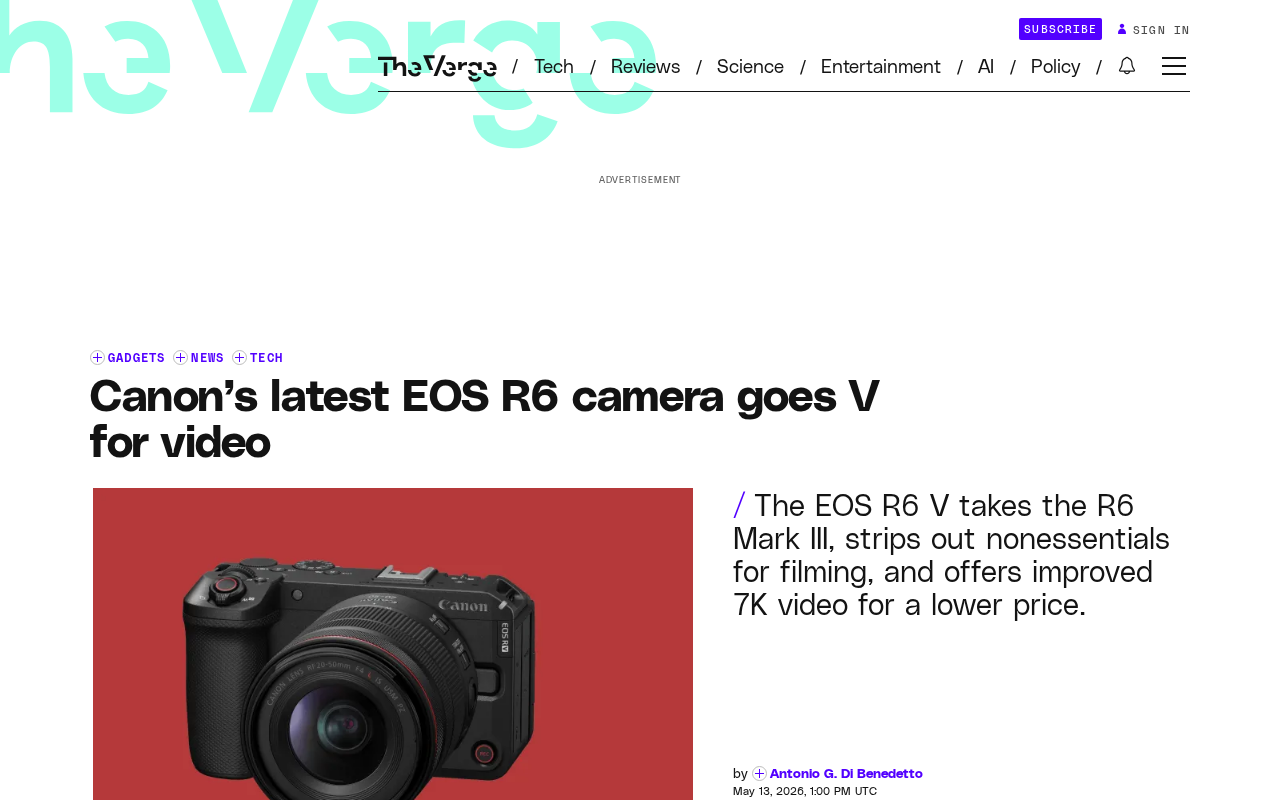
The EOS R6 V features a 32.5-megapixel full-frame sensor with 7K video recording capability, representing a significant leap in video specifications. This pixel count not only meets the demands of high-resolution video capture but also provides ample headroom for post-production cropping and stabilization.
Notably, the advantages of a full-frame sensor (36mm × 24mm) in video production extend beyond image quality — they also lie in the optical characteristics afforded by its physical size. A larger sensor area captures more light at the same aperture, maintaining lower noise levels in low-light conditions. This is critical for scenarios such as documentary filmmaking, wedding videography, and indoor interviews. Additionally, the shallow depth of field (bokeh) produced by a full-frame sensor creates a visual language that APS-C or M43 formats cannot fully replicate — long regarded as one of the key contributors to the coveted "cinematic look."
The EOS R6 V is built on Canon's EOS R system, introduced in 2018. At the heart of this system is the RF mount, with its large 54mm inner diameter and a flange distance (the distance from the rear of the lens to the sensor) of just 20mm — dramatically shorter than the EF mount's 44mm. This allows light to strike the sensor edges at a more perpendicular angle, effectively reducing vignetting and chromatic aberration. The RF mount's built-in 12-pin communication system also supports faster lens-body data exchange, laying the hardware foundation for video-critical functions like phase-detection autofocus and coordinated optical image stabilization. It has also made possible lenses like the RF 28-70mm f/2L — a fast-aperture zoom that would have been virtually impossible to create in the EF era.
A Video-Focused Redesign Based on the EOS R6 Mark III
In terms of product positioning, the Canon EOS R6 V takes the EOS R6 Mark III as its base platform and applies targeted redesigns. To better serve video shooting scenarios, Canon made several key trade-offs with this camera:
- Removed the electronic viewfinder (EVF): Video shooting primarily relies on external monitors or the camera's built-in screen; removing the EVF reduces body weight and power consumption
- Stripped out certain still photography features: Concentrating resources on video performance optimization
- Retained the image quality advantages of the full-frame sensor: The 32.5-megapixel sensor enables oversampling in video mode, enhancing image detail
The Electronic Viewfinder (EVF) is one of the core components of modern mirrorless cameras, typically comprising a high-resolution miniature OLED or LCD display, an eyepiece optical system, and a proximity sensor — a module whose power consumption, size, and cost are far from negligible. For creators whose primary workflow centers on video, the EVF sees far less use than an external monitor or flip screen. Professional video sets almost universally feature external monitors of 5 inches or larger for precise focusing, exposure monitoring, and director's viewing. Removing the EVF not only reduces body weight (typically by around 50–80 grams) and overall power consumption but also simplifies the top of the camera body, freeing up space for the heat dissipation system and additional ports — a critical consideration for thermal management during extended video recording sessions.
This "less is more" approach
Related articles
 Product Reviews
The Programmer's Desk Setup Guide: Building a Workspace That Feels Like Home
Discover how programmers build productive, comfortable workspaces. From multi-monitor setups to ergonomic design, explore the desk philosophy that drives focus and flow.
 Product Reviews
Qoder vs Cursor Real-World Comparison: Which $20/Month AI IDE Is Better?
Hands-on comparison of Qoder vs Cursor AI IDEs: Agent autonomy, human interaction count, and architecture decisions. Qoder needed only 2 interactions vs Cursor's 8.
 Product Reviews
Cursor Cloud Agent Demo: Eliminating Bottlenecks Across the Entire Software Development Lifecycle
Deep analysis of Cursor's Cloud Agent demo showing how cloud VMs, automated test artifacts, and a full-chain control plane systematically eliminate human bottlenecks across the software development lifecycle.