CanyonOS: A Non-Intrusive Observability Platform for Agent Workflows

CanyonOS intercepts agent calls at the platform layer to enable instrumentation-free tracing, single-agent scaling, and cost attribution.
CanyonOS is an open-source platform on Product Hunt positioned as workflow-aware agent infrastructure. By carrying every inter-agent call at the call layer, it gives developers full-chain observability without tracing code while keeping pure Python business logic. It automatically identifies bottleneck agents and scales only them, and breaks costs down to individual agents. Open sourced under AGPL-3.0, it coexists with existing Python stacks. It is still early-stage, so production stability and interception overhead need validation, and whether to adopt this runtime dependency is a key decision.
When building and operating multi-agent applications, developers often face a dilemma: either embed a large amount of tracing logic into the code, which slows down iteration, or remain completely in the dark about inter-agent call relationships and cost overhead. CanyonOS, which recently appeared on Product Hunt, tries to solve this problem with a different approach—it positions itself as a "workflow-aware" platform that lets agents remain pure Python while automatically handling scaling and cost attribution.
What problem it aims to solve
CanyonOS's official description is straightforward: it is a platform for building, scaling, observing, and managing agentic applications. The core selling point is that it "carries every call between your agents"—the platform carries every call between agents, so you can understand the operating state of the entire workflow without writing tracing code.
This design targets exactly the pain points of current multi-agent systems. When a task is split among multiple agents for collaborative completion, the call chain often spans multiple processes and services, and traditional APM tools struggle to understand the semantic relationships between agents. CanyonOS chooses to intercept at the call layer, moving observability down from "application code" to the "platform layer." According to the official description, this approach can automatically identify the few agents that are slowing down the workflow and scale them individually; it can also show each agent's contribution to total cost.
Key features breakdown
Non-intrusive tracing mechanism
"no tracing code to write" is the most noteworthy aspect of CanyonOS. For agents already written in Python, integrating with the platform requires no changes to business logic. This is quite friendly for agent projects in rapid iteration—teams do not need to refactor code for observability, nor do they need to add instrumentation every time a new agent is added.
The difference between APM and agent observability
Traditional APM (Application Performance Monitoring) tools such as Datadog and New Relic design their data models around request-response chains, collecting standardized events such as HTTP/gRPC calls and database queries through SDK instrumentation or eBPF. But call relationships in multi-agent systems carry semantic characteristics—one agent calling another often means task decomposition, tool delegation, or result aggregation. In the span tree of traditional APM, these relationships are just a string of indistinguishable RPC calls and cannot reflect "who is waiting for whose result" or "which agent is the decision bottleneck." By choosing to intercept at the call layer, CanyonOS is actually building an Agent Graph, refining the smallest unit of observability from "service" to "agent role." This also explains why it can perform single-agent scaling and cost attribution—only by understanding call semantics can it determine that a certain agent is a bottleneck rather than merely "slow to respond."
On-demand scaling rather than overall expansion
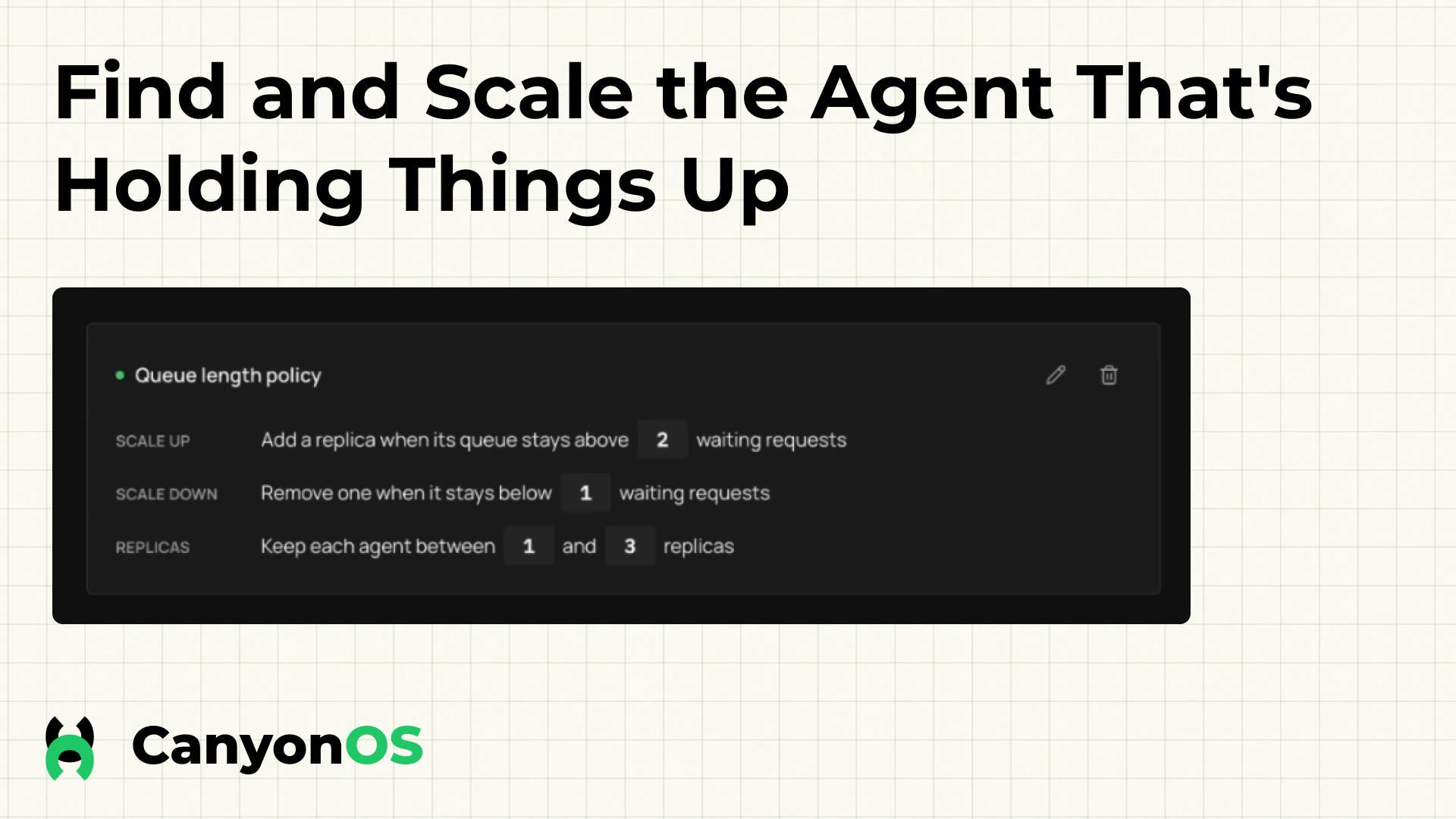
The platform claims it can automatically discover and scale only the agents that are "holding up your workflow." Resource consumption in multi-agent systems is often uneven; a single bottleneck agent may drag down overall throughput, but scaling everything wastes resources. CanyonOS's approach is to refine scaling granularity to individual agents, which has practical significance for cost control.
Technical prerequisites for agent-level scaling
Traditional microservice autoscaling (such as Kubernetes HPA) is based on resource metrics such as CPU and memory, and scales by Pod. But agent bottlenecks are often not at the resource layer but at the logic layer: an agent responsible for retrieval or reasoning becomes a bottleneck because of external API rate limits or model latency, and only then does scaling its replicas make sense. CanyonOS can "scale only the bottleneck agent" on the premise that it carries inter-agent calls and can identify which agent's queue time or call latency is dragging down the end-to-end workflow. This approach is similar to "critical path analysis"—in a multi-stage pipeline, only scaling nodes on the critical path can improve overall throughput. However, this also introduces an engineering constraint: the scaled agents need to be stateless or have externally manageable state; otherwise, consistency across replicas becomes a new problem.
Cost attribution at the agent level
"show how much each agent adds to your costs" means the platform can break down expenses to each agent. For agent workflows that use multiple models and multiple tool calls, this granularity helps determine which parts are worth optimizing or replacing.
Open source and ecosystem positioning
CanyonOS is open source under the AGPL-3.0 license and is categorized on Product Hunt under Open Source, Developer Tools, and GitHub. AGPL-3.0 has strong copyleft requirements for network service scenarios, which means that if it is offered externally as a hosted service, the corresponding open-source obligations must be followed—enterprises need to pay attention to this when evaluating it.
In terms of positioning, it is closer to "agent infrastructure" than to an agent framework itself: it does not dictate how you write agents, and is only responsible for observability, scaling, and cost management after agents are running. This layered approach allows it to coexist with existing Python agent technology stacks.
What AGPL-3.0 actually means
AGPL-3.0 is the strictest variant in the GPL family when it comes to network services. Its core provision is: if you modify CanyonOS's code and provide it externally as a network service (SaaS), you must provide the modified source code to users of that service. Unlike ordinary GPL, which only constrains "distribution of binaries," AGPL also treats "interaction over a network" as a form of distribution. For enterprises, this means: internal use (without providing services externally) is usually not subject to copyleft; but if you want to build an external agent hosting platform based on CanyonOS, you need to evaluate the open-source obligations. By contrast, Apache-2.0 or MIT licenses impose almost no constraints on SaaS scenarios. CanyonOS's choice of AGPL may be related to its commercialization path—building trust through open source while preserving commercial space for an enterprise edition or hosted service.
Who it is for, and what to watch
CanyonOS is aimed at teams that have moved beyond the demo stage and are beginning to face multi-agent collaboration and cost pressure. On Product Hunt, 75 upvotes and 2 comments indicate that it is still in an early exposure stage, with limited community discussion; the stability in actual production environments and the performance overhead of the interception mechanism still need more verification.
One question worth considering: placing call interception at the platform layer eliminates instrumentation, but it also means that the runtime behavior of agents depends on the platform in a certain sense. For teams pursuing extreme lightweight operation or already having a mature observability system, whether they are willing to introduce this layer of dependency will be a key adoption decision.
For developers currently troubled by multi-agent call chains and cost black boxes, CanyonOS offers an idea worth watching: make observability a platform capability rather than an application burden.
One-line Summary
CanyonOS intercepts agent calls at the platform layer to enable instrumentation-free tracing, single-agent scaling, and cost attribution.
Paragraph Summary
CanyonOS is an open-source platform that appeared on Product Hunt, positioned as "workflow-aware" agent infrastructure. By carrying every call between agents at the call layer, it allows developers to keep pure Python business code and gain full-chain observability without writing tracing logic. The platform can automatically identify bottleneck agents that slow down the workflow and scale only those, while breaking down costs to the individual agent level. CanyonOS is open source under AGPL-3.0, does not dictate how agents are written, and can coexist with existing Python technology stacks. The product is still in an early stage with limited community discussion; production stability and the performance overhead of the interception layer still need verification, and whether to introduce this runtime dependency is a key adoption decision.
Related articles

Qwen 4 Max Launches With Zero Benchmarks: What Did Testers Find?
Qwen 4 Max launched with zero benchmarks, but community testers found a five-hour CPU design that can't be manufactured, impressive one-shot visual builds, a 49/100 code-fix score, and a November 25 preview retirement.

Qwen 4 Max Preview: The Truth Behind the Benchmark Controversy and a Developer's Guide
Alibaba's Qwen 4 Max Preview lacks official benchmarks as third-party results conflict. We analyze the controversy, MoE clues, and developer strategies.

Qwen 4 Max Hands-On: Token Efficiency Beats DeepSeek, but Reviews Are Polarized
First hands-on tests of Qwen 4 Max: on 103 3JS tasks it uses about one-third fewer tokens than DeepSeek V4.1 Flash and nailed the mechanical hummingbird task on the first try, but some developers say it performs worse than Qwen 3.8 Flash—reviews are polarized.