Qwen 4 Max Hands-On: Token Efficiency Beats DeepSeek, but Reviews Are Polarized

Qwen 4 Max hands-on tests show it leads on token efficiency by about one-third, but reviews of generation quality are clearly polarized.
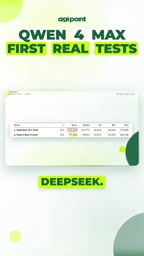
First-batch Qwen 4 Max test data shows that on 103 3JS tasks it averages about 77,000 tokens per task, roughly one-third less than DeepSeek V4.1 Flash's 115,000, offering real value for cost-sensitive scenarios. Quality opinions diverge: Qwen produced a usable mechanical hummingbird 3D result on the first try while DeepSeek needed several attempts, and one Chinese tester retracted earlier criticism; yet some developers say the preview is worse than Qwen 3.8 Flash or still trails frontier labs. The article deems the token efficiency advantage credible, finds the first-pass success rate noteworthy, and calls polarized reviews normal for a preview, recommending small-scale controlled tests with real business tasks.
First Batch of Hands-On Data Emerges
Initial real-world test results for Qwen 4 Max are circulating in the developer community, and the core finding can be summed up in one sentence: It clearly leads on token efficiency, but user opinions are far from reaching consensus.
According to a roundup by a YouTube channel, one developer ran a controlled test comparing Qwen 4 Max and DeepSeekAd V4.1 Flash on the same set of 103 3JS tasks. Qwen consumed an average of about 77,000 tokens per task, while DeepSeek required 115,000—roughly one-third more. For applications that bill by token or are constrained by context length, this gap translates directly into differences in cost and throughput.

Token is the basic unit of text processed by large language models; models bill by token and are limited by context windows in terms of token count. So "how many tokens per task" reflects two things at once: first, inference cost—fewer tokens means a lower bill; second, context pressure—fewer tokens means more content can fit into the same window. In multi-turn scenarios like agents and code generation, the token consumption per task gets multiplied several times over, and a one-third gap may correspond to significant differences in cost and latency. However, token efficiency is not the same as output quality—a model may save tokens through a more concise reasoning chain, or it may sacrifice answer completeness by converging too early, which is exactly why it needs to be evaluated alongside metrics like first-pass success rate.
The Divergence Point on Generation Quality
Fewer tokens does not mean worse results; other tests actually show that Qwen 4 Max's "one-shot" capability is improving.
A frequently cited case is a 3D generation task of a mechanical hummingbird hovering next to a flower. DeepSeek took several attempts to complete it, while Qwen produced a usable result on the first try. This type of task tests the model's understanding of physical structure and spatial relationships, and first-pass success rate often reflects a model's true level better than token count.

Another tester from China generated a particle globe effect and said on social media that he wanted to "take back what I said about Qwen 4"—the implication being that he had previously been critical of the Qwen series, and the new version changed his judgment.

3JS tasks refer to generation tasks based on Three.js (a 3D graphics JavaScript library that runs in the browser), typically requiring the model to output code for directly renderable 3D scenes, involving elements such as geometry construction, materials, lighting, cameras, and animation. This type of task is naturally well suited for model evaluation: on one hand, the results are visual and easy to judge manually as right or wrong; on the other hand, it simultaneously tests code correctness, spatial reasoning, and physical common sense, and a single-turn output often contains hundreds of lines of code, hence the high token consumption. Note that 3JS tasks fall into the relatively "verifiable, structured" category, which favors models that excel at code and spatial reasoning, so an advantage on this task set may not directly generalize to scenarios like writing or long-document analysis.
The Dissenting Voice: The Preview Performs Worse Than the Previous Generation
But community feedback is not consistent. One developer claimed that in his tests, this preview version performed even worse than Qwen 3.8 Flash. That is a fairly sharp assessment—if it holds, it means Qwen 4 Max has regressed on certain task types.
Another developer's observation was more macro: the more you use it, the more you can feel the gap between it and frontier labs. Such assessments give no specific benchmarks, but point to a common phenomenon—new models shine in demo scenarios but reveal shortcomings in stability and consistency when they land in real workflows.
Both voices existing at the same time shows that the currently circulating test samples are limited in size and unevenly distributed across task types. Tasks like 3JS generation and 3D modeling favor Qwen 4 Max, while other types of tasks may be exactly the opposite.
Preview is a version released by model vendors for testing before the official launch, typically used to collect feedback and expose problems; its inference configuration and degree of post-training may differ from the final version. Previews often have not completed all alignment and optimization, fluctuate more across different tasks, and commonly fall short on stability and consistency. This also explains why the same version can simultaneously receive both "exceeds expectations" and "worse than the previous generation" assessments: the former mostly comes from demo-style single-point tasks, the latter mostly from continuous, real engineering workflows. Therefore, a preview's ranking and reputation can only serve as directional references, and it still needs to be re-evaluated after the official release.
How to Interpret This Set of Early Signals
From the available information, several relatively safe judgments can be made:
Token efficiency is a clear advantage of Qwen 4 Max. The roughly one-third token savings comes from a controlled test on the same task set, carries relatively high credibility, and has practical reference value for cost-sensitive development teams.
First-pass success rate is worth watching. The mechanical hummingbird case shows that the model's "one-shot" capability on complex spatial tasks has improved, which is more meaningful than simply compressing tokens—reducing the number of retries is itself another kind of efficiency.
Polarized reviews are normal at the preview stage. The claim that it is worse than Qwen 3.8 Flash and the claim that it "exceeds expectations" appearing at the same time precisely shows that this version fluctuates considerably across different tasks. Preview versions usually have not completed all optimizations, and the final official version's ranking may still change.
Developers are advised not to make technology selection decisions based on a single review, but instead to run small-scale controlled tests using real tasks from their own business scenarios, focusing on two metrics: token consumption and first-pass usability rate.
FAQ
How many tokens does Qwen 4 Max save compared with DeepSeek? According to a controlled test on 103 3JS tasks, Qwen 4 Max consumes about 77,000 tokens per task on average, while DeepSeek V4.1 Flash consumes about 115,000 tokens, saving roughly one-third.
Why do some people think Qwen 4 Max is worse than Qwen 3.8 Flash? Currently there is only subjective feedback from individual developers, with no public comparative data. This may be due to differences in task types, or it may be related to the preview version not yet being fully optimized.
Is it suitable to use Qwen 4 Max in production now? As a preview version, its performance fluctuates considerably; it is recommended to try it first on non-critical paths and conduct a complete evaluation after the official version is released.
One-line Summary
Qwen 4 Max hands-on tests show it leads on token efficiency by about one-third, but reviews of generation quality are clearly polarized.
Paragraph Summary
First-batch hands-on data for Qwen 4 Max shows that in a controlled test on 103 3JS tasks, it consumed about 77,000 tokens per task on average, saving roughly one-third compared with DeepSeek V4.1 Flash's 115,000 tokens, offering real value for cost-sensitive scenarios. On quality, opinions diverge: in a mechanical hummingbird 3D generation task, Qwen produced a usable result on the first try while DeepSeek needed several attempts, and another Chinese tester said he took back his earlier negative assessment; at the same time, some developers believe this preview version is worse than Qwen 3.8 Flash or still lags behind frontier labs. The article argues that the token efficiency advantage is relatively credible, the first-pass success rate is worth watching, and polarized reviews are normal at the preview stage, recommending small-scale controlled tests using real business tasks.
Related articles
How the Grok Team Hits 11,000 PRs a Month: Replacing Manual Review with Deterministic Constraints
Inside the Grok team's formula for 11,000 monthly PRs at a 0.5% rollback rate: Lint rules, type systems, and formal verification as deterministic constraints.

Is Spacetime Made of Something? Six Possible Answers from Quantum Gravity
Is spacetime made of something? This article surveys the main candidate answers from quantum gravity: spacetime may be fundamental, geometry quantized, causal relations prior to distance, spacetime an emergent state of matter, geometry derived from string theory, or no spacetime atoms needed at all.
After GTA 6, Where Does the Game Industry Go?
The Vergecast talks with Game File's Stephen Totilo about GTA 6's impact on gaming: billion-dollar budgets, console market struggles, cloud gaming tests, and the future of microtransactions—and whether it marks the end of an era.